
SLIDE 1
RBF in Zimbabwe Results & Lessons from Mid-term Review
Ronald Mutasa, Task Team Leader, World Bank May 7, 2013
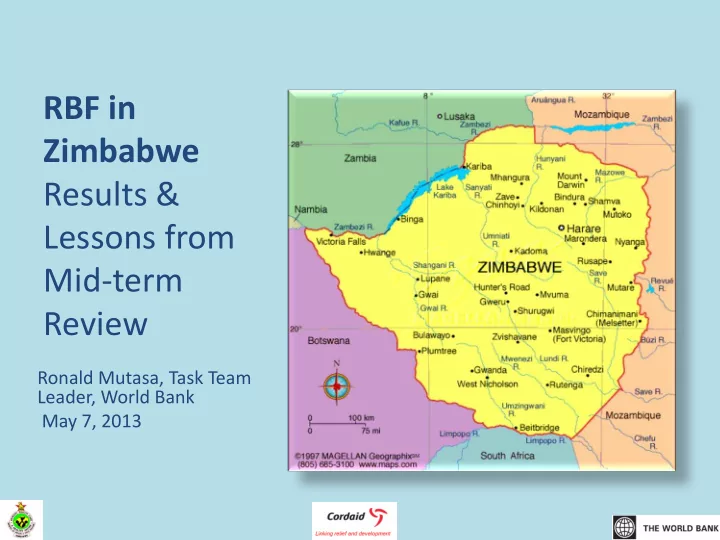
RBF in Zimbabwe Results & Lessons from Mid-term Review - - PowerPoint PPT Presentation
RBF in Zimbabwe Results & Lessons from Mid-term Review Ronald Mutasa, Task Team Leader, World Bank May 7, 2013 Outline Country Context Technical Design Implementation Timeline Midterm Review Results Evaluation
Ronald Mutasa, Task Team Leader, World Bank May 7, 2013
Timeline
Maternal Mortality Ratio Time Trend
Life expectancy at birth, total (years – peak of crisis – 2008) Maternal mortality ratio (per 100,000 live births – peak of crisis – 2008)
59 62 41 44 48 52 40 45 50 55 60 65 390 830 790 869 645 300 400 500 600 700 800 900 1990 1991 1992 1993 1994 1995 1996 1997 1998 1999 2000 2001 2002 2003 2004 2005 2006 2007 2008
Zimbabwe Sub-Saharan Africa (all income levels)
RBF aligned with & supports national health strategy and
policy
User fee removal Increase access to priority maternal, family planning and
child health services
Decentralized service delivery and revitalized primary
health care
Prioritized package of services directly linked to burden of
disease for mothers, newborns and children under 5
RBF used to operationalize GoZ Results-Based Management
Strategy
Three components
& external verifier
Contracting
capacity (management of RBF cycle @ facility level, District, Provincial and National Levels
Capacity Building
aspects of the health system
mixed methods approach
performance
Documentation
Contract
Tracing clients and client satisfaction Policy and Supervision Policy and Supervision Policy and Supervision
MoHCW Provincial Health Executive Health Facilities and HCC (387) District Health Executive National Steering Committee District Steering Committee
CORDAID Private Purchasing Agency (NPA)
Contract + Payment Payment Community Based Organisations Clients
CORDAID Local Purchasing Unit
Payment Contract + Verification Contract
Implementation Arrangements
Rural Health Centers District Hospital
1.
OPD new consultations
2.
First ANC visit during the first 16 weeks of pregnancy (October 2012)
3.
Ante natal care 4 visits completed
4.
Post natal care 2 or more
5.
Normal deliveries
6.
HIV VCT in ANC
7.
Syphilis RPR test
8.
IPT (x2 doses)
9.
Tetanus TT2+
10.
ARVs to HIV+ preg. Women (PMTCT)
11.
Family planning short and long term methods
12.
High risk perinatal referrals
13.
Vitamin A supplementation
14.
Children fully immunized
15.
Growth monitoring, children < 5yrs
16.
Cure discharged acute malnutrition children < 5yrs (October 2012)
1.
Normal deliveries in district hospital
2.
Deliveries with complications (caesareans excluded) and post partum complications
3.
Caesareans performed
4.
Family planning: Tuba Ligations
5.
Counter referral note arrives at RHC (October 2012)
July 2011
March 2012
component
February 2013
The extent of progress –
Project Development Objective
Interactions between RBF
and various pillars of health systems
Comparison of RBF &
comparison district performance.
Multi-stakeholder process In-depth data analysis to
inform decisions
Key policy recommendations
& lessons for management improvement
timeliness
accuracy of reporting
accountability
Income Loss Due to the 5% Difference Rule Total income lost From March to September 2012 = $157,529.30
0% 5% 10% 15% 20% 25% 30% 35% mrt-12 apr-12 mei-12 jun-12 jul-12 aug-12 sep-12
Lost RBF revenue due to errors
25 50 75 100 Mar Apr May Jun Mul Aug Sep Oct Nov Dec 2012
Percent
ANC PNC Vaccination
Increased coverage - select indicators
100 200 300 400 500 600 700 800 900 1000 Mar Apr May Jun Jul Aug Sep Oct Nov Total n. of cases
from participating RHCs
Institutional deliveries, Jul. 2011 to Aug. 2012 – RHC vs. hospital
50 100 150 200 250 Jul 11 Aug 11 Sep 11 Oct 11 Nov 11 Dec 11 Jan 12 Feb 12 Mar 12 Apr 12 May 12 Jun 12 Jul 12 Aug 12 Number of deliveries Deliveries in RHC Deliveries in Hospital Linear (Deliveries in RHC) Linear (Deliveries in Hospital)
5 10 15 20 25 30 35 40
Mar-11 Apr-11 May-11 Jun-11 Jul-11 Aug-11 Sep-11 Oct-11 Nov-11 Dec-11 Jan-12 Feb-12 Mar-12 Apr-12 May-12 Jun-12 Jul-12 Aug-12 Sep-12 Oct-12
per 10,000 population RBF districts non RBF districts
ANC visits in RBF districts compared to 16 non-RBF districts
5 10 15 20 25 30 35
per 10,000 population
Normal deliveries
RBF non RBF
facilities compared to 16 non-RBF districts
10 20 30 40 50 60 70
Mar-11 Apr-11 May-11 Jun-11 Jul-11 Aug-11 Sep-11 Oct-11 Nov-11 Dec-11 Jan-12 Feb-12 Mar-12 Apr-12 May-12 Jun-12 Jul-12 Aug-12 Sep-12 Oct-12
per 10,000 population
Hypertension cases all ages
RBF non RBF
No evidence that RBF districts neglect non-incentivized services compared to 16 non-RBF districts
1000 2000 3000 4000 5000 6000 7000 8000
Mar Apr May Jun Jul Aug Sep Oct Nov
HIV VCT in ANC
No improvement in HIV counseling and testing in context of ANC; presumably because this is already covered under HIV program
20 30 40 50 60 70 80 90 T1 T2 T3 T4
%
Average score - RHCs and hospitals combined
DHE/PHE Score CBOs Score
IE Question: What is the causal impact of HRBF on service provision and population health indicators of interest?
Given the design of the HRBF, a quasi-
experimental approach
Treatment: Facilities and patients residing in districts that introduce the HRBF program
Control: Facilities and households in matched “business as usual” districts
A difference-in-difference estimator
between matched facilities in treatment and control will estimate program impact Process Evaluation
Application
Opens up the “Black Box” of RBF
interventions
Documents and describes how the
program operates, the services it delivers, and functions it carries out
Better understand contextual factors
Mixed methods
Sequential (quant –qualitative) Selection by performance (best,
medium and worst)
Executives, Provincial Health Executives; and HE s and PHEs to perform quarterly supervision.
(and increase earnings)
scale
control programs, in line with MOHCW quality policy
Evaluation plus country-level dissemination (delivery science)
2.
Demand and supply side innovations in low-income urban areas (DFID & Norway funding)
3.
Broaden donor dialogue & develop joint learning agenda
4.
Strong interest to expand services – TB/HIV/AIDS –Government
Possible domestic co-financing for TB/HIV indicators
5.
Establish a system to better monitor equity effects and verification on user-fees
6.
Improvements to supervision tool – emphasis on clinical quality of care
7.
Scaling up efforts by Government to plan for RBF sustainability – National Task Force
8.
Support Government and development partners efforts to scale-up RBF 45 districts – Health
Transition Fund