Read-Copy-Update (RCU) Josh Triplett May 22, 2006 Topics The RCU - - PDF document

read copy update rcu
SMART_READER_LITE
LIVE PREVIEW

Read-Copy-Update (RCU) Josh Triplett May 22, 2006 Topics The RCU - - PDF document

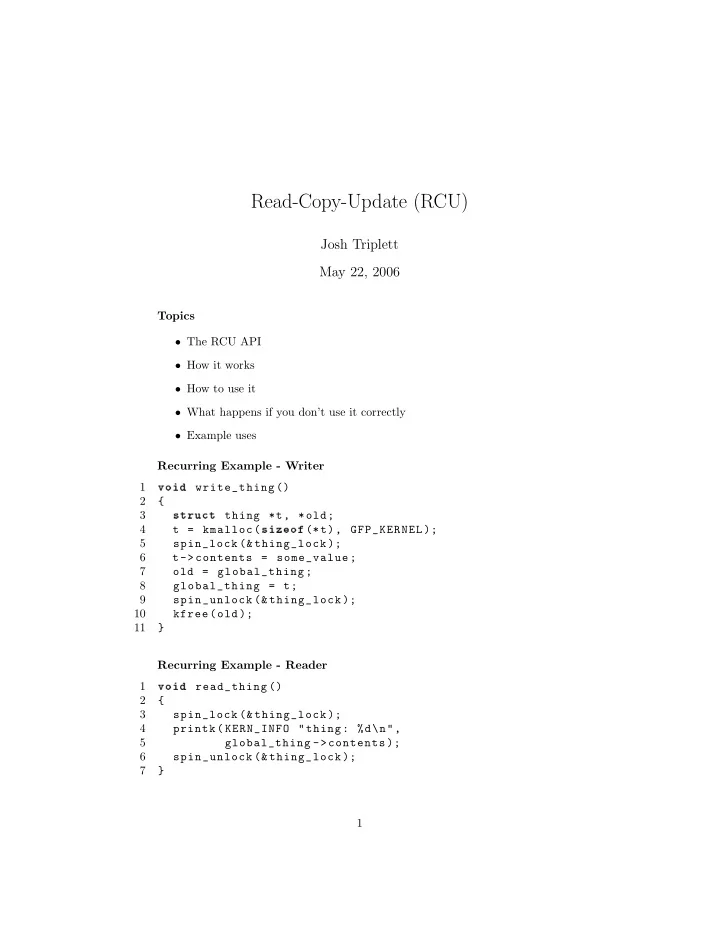
Read-Copy-Update (RCU) Josh Triplett May 22, 2006 Topics The RCU API How it works How to use it What happens if you dont use it correctly Example uses Recurring Example - Writer 1 write_thing () 2 { 3


slide-1
SLIDE 1

Read-Copy-Update (RCU)

Josh Triplett May 22, 2006

Topics

  • The RCU API
  • How it works
  • How to use it
  • What happens if you don’t use it correctly
  • Example uses

Recurring Example - Writer 1 ✈♦✐❞ write_thing () 2 { 3 str✉❝t thing *t, *old; 4 t = kmalloc(s✐③❡♦❢(*t), GFP_KERNEL ); 5 spin_lock (& thing_lock ); 6 t->contents = some_value; 7

  • ld = global_thing;

8 global_thing = t; 9 spin_unlock (& thing_lock ); 10 kfree(old); 11 } Recurring Example - Reader 1 ✈♦✐❞ read_thing () 2 { 3 spin_lock (& thing_lock ); 4 printk(KERN_INFO "thing: %d\n", 5 global_thing ->contents ); 6 spin_unlock (& thing_lock ); 7 } 1

slide-2
SLIDE 2

The RCU API

  • rcu_read_lock/rcu_read_unlock
  • synchronize_rcu
  • call_rcu
  • rcu_barrier
  • _bh variants
  • rcu_assign_pointer
  • rcu_dereference

r❝✉❴r❡❛❞❴❧♦❝❦/r❝✉❴r❡❛❞❴✉♥❧♦❝❦ - Description

  • Delimit an RCU read-side critical section
  • Allows writers to detect concurrent readers
  • Prevents “quiescent state”
  • Reclamation deferred until current readers complete
  • May run concurrently with other readers and with writers
  • No corresponding writer lock: use other synchronization

r❝✉❴r❡❛❞❴❧♦❝❦/r❝✉❴r❡❛❞❴✉♥❧♦❝❦ - Usage 1 ✈♦✐❞ read_thing () 2 { 3 rcu_read_lock (); 4 printk(KERN_INFO "thing: %d\n", 5 global_thing ->contents ); 6 rcu_read_unlock (); 7 } r❝✉❴r❡❛❞❴❧♦❝❦/r❝✉❴r❡❛❞❴✉♥❧♦❝❦ - Implementation 1 ★❞❡❢✐♥❡ rcu_read_lock () preempt_disable () 2 ★❞❡❢✐♥❡ rcu_read_unlock () preempt_enable ()

  • No overhead without CONFIG_PREEMPT
  • Low overhead with CONFIG_PREEMPT
  • Quiescent state: context switch
  • Readers may not block

2

slide-3
SLIDE 3

s②♥❝❤r♦♥✐③❡❴r❝✉ - Description

  • Guarantees that all current readers have finished
  • Block until quiescent state on all CPUs
  • Use after removing item for future readers
  • Use before freeing item concurrent readers could still access

s②♥❝❤r♦♥✐③❡❴r❝✉ - Usage 1 ✈♦✐❞ write_thing () 2 { 3 str✉❝t thing *t, *old; 4 t = kmalloc(s✐③❡♦❢(*t), GFP_KERNEL ); 5 spin_lock (& thing_lock ); 6 t->contents = some_value; 7

  • ld = global_thing;

8 global_thing = t; 9 spin_unlock (& thing_lock ); 10 synchronize_rcu (); 11 kfree(old); 12 } s②♥❝❤r♦♥✐③❡❴r❝✉ - Toy implementation 1 ✈♦✐❞ synchronize_rcu () 2 { 3 ✐♥t cpu; 4 for_each_cpu(cpu) 5 run_on_only(cpu); 6 run_on_all_cpus (); 7 }

  • Real, non-toy operating systems used this algorithm

❝❛❧❧❴r❝✉ - Description

  • Invoke callback when current readers have finished
  • Remove item from view of future readers first
  • Reclaim item in callback
  • Does not block

3

slide-4
SLIDE 4

❝❛❧❧❴r❝✉ - Usage (Data structure) 1 str✉❝t thing { 2 ✐♥t contents; 3 str✉❝t rcu_head rcu; 4 }; ❝❛❧❧❴r❝✉ - Usage (Writer) 1 ✈♦✐❞ write_thing () 2 { 3 str✉❝t thing *t, *old; 4 t = kmalloc(s✐③❡♦❢(*t), GFP_KERNEL ); 5 spin_lock (& thing_lock ); 6 t->contents = some_value; 7

  • ld = global_thing;

8 global_thing = t; 9 spin_unlock (& thing_lock ); 10 call_rcu(old ->rcu , reclaim_thing ); 11 } ❝❛❧❧❴r❝✉ - Usage (Callback) 1 ✈♦✐❞ reclaim_thing(str✉❝t rcu_head *r) 2 { 3 str✉❝t thing *t; 4 t = container_of(r, str✉❝t thing , rcu); 5 kfree(t); 6 }

  • container_of gives structure pointer from member pointer

❝❛❧❧❴r❝✉ - Implementation

  • str✉❝t rcu_head contains list pointer
  • call_rcu queues rcu_head in per-CPU “next” list
  • “next” list moves to “current” list in quiescent state at start of grace

period

  • “current” list moves to “done” list in quiescent state at end of grace period
  • Callbacks on “done” list get called and discarded

4

slide-5
SLIDE 5

s②♥❝❤r♦♥✐③❡❴r❝✉ - Real implementation 1 ✈♦✐❞ synchronize_rcu () { 2 str✉❝t rcu_synchronize rcu; 3 init_completion (&rcu.completion ); 4 call_rcu (&rcu.head , wakeme_after_rcu ); 5 wait_for_completion (&rcu.completion ); 6 } 7 st❛t✐❝ ✈♦✐❞ wakeme_after_rcu ( 8 str✉❝t rcu_head *head) { 9 str✉❝t rcu_synchronize *rcu; 10 rcu = container_of(head , 11 str✉❝t rcu_synchronize , head ); 12 complete (&rcu ->completion ); 13 }

  • rcu_synchronize contains rcu_head and completion
  • wait_for_completion blocks until complete called

r❝✉❴❜❛rr✐❡r

  • Blocks until all RCU callbacks on all CPUs have completed
  • Usage example: module unloading
  • Implementation: CPU count and wait_for_completion

❴❜❤ variants

  • Used for “bottom half” handlers
  • Need shorter grace periods
  • Quiescent state: no bottom half running
  • Read-side critical sections:

1 ★❞❡❢✐♥❡ rcu_read_lock_bh () local_bh_disable () 2 ★❞❡❢✐♥❡ rcu_read_unlock_bh () local_bh_enable ()

  • call_rcu_bh: different queues

r❝✉❴❛ss✐❣♥❴♣♦✐♥t❡r - Description

  • Assign to an RCU-protected pointer
  • Use after initializing item
  • Makes item visible to readers
  • Includes appropriate memory barrier

5

slide-6
SLIDE 6

Without r❝✉❴❛ss✐❣♥❴♣♦✐♥t❡r

  • Writes could get reordered
  • Reader could see:

1 global_thing = t; 2 t->contents = some_value;

  • Reader can read global_thing->contents in between
  • Reader gets random uninitialized contents

r❝✉❴❛ss✐❣♥❴♣♦✐♥t❡r - Usage 1 ✈♦✐❞ write_thing () 2 { 3 str✉❝t thing *t, *old; 4 t = kmalloc(s✐③❡♦❢(*t), GFP_KERNEL ); 5 spin_lock (& thing_lock ); 6 t->contents = some_value; 7

  • ld = global_thing;

8 rcu_assign_pointer (global_thing , t); 9 spin_unlock (& thing_lock ); 10 synchronize_rcu (); 11 kfree(old); 12 } r❝✉❴❛ss✐❣♥❴♣♦✐♥t❡r - Implementation 1 ★❞❡❢✐♥❡ rcu_assign_pointer (p, v) \ 2 ({ \ 3 smp_wmb (); \ 4 (p) = (v); \ 5 }) smp_wmb() provides a write memory barrier in SMP kernels. r❝✉❴❞❡r❡❢❡r❡♥❝❡ - Description

  • Get a copy of an RCU-protected pointer to dereference
  • Use inside rcu_read_lock()/rcu_read_unlock()
  • Includes appropriate memory barrier
  • Prevents read reordering

6

slide-7
SLIDE 7

Without r❝✉❴❞❡r❡❢❡r❡♥❝❡

  • Reads could get reordered
  • Write memory barrier forces write of contents, then pointer
  • Reader can read new pointer, dereference, and find old contents
  • Only an issue on Alpha CPUs

r❝✉❴❞❡r❡❢❡r❡♥❝❡ - Usage 1 ✈♦✐❞ read_thing () 2 { 3 rcu_read_lock (); 4 printk(KERN_INFO "thing: %d\n", 5 rcu_dereference (global_thing)->contents ); 6 rcu_read_unlock (); 7 } r❝✉❴❞❡r❡❢❡r❡♥❝❡ - Alternate Usage 1 ✈♦✐❞ read_thing () 2 { 3 str✉❝t thing *local_thing; 4 rcu_read_lock (); 5 local_thing = rcu_dereference (global_thing ); 6 printk(KERN_INFO "thing: %d\n", 7 local_thing ->contents ); 8 rcu_read_unlock (); 9 }

  • Useful if using local_thing repeatedly
  • Cannot use local_thing after rcu_read_unlock()

r❝✉❴❞❡r❡❢❡r❡♥❝❡ - Implementation 1 ★❞❡❢✐♥❡ rcu_dereference (p) \ 2 ({ \ 3 typeof(p) _________p1 = p; \ 4 smp_read_barrier_depends (); \ 5 (_________p1 ); \ 6 })

  • Uses GCC extension “statements as expressions”
  • Saves copy of pointer, calls smp_read_barrier_depends(), returns copy

7

slide-8
SLIDE 8
  • Allows use of rcu_dereference() in expressions
  • smp_read_barrier_depends() no-op except on SMP Alpha

Final version of writer 1 ✈♦✐❞ write_thing () 2 { 3 str✉❝t thing *t, *old; 4 t = kmalloc(s✐③❡♦❢(*t), GFP_KERNEL ); 5 spin_lock (& thing_lock ); 6 t->contents = some_value; 7

  • ld = global_thing;

8 rcu_assign_pointer (global_thing , t); 9 spin_unlock (& thing_lock ); 10 synchronize_rcu (); 11 kfree(old); 12 } Final version of reader 1 ✈♦✐❞ read_thing () 2 { 3 rcu_read_lock (); 4 printk(KERN_INFO "thing: %d\n", 5 rcu_dereference (global_thing)->contents ); 6 rcu_read_unlock (); 7 } RCU API summary

  • rcu_read_lock/rcu_read_unlock
  • synchronize_rcu
  • call_rcu
  • rcu_barrier
  • _bh variants
  • rcu_assign_pointer
  • rcu_dereference

8