Reading Life Between the Lines: Using Childrens Literature for Tough - - PowerPoint PPT Presentation

reading life between the lines using children s
SMART_READER_LITE
LIVE PREVIEW

Reading Life Between the Lines: Using Childrens Literature for Tough - - PowerPoint PPT Presentation

Reading Life Between the Lines: Using Childrens Literature for Tough Conversations about Diversity Michelle H. Martin, Beverly Cleary Professor for Children & Youth Services & MLIS Chair, UW iSchool Created with J. Elizabeth Mills,


slide-1
SLIDE 1

Michelle H. Martin, Beverly Cleary Professor for Children & Youth Services & MLIS Chair, UW iSchool Created with J. Elizabeth Mills, doctoral candidate, UW iSchool
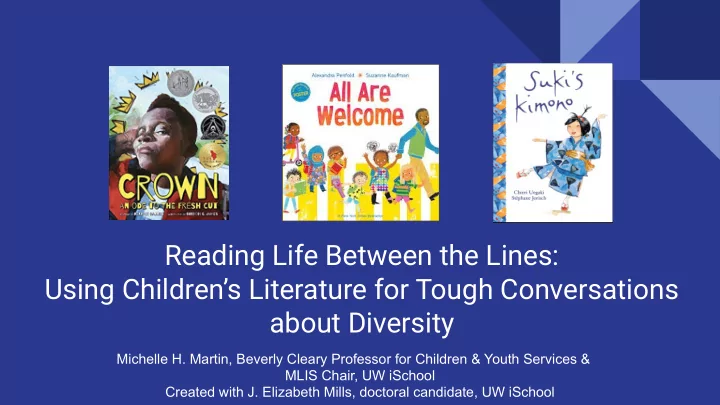
Reading Life Between the Lines: Using Children’s Literature for Tough Conversations about Diversity

slide-2
SLIDE 2

Agenda

  • Why have tough conversations about diversity?
  • Patricia Montiel Overall’s Cultural Competency Conceptual Framework for LIS

Professionals

  • Crown: Ode to the Fresh Cut by Derrick Barnes & Gordon C. James
  • Suki’s Kimono, by Chieri Uegaki & Stephane Jorisch
  • All Are Welcome, by Alexandra Penfold and Suzanne Kaufman
  • Suggestions for exploring new diverse books.
  • Reflection/conclusion
slide-3
SLIDE 3

Goals

  • Learn about the importance of cultivating cultural competence
  • Learn about Montiel Overall’s framework and why it matters for your work

in the future

  • Begin the process of “inward gazing”
  • Suggestions for exploring new picture books and discuss how you might

prepare yourself to use them with a lens toward cultural competence.

  • Discuss some hands-on activities that can support these tough conversations.
slide-4
SLIDE 4

Cultural Competence

  • Why have tough conversations about diversity?
  • What is cultural competence?
  • Why does it matter?
slide-5
SLIDE 5

“Cultural Competence: A Conceptual Framework for Library and Information Science Professionals”

“Cultural competence is the ability to recognize the significance of culture in one’s own life and in the lives of others; and to come to know and respect diverse cultural backgrounds and characteristics through interaction with individuals from diverse linguistic, cultural, and socioeconomic groups; and to fully integrate the culture of diverse groups into services, work, and institutions in order to enhance the lives of both those being served by the library profession and those engaged in service.” (Montiel Overall, 2009, pp.189-190)

slide-6
SLIDE 6

“Cultural Competence: A Conceptual Framework for Library and Information Science Professionals”

  • Cultural competence is dynamic and ongoing--you’re never done. There’s always more to

learn.

  • You will be more culturally competent in some realms than in others
  • You might even need to “study up” to become more culturally competent in knowledge and

understanding of your own background!

  • “Cultural competence does not end with knowledge about diverse cultures.

It begins a lifelong process of learning about cultural differences to effectively reach those who would benefit the most from library services” (p. 200).

slide-7
SLIDE 7

“Cultural Competence: A Conceptual Framework for Library and Information Science Professionals”

Montiel Overall, P. (2009). Cultural competence: a conceptual framework for library and information science

  • professionals. The Library Quarterly: information, community policy, 79(2), 190.
slide-8
SLIDE 8

Microaggressions as Mosquito Bites

(what often happens when you remain oblivious to cultural competence)

You Tube: https://fusion.tv/video/354460/how-microaggressions-are-like-mosquito-bites/

slide-9
SLIDE 9

Microaggressions & Racial Battle Fatigue

  • “Racial Microaggressions in Everyday Life.” Psychology Today, Oct. 5, 2010.
  • “21 Microaggressions You Hear on a Daily Basis.” BuzzFeed, December 9, 2013.
  • “How Racial Microaggressions Create Hostile Spaces.” Scholars Strategy Network,

November 16, 2018.

  • “Allies and Microaggressions.” Inside Higher Ed, April 13, 2016.
  • “Black People Aren’t Making Things Up: The Science Behind Racial Battle Fatigue”

https://thinkprogress.org/black-people-arent-making-things-up-the-science-behind-racial

  • battle-fatigue-9726fcebc938/
slide-10
SLIDE 10

Crown: An Ode to the Fresh Cut, by Derrick Barnes & Gordon C. James

slide-11
SLIDE 11

Crown: An Ode to the Fresh Cut, by Derrick Barnes & Gordon C. James

  • What cultural competence do you HAVE that helps you understand this book?
  • What cultural competence do you LACK that may take parts of this book
  • utside of your “comfort zone” or realms of experience?
  • How can you build cultural competence for a text like this?
slide-12
SLIDE 12

Some hair terminology

Images from Google Images; links embedded A “crisp but subtle line” & a bald fade Locs/Locks Do rag/Du rag Waves & a Dark Caesar

slide-13
SLIDE 13

Further Resources

Martin, Michelle H. “Facing the Black Child: The Bold Direction of Twenty-First Century Picturebooks.” Children & Libraries (Fall 2018): 3-6. Martin, Michelle H. and Rachelle D. Washington. “Kitchens and Edges: The Politics of Hair in African American Children’s Picturebooks.” The Embodied Child: Readings in Children’s Literature and

  • Culture. Eds. Roxanne Harde and Lydia Kokkola. New York: Routledge, 2017.

Recent Picture Books: Don’t Touch My Hair by Sharee Miller Hair, It’s a Family Affair by Mylo Freeman Princess Truly series by Kelly Greenawalt & Amariah Rauscher (not #OwnVoices)

slide-14
SLIDE 14

Activity Ideas for Crown

Torn Art Self-Portraits Poems for Two Voices

slide-15
SLIDE 15

Torn art self portraits

slide-16
SLIDE 16

Torn Art Self Portraits

Rules: 1. No scissors 2. Only glue and torn paper 3. Quick, impressionistic 4. Let “perfection” go 5. Don’t take yourself too literally or seriously

slide-17
SLIDE 17

Torn Art Self Portraits

slide-18
SLIDE 18

Poems for Two Voices

slide-19
SLIDE 19

Poems for Two Voices

Taken from Paul Fleischman’s books, Joyful Noise and I Am Phoenix Rules:

  • Attend to formatting: write words across from one another

that should be read at the same time

  • Don’t try to rhyme
  • Connect it with some aspects of your self portrait
slide-20
SLIDE 20

A Friendship in Two Voices

By Liz Mills & Michelle Martin I’m Liz I’m Michelle My traditions are Japanese & Caucasian Mine are African American My Mom made onigiri My Mom made collard greens & black-eyed peas My Dad is a Professor of Japanese Mine was an auto mechanics teacher We both have one brother We both have one brother I hail from Columbia, South Carolina And I from Pittsburgh, Pennsylvania But we both eat Grits Grits Love Music Music Play An instrument An instrument And find the best of all worlds In children’s books In children’s books

slide-21
SLIDE 21

Suki’s Kimono by Chieri Uegaki & Stephane Jorisch

slide-22
SLIDE 22

Suki’s Kimono by Chieri Uegaki & Stephane Jorisch

  • What do you associate with the word and/or the image of a kimono?
  • What do you already know about traditional Japanese dress? What would you

need to know to be able to feel culturally competent when reading this book?

  • What is Suki’s emotional journey through this book? How does it reflect an

emotional journey you yourself have taken in your life? How about for the children in your programs?

  • How can you promote cultural pride through

your reading of this book?

slide-23
SLIDE 23

Links and Activities Related to Suki’s Kimono

All About Kimono & Yukata Kids Web Japan Rhythmic Taiko Drumming Kids Web Japan: Children’s Day Facebook, Storytime Japan Make an origami kimono Watch a taiko drumming video and try some drumming yourself Draw a picture of something someone in your family does that makes you proud.

slide-24
SLIDE 24

All Are Welcome by Alexandra Penfold and Suzanne Kaufman

slide-25
SLIDE 25

Links Related to All Are Welcome

Why do Muslim women wear a hijab? Soccer Around the World And A to Z of Breads from Around the World Science Kids: Flags of the World Sikh Turbans & Patkas Chinese New Year

slide-26
SLIDE 26

Activity Ideas for All Are Welcome

Lunar New Year Dragon Craft International Flag Handprint Wreath

slide-27
SLIDE 27

Your Homework: Diverse Book Exploration

  • Choose a book you don’t know from a background that isn’t your own.
  • How would you evaluate this book (positively? negatively?) What would you say about

it in a review?

  • Who would enjoy this book?
  • What questions would you ask children about it? (Be sure to ask questions about

what’s IN the book and not just ask children to use the book to explore or consider their

  • wn lives. Don’t forget about the illustrations!)
  • If a certain level of cultural competence is needed for understanding and enjoying this

book, how could you help foreground the book’s content?

slide-28
SLIDE 28
slide-29
SLIDE 29

Bibliography Andrews, T., & Collier, B. (2015). Trombone shorty. New York: Abrams Books for Young Readers. Averbeck, J., & Ismail, Y. (2015). One word from Sophia. New York: Atheneum Books for Young Readers. Barnes, D., & James, G. C. (2017). Crown: An ode to the fresh cut. Chicago: Bolden/Agate. Bogan, C., & Cooper, F. (2017). Where's Rodney? San Francisco, CA: Yosemite Conservancy, Yosemite National Park. De la Peña, M., & Long, L. (2018). Love. New York: G.P. Putnam's Sons. De la Peña, M., & Ramírez, A. (2017). Miguel and the grand harmony. Los Angeles: Disney Press. Miller, S. (2018). Don't touch my hair! New York: Little, Brown and Company. Montiel Overall, P. (2009). Cultural competence: A conceptual framework for library and information science professionals. Library Quarterly, 79(2), 175–204. Muñoz Ryan, P. (2001). Mice and beans. New York: Scholastic. Penfold, A. (2018). All are welcome. New York: Alfred A. Knopf. Thong, R., & Lin, G. (2000). Round is a mooncake: A book of shapes. San Francisco: Chronicle Books. Uegaki, C., & Jorisch, S. (2003). Suki's kimono. Toronto: Kids Can Press. Yamasaki, K., (2018). When the cousins came. New York: Holiday House.

slide-30
SLIDE 30

http://cs.ala.org/websurvey/alsc/dia/map.cfm

Contact Information:

  • Dr. Michelle H. Martin

University of Washington Information School Mary Gates Hall 370F mhmarti@uw.edu 206-221-5623