Real Estate Readiness: A Workshop Series for Arts and Culture - - PowerPoint PPT Presentation

real estate readiness a workshop series for arts and
SMART_READER_LITE
LIVE PREVIEW

Real Estate Readiness: A Workshop Series for Arts and Culture - - PowerPoint PPT Presentation

Real Estate Readiness: A Workshop Series for Arts and Culture Nonprofits Movimiento de Arte y Cultura Latino Americana in downtown San Jose Stephaney Kipple Presented by : Andrea Papanastassiou The Northern California Community Loan Fund Jack


slide-1
SLIDE 1

Real Estate Readiness: A Workshop Series for Arts and Culture Nonprofits

Presented by : The Northern California Community Loan Fund May 24, 2015 Stephaney Kipple Andrea Papanastassiou Jack Tse

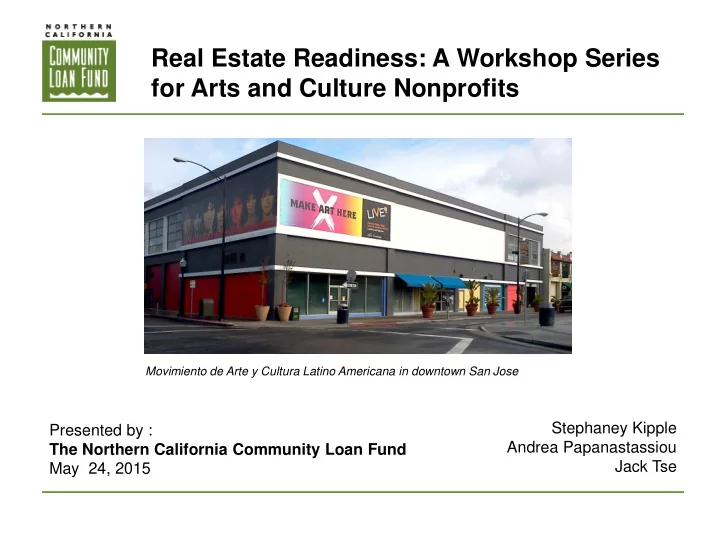
Movimiento de Arte y Cultura Latino Americana in downtown San Jose

slide-2
SLIDE 2

Introduction

Organizational Capacity

Financial Capacity Location Space Planning Closing

AGENDA

  • Introduction
  • Organizational and Staff Capacity
  • Financial Capacity
  • Location and Geographic Considerations
  • Space Planning
  • Survey Tool
  • Closing Comments and Questions

2

slide-3
SLIDE 3

3

NCCLF promotes economic justice and alleviates poverty by increasing the financial resilience and sustainability of nonprofits and enterprises. Through flexible financial products and sound advice, we create opportunities to make socially responsible investments that revitalize Northern California communities.

Mission

NCCLF envisions financially strong and culturally vibrant communities where each person has access to decent jobs, homes, health care, education, and economic opportunities. We work in partnership with individuals and organizations who share our vision of sustainable communities and social and economic justice.

Vision

slide-4
SLIDE 4

NCCLF OVERVIEW

Investing in opportunity, together.

Introduction

Organizational Capacity

Financial Capacity Location Space Planning Closing

Lending & NMTC

Consulting

Socially Responsible Investing

Policy

slide-5
SLIDE 5

NCCLF OVERVIEW

NCCLF CONSULTING & TRAINING PROGRAM Helping nonprofits use their resources strategically

Introduction

Organizational Capacity

Financial Capacity Location Space Planning Closing

Workshops and individual consulting engagements that help nonprofits manage their real estate resources. – Lease vs. Buy Analysis – NMTC Feasibility Analysis – Facility Strategic Planning – Real Estate Coaching

Real Estate Consulting

slide-6
SLIDE 6

NCCLF OVERVIEW

6

NCCLF CONSULTING & TRAINING PROGRAM Helping nonprofits use their resources strategically

Introduction

Organizational Capacity

Financial Capacity Location Space Planning Closing

Workshops and individual consulting engagements that strengthen the financial management capacity of nonprofit leadership. –Financial Assessments –Business Model Optimization –Budget Development –Cash Flow Management –Financial Education

Financial Management Consulting

slide-7
SLIDE 7

MISSION FIRST, THEN REAL ESTATE

Neighborhood Impact Building Business Plan / Outcomes Programs Mission / Vision

7

Introduction

Organizational Capacity

Financial Capacity Location Space Planning Closing

slide-8
SLIDE 8

DEVELOPMENT PROCESS

8

Real Estate Readiness Feasibility & Facility Strategic Planning Pre- Development Project Management

Before Space is Secure After Space is Secure

Introduction

Organizational Capacity

Financial Capacity Location Space Planning Closing

slide-9
SLIDE 9

REAL ESTATE READINESS

  • Organizational, Staff,

and Board Capacity

  • Financial Capacity
  • Property/Asset

Management

Introduction

Organizational Capacity

Financial Capacity Location Space Planning Closing

NCCLF provided Flight Deck/Ragged Wing ensemble with Financial Management and Capacity coaching.

slide-10
SLIDE 10

FACILITY STRATEGIC PLAN

  • What do you need?

What is your plan?

  • Location Considerations
  • Space planning
  • Program uses: current,

ideal, and minimum

  • Lease vs. Buy Analysis
  • Lease

negotiations/purchase agreements

Introduction

Organizational Capacity

Financial Capacity Location Space Planning Closing

NCCLF provided consulting services for the space planning, site selection, financing for Girls, Inc’s Simpson Center.

slide-11
SLIDE 11

PREDEVELOPMENT

  • Securing Space
  • Financing Options
  • Planning (A&E)

Introduction

Organizational Capacity

Financial Capacity Location Space Planning Closing

NCCLF provided consulting services to Destiny Arts; assisting in Financial Assessment ,Space Planning and Acquisition consulting for the organization. NCCLF also provided financing for the purchase of their building.

slide-12
SLIDE 12

PROJECT MANAGEMENT

  • Design Coordination
  • Construction Bidding
  • Construction Management
  • Reporting to and Compliance with

Funders

Introduction

Organizational Capacity

Financial Capacity Location Space Planning Closing

slide-13
SLIDE 13

REAL ESTATE READINESS

What is your capacity?

  • Look through three different lenses:

– Organizational Capacity – Staff & Board Capacity – Financial Capacity

Introduction

Organizational Capacity

Financial Capacity Location Space Planning Closing

slide-14
SLIDE 14

ORGANIZATIONAL CAPACITY

  • Clear Mission, Vision & Strategy?
  • Governance & Leadership?
  • Business Plan for the Future?
  • Strategic Relationships?
  • Systems & Staffing for:
  • Program Delivery?
  • Impact Measurement?
  • Resource Development?
  • Internal Operations & Management?

Introduction

Organizational Capacity

Financial Capacity Location Space Planning Closing

slide-15
SLIDE 15

ORGANIZATIONAL CAPACITY

Start - Up Growing Maturity

Programs  Simple Programs  Mix of diverse programs  Strong commitment to service delivery  Programs begin to establish themselves  More consistent program delivery  Core programs established & recognized in the community  Long-range program planning  Programs function well Staffing  Mostly Volunteers  Small enthusiastic staff  “Family” culture  More staff  Division of Labor  No formal personnel policies  Larger, more specialized staff  Professional managers hired Financial Systems  Small Budget  Limited accounting system  Dependent on few funding sources  Established relationship with key funder(s)  Cash flow challenges  Reliable and diverse funding streams  Significant cash reserves  Fundraising staff

What stage is your organization in?

Introduction

Organizational Capacity

Financial Capacity Location Space Planning Closing

slide-16
SLIDE 16

ORGANIZATIONAL CAPACITY

  • Strategic Plan: How your organization’s programs carry out

your Mission & Vision.

  • Business Plan: How your programs operate to deliver their

desired outcomes.

  • Facility Plan: Space needs, corporate structure, financing and

timing based on the Strategic and Business plans.

  • Capital Campaign Plan: Marketing for donations and

fundraising required.

Plans that Shape Facility Decisions

Introduction

Organizational Capacity

Financial Capacity Location Space Planning Closing

slide-17
SLIDE 17

STAFF & BOARD CAPACITY

Indicators of…

  • Stable & experienced leadership team
  • Dedicated Project Manager
  • Staffing to continue operating programs
  • Board Facility Committee
  • Defined roles & responsibilities
  • Defined decision-making process

Introduction

Organizational Capacity

Financial Capacity Location Space Planning Closing

slide-18
SLIDE 18

FINANCIAL CAPACITY

Indicators of… Financial strength:

  • Increasing net income
  • Healthy reserves
  • Healthy financial ratios
  • Fundraising capacity
  • Financial systems to track sources and

uses of funds

  • Strong budget development, variance

monitoring, contingency planning processes

Introduction

Organizational Capacity

Financial Capacity Location Space Planning Closing

slide-19
SLIDE 19

FINANCIAL CAPACITY

  • Organizational Financial Assessment
  • Financial Position: ability to pay debts, meet

unexpected financial challenges, undertake new

  • pportunities
  • Financial Performance: business model, changes in

revenue & expenses, revenue diversity, fundraising strategies

Introduction

Organizational Capacity

Financial Capacity Location Space Planning Closing

slide-20
SLIDE 20

FINANCIAL CAPACITY

Balance Sheet: Statement

  • f Financial Position

Snapshot – Overall financial health at a moment in time

  • Assets

– What you own

  • Liabilities

– What you owe

  • Net Assets

– Difference between what an

  • rganization owns (assets)

and what it owes (liabilities) – Equity; retained earnings

20

Assets Current Assets Cash and cash equivalents 6,843 Prepaid Expenses 12,760 Grants Receivable 155,264 Total Current Asseets 174,867 Property and Equipment Buildings and Building Improvements 594,600 Leasehold Improvements 370,156 Furniture, Fixture, Equipment 277,331 Less: Accumulated Depreciation (617,001) Total Fixed Assets (Net) 625,086 Total Assets 799,953 Liabilities and Net Assets Current Liabilities Accounts Payable 106,176 Accrued Expenses 144,679 Current portion of loan 15,405 Total Current Liabilities 266,260 Long Term Liabilities Mortgage Loan 331,186 Total Long Term Liabilities 331,186 Net Assets Unrestricted 181,471 Temporarily Restricted 21,036 Total Net Assets 202,507 Total Liabilities & Net Assets 799,953

Introduction

Organizational Capacity

Financial Capacity Location Space Planning Closing

slide-21
SLIDE 21

FINANCIAL CAPACITY

Multi-year Budget

  • Tied to strategic goals

and objectives

  • Looks at long-term

health

  • Saves time and effort

in preparing annual budget

21

FY1 FY2 FY3 INCOME Government 477,900

492,230 207,000

Foundation Grants 415,000

427,450 440,200

Individual Contributions 62,000

75,000 110,000

Earned Income 25,500

26,265 27,000

Miscellaneouse 300

300 310

Total Income 980,700 1,021,245 1,051,882 EXPENSE Salaries 570,000

600,000 618,000

Consultants 140,833

145,058 149,410

Supplies 86,700

89,301 91,980

Training 1,800

1,854 1,910

Insurance 11,252

11,590 11,937

Rent 75,600

77,868 80,204

Dues and Subscriptions 1,500

1,545 1,591

Telephone 6,000

6,180 6,365

Utilities 3,600

3,708 3,819

Repairs & Maintenance 5,000

5,150 5,305

Accounting and Legal 12,000

12,360 12,731

Deprecaition 7,500

7,725 7,957

Advertising 5,600

5,768 5,941

Special Events 40,000

41,200 42,436

Miscellaneous 4,000

4,120 4,244

Total Expenses 971,385 1,013,427 1,043,830 Net Operating Income 9,315 7,818 8,053

Introduction

Organizational Capacity

Financial Capacity Location Space Planning Closing

slide-22
SLIDE 22

FINANCIAL CAPACITY

  • What are your trends and projections?
  • Net Income, unrestricted cash
  • Growth of donor/subscriber base

(c) Northern California Community Loan Fund 2013 22

Introduction

Organizational Capacity

Financial Capacity Location Space Planning Closing

slide-23
SLIDE 23

FINANCIAL CAPACITY

  • Healthy Reserves
  • Operating reserves equal to 3-6 months operating expenses
  • Capital reserves for repair or replacement of fixed assets
  • Opportunity reserves for future expansion or alternative

endeavors

  • Measuring Your Organization’s Reserves
  • Days’ Cash = (Cash + Cash Equivalents) x 365/Operating

Expenses-depreciation

  • Indicates the number of days the organization can pay its
  • bligations without any new cash inflows (Benchmark: 90

days of cash)

Introduction

Organizational Capacity

Financial Capacity Location Space Planning Closing

slide-24
SLIDE 24

FINANCIAL CAPACITY

24

Assets Current Assets Cash and cash equivalents 6,843 Prepaid Expenses 12,760 Grants Receivable 155,264 Total Current Asseets 174,867 Property and Equipment Buildings and Building Improvements 594,600 Leasehold Improvements 370,156 Furniture, Fixture, Equipment 277,331 Less: Accumulated Depreciation (617,001) Total Fixed Assets (Net) 625,086 Total Assets 799,953 Liabilities and Net Assets Current Liabilities Accounts Payable 106,176 Accrued Expenses 144,679 Current portion of loan 15,405 Total Current Liabilities 266,260 Long Term Liabilities Mortgage Loan 331,186 Total Long Term Liabilities 331,186 Net Assets Unrestricted 181,471 Temporarily Restricted 21,036 Total Net Assets 202,507 Total Liabilities & Net Assets 799,953

Introduction

Organizational Capacity

Financial Capacity Location Space Planning Closing

FY1 INCOME Government 477,900 Foundation Grants 415,000 Individual Contributions 62,000 Earned Income 25,500 Miscellaneous 300 Total Income 980,700 EXPENSE S alaries 570,000 Consultants 140,833 S upplies 86,700 Training 1,800 Insurance 11,252 Rent 75,600 Dues and S ubscriptions 1,500 Telephone 6,000 Utilities 3,600 Repairs & Maintenance 5,000 Accounting and Legal 12,000 Depreciation 7,500 Advertising 5,600 S pecial Events 40,000 Miscellaneous 4,000 Total Expenses 971,385 Net Operating Income 9,315

BUDGET: BALANCE SHEET:
slide-25
SLIDE 25

FINANCIAL CAPACITY

  • Days’ Cash = (Cash + Cash Equivalents) x 365/Operating Expenses-

depreciation

  • Cash and cash equivalents= $6,843
  • Operating expenses= $971,385
  • Depreciation= $7,500
  • Days’ Cash= ($6,843) * 365/ ($971,385-$7,500)
  • Days’ Cash= 2.59 days

How much cash is needed to reach the recommended 90 day benchmark?

  • One Days’ Cash= ($971,385-$7,500)/ 365 days= $2,641
  • 90 Days’ Cash= $2,641 * 90 days = $237,690
  • Cash requirement is roughly 25% of operating expenses

Introduction

Organizational Capacity

Financial Capacity Location Space Planning Closing

slide-26
SLIDE 26

FINANCIAL CAPACITY

  • The 5 C’s of Credit
  • Capacity: cash flow for loan repayment
  • Capital: resources available for project equity
  • Collateral: security pledged for the loan
  • Conditions: requirements to mitigate risk
  • Character: management & board, track record of
  • rganization

What do funders look for?

Introduction

Organizational Capacity

Financial Capacity Location Space Planning Closing

slide-27
SLIDE 27

FINANCIAL CAPACITY

  • Organization:
  • 5 “C”s are strong!
  • Clear programmatic need
  • Clear plan for on-going programmatic support
  • Board & Staff leadership with common goals
  • Project: Site control and a clear plan
  • Donors: ready to expand support
  • Potential lead donors identified

Can you launch a successful campaign?

Introduction

Organizational Capacity

Financial Capacity Location Space Planning Closing

slide-28
SLIDE 28

FINANCIAL CAPACITY

Capital Campaign Expenses (10-15% of funds):

  • Campaign Consultant
  • Capital Campaign feasibility study
  • Campaign Staff
  • Fundraising Software & Training
  • Marketing Material (renderings, mailings, photography, web

presence, etc.)

  • Marketing Events expenses

Preparing for a successful campaign

Introduction

Organizational Capacity

Financial Capacity Location Space Planning Closing

slide-29
SLIDE 29

REAL ESTATE READY

Organizational Capacity Staff & Board Capacity Financial Capacity

Clear Mission & Program Strategy Strategic Plan / Business Plan Board & Staff with Common Vision Track Record Dedicated Project Manager Clear Lines of Communication / Authority Able to Maintain Programs & Facility Project Operating Systems to Support New Staff / Programs / Space Stable & Experienced Leadership Team Ability to Secure New Funds / Capital Campaign Budgeting System & Contingency Planning Process 5 C’s & Ratios are Strong Strong Accounting System Increasing Net Income Reserves

Introduction

Organizational Capacity

Financial Capacity Location Space Planning Closing

slide-30
SLIDE 30

MISSION FIRST, THEN REAL ESTATE

Neighborhood Impact Building Business Plan / Outcomes Programs Mission / Vision

Introduction

Organizational Capacity

Financial Capacity Location Space Planning Closing

slide-31
SLIDE 31

FACILITY PLANNING CYCLE

  • Space needs can

change with program changes.

  • There is no perfect

space, only best fit for particular time.

  • Revisit facility needs

when programs change

  • r EVERY 7-10

YEARS!

Strategic

  • r Business

Planning Facility Strategic Planning Renovate, Expand, Satellite, or move Operations (7-10 years)

Introduction

Organizational Capacity

Financial Capacity Location Space Planning Closing

slide-32
SLIDE 32

WHEN TO START PLANNING

Timeline Goal

1-2 Months Continue to rent your current location 3 - 6 Months Secure a new lease that better meets your needs 6 -12 Months Purchase an as-is building that meets your needs 1 – 3+ Years Purchase a building that will require light renovation or remodel 3 – 8+ Years Purchase land and build a new facility

Easiest Hardest

Introduction

Organizational Capacity

Financial Capacity Location Space Planning Closing

slide-33
SLIDE 33

SPACE PLANNING CHALLENGES

  • Facility Planning is more difficult if you are:
  • Driven by specific real estate opportunities
  • In financial crisis
  • In imminent danger of losing space
  • If your space needs are immediate
  • If Board and Executive staff do not agree

Introduction

Organizational Capacity

Financial Capacity Location Space Planning Closing

slide-34
SLIDE 34

DECISION MAKING TOOL: SURVEY

Space planning considerations when surveying your

  • rganization’s staff and board (be specific):
  • Proximity to transit: Regional/local/bus/or particular

transit agency

  • Located near: clients/audience; specific funders;

complementary organizations

  • Space considerations: traditional or open office;

client meeting spaces

  • Building features your program requires: kitchen;

loading dock; ceiling height; theatre

Introduction

Organizational Capacity

Financial Capacity Location Space Planning Closing

slide-35
SLIDE 35

DECISION MAKING TOOL: SURVEY

(c) Northern California Community Loan Fund 2013 35

Introduction

Organizational Capacity

Financial Capacity Location Space Planning Closing

(1 being highest priority)

1 2 3 4 1 4 3 2 Example: Proximity to Organizations, Funders, Individuals Located near: Clients/target audience Funder: City Hall Funder: XYZ Foundation Complementary organization: Partner organization

slide-36
SLIDE 36

DECISION MAKING TOOL: SURVEY

Survey resources:

  • www.surveymonkey.com
  • www.google.com/forms

Introduction

Organizational Capacity

Financial Capacity Location Space Planning Closing

slide-37
SLIDE 37

DECISION MAKING TOOL: SURVEY

  • Develop 2 planning considerations to survey

your organization’s staff and board

  • Share your top priority for your organization

Introduction

Organizational Capacity

Financial Capacity Location Space Planning Closing

slide-38
SLIDE 38

FACILITY PLANNING

Location Considerations

  • Where do you want to be located?
  • What drives your location decision?

Space Planning

  • What (and how much) do you need?
  • What specific program features drive your space needs?

Introduction

Organizational Capacity

Financial Capacity Location Space Planning Closing

slide-39
SLIDE 39

LOCATION CONSIDERATIONS

Clients/ Audience Funders Collaborators

Clustering

Volunteers Partners Employees Policymakers

Introduction

Organizational Capacity

Financial Capacity Location Space Planning Closing

slide-40
SLIDE 40

LOCATION CONSIDERATIONS

40

Introduction

Organizational Capacity

Financial Capacity Location Space Planning Closing

San Antonio Havenscourt Elmhurst

What neighborhood or area serves your Mission and Vision best?

slide-41
SLIDE 41

FEDERAL FUNDING CONSIDERATIONS New Markets Tax Credit (NMTC)

Image: map created with PolicyMap, 2015

Eligible Zones in Purple

Introduction

Organizational Capacity

Financial Capacity Location Space Planning Closing

slide-42
SLIDE 42

PRICE CONSIDERATIONS

Neighborhood Market Rate Rent PSF (Class B and C) Downtown $2.48 Japantown $2.06 North San Jose $2.75 South San Jose $1.63 East San Jose $2.18 Horace Mann $2.29 Willow Glenn $2.31 San Jose Citywide Avg. $2.82 (Includes A)

Source: Loopnet.com

Introduction

Organizational Capacity

Financial Capacity Location Space Planning Closing

slide-43
SLIDE 43

BUILDING: SPACE NEEDS ANALYSIS

Program Space Needs:

  • Existing
  • Next 5-10

years

  • Ideal

Special features needed? Timing of growth or reductions Shared use

  • pportunities

Co-location

  • pportunities

(partners, collaborators)

Potential factors:

Introduction

Organizational Capacity

Financial Capacity Location Space Planning Closing

slide-44
SLIDE 44

SPECIAL FEATURES: BASIC CONSIDERATIONS In-Class Exercise

  • What Type of Use?

– Performing Arts – Visual Arts – MakerSpace – Workshops/Classrooms

  • When do you need it?

– Time of Day – Frequency – Duration of Use

44

Introduction

Organizational Capacity

Financial Capacity Location Space Planning Closing

slide-45
SLIDE 45

BUILDING: BASIC CALCULATIONS

  • Private Offices:
  • Cubicle:
  • Conference Room:
  • Classroom/Workshop range: 20-60 sq. ft. per person

Introduction

Organizational Capacity

Financial Capacity Location Space Planning Closing

slide-46
SLIDE 46

CURRENT, MINIMUM & IDEAL SPACE NEEDS

  • How many square feet does your organization occupy? OR
  • How many people in what kind of configuration do you have?

Use Current Minimum Ideal Admin Program 1

Introduction

Organizational Capacity

Financial Capacity Location Space Planning Closing

slide-47
SLIDE 47

MINIMUM & IDEAL SPACE NEEDS

Uses: Program 1 Minimum Ideal

Office: Desk Space (dedicated or shared) 3 @ 50 sf each, dedicated 4 @100 sf each, dedicated Rehearsal & Classroom (size & frequency of use) 1 @ 400 sf each 15 evenings per month 1 @ 600 sf each 15 evenings & 10 days per month Parking (frequency of use) 10 stalls 4pm-7pm 20 stalls 4pm-7pm

Other

  • 120 sf sound booth

Totals

550 sf + 10 parking stalls 1,120 sf + 20 parking stalls

Introduction

Organizational Capacity

Financial Capacity Location Space Planning Closing

slide-48
SLIDE 48

EXAMPLE

Uses: Program 1 Program 2 Program 3 Office 3-4 desks 150-400 sf 1 desk 64-100sf 3 offices@ 192-300 sf 500 sf for 8 cubicles Classroom 400-600 sf

  • Theater
  • 800-1,000 sf
  • Parking

10-20 stalls 4pm-7pm 0-2 stalls 9am-5pm 10 stalls 9am-noon Other Sound Booth @ 120 sf Loading dock Server room @ 50 sf Totals 550 sf - 1,120 sf 864 sf - 1,100 sf 742 sf – 850 sf

Introduction

Organizational Capacity

Financial Capacity Location Space Planning Closing

slide-49
SLIDE 49

MINIMUM & IDEAL SPACE NEEDS

Uses: Program 1 Program 2 Program 3 Totals 550 sf - 1,120 sf 864 sf - 1,100 sf 742 sf – 850 sf Parking 10-20 stalls- 4pm-7pm 0-2 stalls 9am-5pm 10 stalls Other Sound Booth? Loading dock? Server room?

49

Rough guess of space required 2,156 - 3,070 sf With 25% common area 2,700 – 3,850 sf + 10 – 22 parking stalls (Programs 2 & 3 share parking)

Introduction

Organizational Capacity

Financial Capacity Location Space Planning Closing

slide-50
SLIDE 50

CURRENT, MINIMUM & IDEAL SPACE NEEDS

Use Current Minimum Ideal Admin Program 1

50

  • How many square feet does your organization occupy? OR
  • How many people in what kind of configuration do you have?

Introduction

Organizational Capacity

Financial Capacity Location Space Planning Closing

slide-51
SLIDE 51

CLOSING

  • 1. Organizational Capacity
  • What stage is your organization in? What are

programmatic goals?

  • 2. Financial Capacity
  • What are your reserves? Calculate your days’ cash
  • 3. Facility Planning
  • Where in the facility planning cycle are you?
  • Where would you prefer to be?
  • What are your current space uses?
  • What is your space plan?

Introduction

Organizational Capacity

Financial Capacity Location Space Planning Closing

slide-52
SLIDE 52

PREPARATION FOR WORKSHOP 2

  • 1. Discuss your space needs survey with your team
  • Bring your planning considerations to Workshop 2
  • 2. Conduct your space planning assessment
  • Define your space uses (by admin and program)
  • 3. Calculate your days cash
  • Last year’s and current year’s
  • 4. RSVP for Workshop 2 to receive your budget

calculator

  • 5. Bring your current year’s budget, your budget

calculator and your laptop to workshop 2

52

Introduction

Organizational Capacity

Financial Capacity Location Space Planning Closing

slide-53
SLIDE 53

PREPARATION FOR WORKSHOP 2

1. Get input on your space planning considerations 2. Use the budget calculator on different space options

53

Introduction

Organizational Capacity

Financial Capacity Location Space Planning Closing

slide-54
SLIDE 54

CONTACT INFORMATION

Joanne Lee Director of Consulting Services jlee@ncclf.org Andrea Papanastassiou Deputy Director of Consulting andreap@ncclf.org Stephaney Kipple Real Estate Consultant skipple@ncclf.org Jack Tse Real Estate Consultant jtse@ncclf.org Introduction

Organizational Capacity

Financial Capacity Location Space Planning Closing Lori Campbell Financial Management Consultant lcampbell@ncclf.org