Rearrangement of 3-(4,5-dimethoxy -2-vinylphenyl)-2- methyl - - PDF document

rearrangement of 3 4 5 dimethoxy 2 vinylphenyl 2 methyl 5
SMART_READER_LITE
LIVE PREVIEW

Rearrangement of 3-(4,5-dimethoxy -2-vinylphenyl)-2- methyl - - PDF document

Rearrangement of 3-(4,5-dimethoxy -2-vinylphenyl)-2- methyl -5-nitroisoquinolin -1( 2H )-one to 2-(6,7-dimethoxy -1-oxoisoquinolin -2( 1H )-yl)- N - methylbenzamide: a mechanistic proposal Treus, M. 1 ; Salas; C. O. 2 ; Estvez, J. C. 1 ; Tapia,


slide-1
SLIDE 1

Rearrangement of 3-(4,5-dimethoxy -2-vinylphenyl)-2- methyl -5-nitroisoquinolin -1(2H)-one to 2-(6,7-dimethoxy -1-oxoisoquinolin -2(1H)-yl)-N- methylbenzamide: a mechanistic proposal

Treus, M.1; Salas; C. O.2; Estévez, J. C.1; Tapia, R. A.2; Estévez, R. J.1,*

1 Centro Singular de Investigación en Química Biolóxica e Materiais Moleculares and Departamento de

Química Orgánica, Universidade de Santiago de Compostela, 15782 Santiago de Compostela, Spain.

2 Departamento de Química Orgánica, Facultad de Química, Pontificia Universidad Católica de Chile,

702843 Santiago de Chile, Chile; cosalas@uc.cl * Correspondence: ramon.estevez@usc.es; Tel.: +34-881-815-731

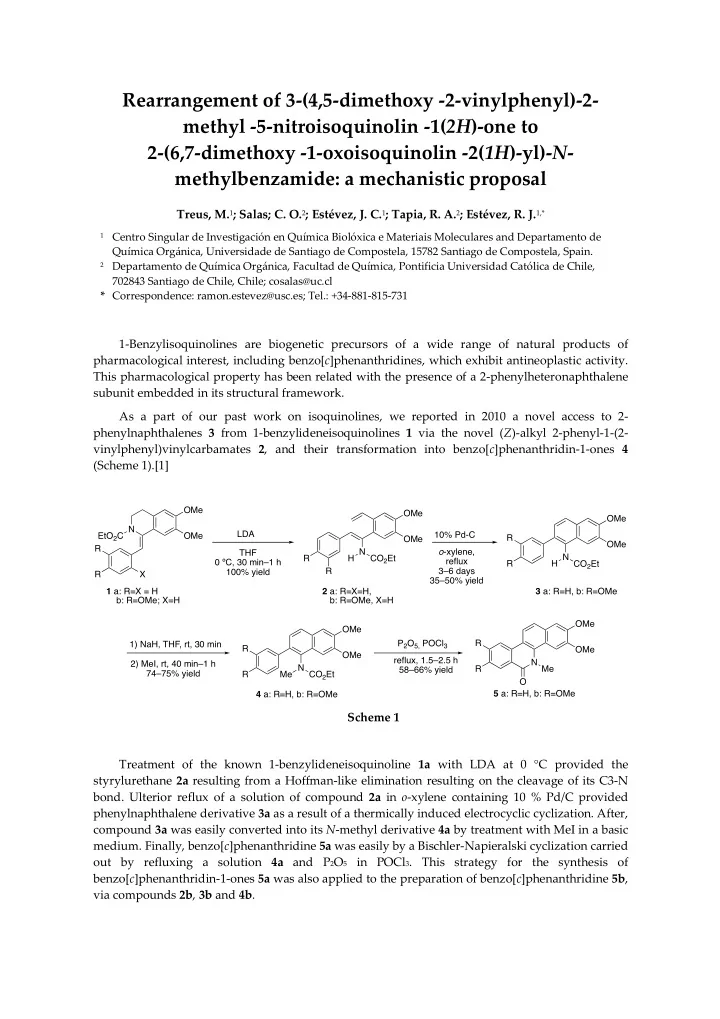
1-Benzylisoquinolines are biogenetic precursors of a wide range of natural products of pharmacological interest, including benzo[c]phenanthridines, which exhibit antineoplastic activity. This pharmacological property has been related with the presence of a 2-phenylheteronaphthalene subunit embedded in its structural framework. As a part of our past work on isoquinolines, we reported in 2010 a novel access to 2- phenylnaphthalenes 3 from 1-benzylideneisoquinolines 1 via the novel (Z)-alkyl 2-phenyl-1-(2- vinylphenyl)vinylcarbamates 2, and their transformation into benzo[c]phenanthridin-1-ones 4 (Scheme 1).[1] Scheme 1 Treatment of the known 1-benzylideneisoquinoline 1a with LDA at 0 °C provided the styrylurethane 2a resulting from a Hoffman-like elimination resulting on the cleavage of its C3-N

  • bond. Ulterior reflux of a solution of compound 2a in o-xylene containing 10 % Pd/C provided

phenylnaphthalene derivative 3a as a result of a thermically induced electrocyclic cyclization. After, compound 3a was easily converted into its N-methyl derivative 4a by treatment with MeI in a basic

  • medium. Finally, benzo[c]phenanthridine 5a was easily by a Bischler-Napieralski cyclization carried
  • ut by refluxing a solution 4a and P2O5 in POCl3. This strategy for the synthesis of

benzo[c]phenanthridin-1-ones 5a was also applied to the preparation of benzo[c]phenanthridine 5b, via compounds 2b, 3b and 4b.

H N CO2Et H N CO2Et Me N CO2Et N O OMe R R R OMe OMe OMe OMe R R R R OMe OMe OMe 1 a: R=X = H b: R=OMe; X=H Me 2 a: R=X=H, b: R=OMe, X=H 3 a: R=H, b: R=OMe 4 a: R=H, b: R=OMe 5 a: R=H, b: R=OMe OMe OMe N EtO2C X R R 10% Pd-C

  • -xylene,

reflux 3–6 days 35–50% yield 1) NaH, THF, rt, 30 min 2) MeI, rt, 40 min–1 h 74–75% yield P2O5, POCl3 reflux, 1.5–2.5 h 58–66% yield R LDA THF 0 ºC, 30 min–1 h 100% yield

slide-2
SLIDE 2

Scheme 2 Proceeding as for 1a and 1b, reaction of compound 1c with LDA in THF at 0 °C for 1.5 h gave a complex reaction mixture. However, when a solution of compound 1c and NaH in DMF was heated at 130 °C for 3 h, the isoquinoline 8a resulted, probably by means of a nitro facilitated thermal electrocyclic cyclization of 1a involving its N-ethoxycarbonyl substituent. This resulted in the formation of protoberberine derivative 6, which could spontaneously be converted into compound 8a by a Hofmann-like elimination by the action of hydride. Methylation of 8a provided 8b, which when subjected to the conditions for the transformation

  • f 2a into 3a did not gave the expected benzophenanthridine 5c. Alternatively, 8b was subjected to a

known protocol for the transformation

  • f

3-(2-vinylphenyl)-isoquinolin-1(2H)-ones (8) benzo[c]phenanthridin-1-ones (5). The treatment of 8b with thallium trinitrate allowed us to obtain the acetal derivative 9, which was directly solved in a MeOH/H2O mixture and heated at 70 ºC for two days, after adding p-toluensulfonic acid.[2] Surprisingly, the resulting compound was the isoquinolin-1-one 10. Compound 10 could result from the expected 5c, via an unknown rearrangement. But, although this possibility was not discarded, we assumed that the nitro group prevents the cyclization required for the transformation of compound 9 into benzo[c]phenanthridine 5c in favor of a novel, complex rearrangement involving the transformation of 9 into the benzazepindione 11. A benzylic acid rearrangement could explain the transformation of compound 11 into compound 12, which could undertook a decarboxylative oxidation leading the isoquinoline 10 (Scheme 3). Scheme 3

1c OMe OMe N EtO2C NO2 OMe OMe N NO2 O NaH DMF 130 ºC, 3 h 55% yield N O OMe OMe H 6 NO2 8a: R=H 8b: R=Me

  • 1. NaH, THF, rt, 30 min
  • 2. MeI, rt, 2h

N O OMe OMe Me NO2 OMe MeO Tl(NO3)3. 3 H2O MeOH rt, 5 min p-TsOH MeOH, H2O 70 ºC, 2 days 86% yield (two steps) 9 N OMe OMe O O MeHN 10 8b N O OMe OMe Me NO2 5c N O OMe OMe Me NO2 OMe MeO 9 OMe OMe N O 10 OMe OMe N O O 11 H+, H2O OMe OMe N OH O O H 12 H+, H2O

  • CO2, -H2

O MeHN O MeHN O MeHN H+, H2O ???

slide-3
SLIDE 3

Transformation of nitroisoquinoline 9 into benzazepindione 11 could occur via the mechanism depicted in Scheme 4. Scheme 4 Hydrolysis of ketal 9 provided nitroisoquinoline 13. Protonation of this compound resulted in the formation of its conjugated acid 14, which spontaneously opened to the corresponding d-ketoacid amide 15. Isomerization of this compound to compound 16 is followed by an intramolecular Michael- like reaction leading to the complex oxazole 17. The opening of the oxazole ring of this compound gave the nitroso d-ketoacid amide 18, which undertook a cyclization, via its enol 19, that provided the complex benzazetidine 20. Protonation of this compound, followed by the opening of the azetidine ring of the resulting conjugate acid 21 could explain the formation of the key nitrene 22, that should rearrange to the a-ketophenylacetic acid amide 23, precursor of the benzazepindione 11. This mechanistic proposal for the striking transformation of isoquinoline 9 into isoquinoline 10 is

  • pen to discussion. Any comment or alternative mechanism will be welcomed.

References

1. Treus, M.; Salas; C. O.; González, M. A.; Estévez, J. C.; Tapia, R. A.; Estévez, R. J. (Z)-Ethyl 2-phenyl -1-(2- vinylphenyl)vinylcarbamates. Part 1: Synthesis and preliminary studies on their divergent transformation into benzo[c]phenanthridines and 2-phenyl-1,4-naphthoquinones. Tetrahedron 2010, 66, 9986e9995, DOI 10.1016/j.tet.2010.10.035. 2. (a) Hanaoka, M.; Motonishi, T.; Mukai, C. J. Chem. Soc., Chem. Commun. 1984, 718; (b) Hanaoka, M.; Motonishi, T.; Mukai, C. J. Chem. Soc., Perkin Trans. 1 1986, 2253

N O OMe OMe Me NO2 OMe MeO 9 H+, H2O N O OMe OMe Me N O 13 H O O H+ N O OMe OMe Me N O 14 H O O H2O (-H+) NHMe O OMe OMe N O 15 H O O O H NHMe O OMe OMe N O 16 H O HO O NHMe O OMe OMe N O 17 H O O O H NHMe O OMe OMe N O 18 H O O HO OMe OMe N O 19 (G=CONHMe) H O O OH H G OMe OMe N O 20 H HO O OH G H+ OMe OMe N O 21 H H2O O O G H OMe OMe N O 22 H O O G

  • H3O+

N OMe OMe O 23 H O O H OMe OMe N O O MeHNOC H+

  • H2O

11 G ???