SLIDE 1
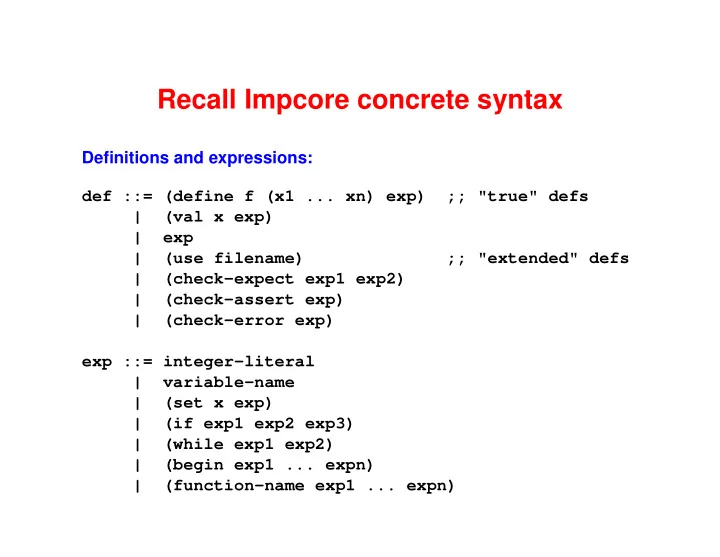
Recall Impcore concrete syntax
Definitions and expressions: def ::= (define f (x1 ... xn) exp) ;; "true" defs | (val x exp) | exp | (use filename) ;; "extended" defs | (check-expect exp1 exp2) | (check-assert exp) | (check-error exp) exp ::= integer-literal | variable-name | (set x exp) | (if exp1 exp2 exp3) | (while exp1 exp2) | (begin exp1 ... expn) | (function-name exp1 ... expn)
SLIDE 2 Define behaviors inductively
We’ll focus on expressions Base cases (plural!): numerals, names Inductive steps: compound forms
- To determine behavior of a compound form, look
at behaviors of its parts
SLIDE 3
First, simplify the task of specification
What’s different? What’s the same? x = 3; (set x 3) while (i * i < n) (while (< (* i i) n) i = i + 1; (set i (+ i 1))) Abstract away gratuitous differences
SLIDE 4 Abstract syntax
Same inductive structure as concrete syntax But,
- More uniform representation
- Designed for compiler, not programmer
Concrete syntax: sequence of symbols Abstract syntax: ???
SLIDE 5
The abstraction is a tree
The abstract-syntax tree (AST): Exp = LITERAL (Value) | VAR (Name) | SET (Name name, Exp exp) | IFX (Exp cond, Exp true, Exp false) | WHILEX (Exp cond, Exp exp) | BEGIN (Explist) | APPLY (Name name, Explist actuals) One kind of “application” for both user-defined and primitive functions (One syntax, two behaviors)
SLIDE 6
In C, trees are fiddly
typedef struct Exp *Exp; typedef enum { LITERAL, VAR, SET, IFX, WHILEX, BEGIN, APPLY } Expalt; /* which alternative is it? */ struct Exp { // ’alt’ combines with any field in union Expalt alt; union { Value literal; Name var; struct { Name name; Exp exp; } set; struct { Exp cond; Exp true; Exp false; } ifx; struct { Exp cond; Exp exp; } whilex; Explist begin; struct { Name name; Explist actuals; } apply; }; };
SLIDE 7
Let’s picture some trees
An expression: (f x (* y 3))
SLIDE 8
Let’s picture some trees
And a definition: (define abs (n) (if (< n 0) (- 0 n) n))
SLIDE 9
Behaviors of ASTs, part I: Atomic forms
Numeral: stands for a value Name: stands for what?
SLIDE 10 In Impcore, a name stands for a value
Environment associates each variable with one value Written
fx1 7! n1 ; : : :xk 7! nk g,
associates variable xi with value ni. Environment is finite map, aka partial function x
2 dom
- x is defined in environment
- (x)
the value of x in environment
7! v g
extends/modifies environment
to map x to v
SLIDE 11
Environments in C, abstractly
An abstract type: typedef struct Valenv *Valenv; Valenv mkValenv(Namelist vars, Valuelist vals); bool isvalbound(Name name, Valenv env); Value fetchval (Name name, Valenv env); void bindval (Name name, Value val, Valenv env);
SLIDE 12 “Environment” is formal term
You may also hear:
So-called “Scope rules” determine which environment governs where
SLIDE 13
Find behavior using environment
Consider the program fragment (* y 3) ;; what does it mean? Key Idea: Look up the meaning of variables in an environment
SLIDE 14 Impcore uses three environments
Global variables
(“ksee”)
Functions
(“fee”)
Formal parameters
(“roe”)
There are no local variables
- Just like awk; if you need temps, use extra
formal parameters Function environment
not shared with
variables—just like Perl