Recall that within our family of exponential functions there is - - PDF document

recall that within our family of exponential
SMART_READER_LITE
LIVE PREVIEW

Recall that within our family of exponential functions there is - - PDF document

Mt020.02 Slide 1 on 04/07/00 Recall that within our family of exponential functions there is exactly one function f(x) = a x for each base a > 0. Among all the positive bases, there is one which deserves special attention. There is a


slide-1
SLIDE 1

Mt020.02 Slide 1 on 04/07/00

raj

Recall that within our family of exponential functions there is exactly one function f(x) = ax for each base a > 0. Among all the positive bases, there is one which deserves special

  • attention. There is a number e = 2.71828....

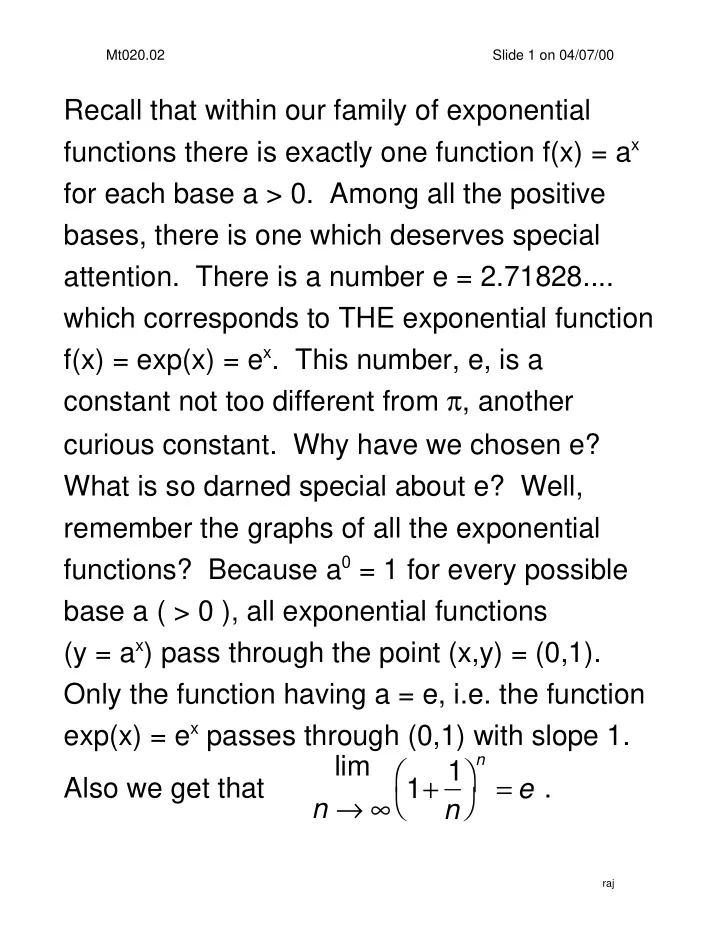
which corresponds to THE exponential function f(x) = exp(x) = ex. This number, e, is a constant not too different from π, another curious constant. Why have we chosen e? What is so darned special about e? Well, remember the graphs of all the exponential functions? Because a0 = 1 for every possible base a ( > 0 ), all exponential functions (y = ax) pass through the point (x,y) = (0,1). Only the function having a = e, i.e. the function exp(x) = ex passes through (0,1) with slope 1. Also we get that lim n → ∞ 1+ 1 n    

n

= e .

slide-2
SLIDE 2

Mt020.02 Slide 2 on 04/07/00

raj

Today’s topic is another family of functions, the logarithmic functions. Just as there is one member of the exponential function family for each positive base a (> 0), there is one member of the logarithmic function family, loga(x), for each positive base a (> 0). In fact the pair, ax and loga(x) are intimately related because loga(ax) = x and also aloga(x) = x This is to say that each of the functions, ax and loga(x) “undoes” the other. Another way to say the same thing is to assert that

y = ax is exactly the same as saying loga(y) = x.

slide-3
SLIDE 3

Mt020.02 Slide 3 on 04/07/00

raj

In English we describe this by saying that w = loga(x) means that w is the exponent that you need to install on a to obtain the value x. Examples: log2(64) = 6 log25(5) = 0.5 log10(1000) = 3 log27(3) = 1/3. Notice that when a > 0, we always have ax > 0. As a result of this loga(y) has no meaning whenever y ≤ 0. This translates into “We can never take a logarithm of a non positive quantity.” There are two logarithms which we use more than others, base a = 10 and base a = e. The first, log10(x), are called base 10 (or common)

slide-4
SLIDE 4

Mt020.02 Slide 4 on 04/07/00

raj

logarithms, and the second type, loge(x), are called base e (or natural) logarithms. We have special notations for these special logarithms: log(x) means the common log, log10(x) and ln(x) means the natural log, loge(x). Here are some sample problems: Solve for x: log(x) = 2 ln(e6) = x log3(x) = 4 logx(144) = 2 There are several rules for manipulating logs:

  • 1. logb(mn) = logb(m) + logb(n)
  • 2. logb(m/n) = logb(m) - logb(n)
  • 3. logb(aw) = wlogb(a)
  • 4. logb(1) = 0 and 5. logb(b) = 1
slide-5
SLIDE 5

Mt020.02 Slide 5 on 04/07/00

raj

Example: If log(7) = .8451, and log(2) = .3010, then find log(24.5). Solution: log(24.5) = log(49/2) = log(72/2) = log(72) – log(2) = 2log(7) – log(2) 2 (.8451) – (.3010) = 1.3892 Simplify: ln 2ab a + b       Simplify: ln e x x 2 1+ x 2      

slide-6
SLIDE 6

Mt020.02 Slide 6 on 04/07/00

raj

Solve for x: 8 −103x+1 = 13 5 Solve for x: 4ln x + 2

( ) = 12

7