
SLIDE 1
1
Recent results of the Pierre Auger Observatory
Creusot Alexandre for the Pierre Auger Collaboration University of Nova Gorica
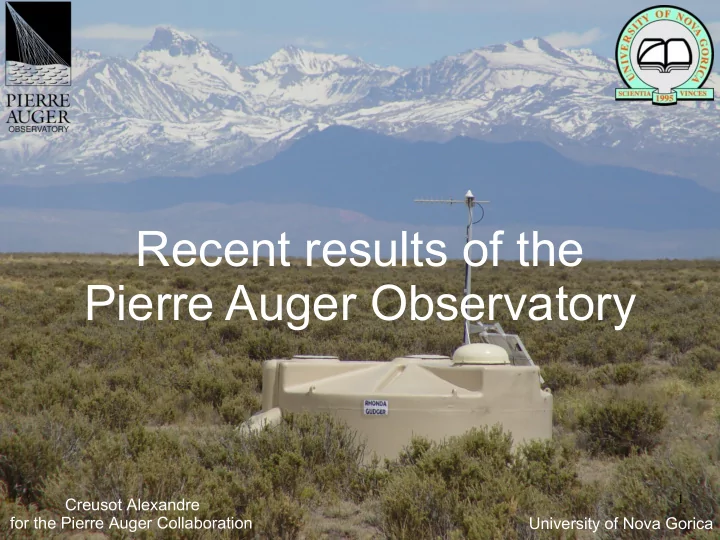
Recent results of the Pierre Auger Observatory 1 Creusot Alexandre - - PowerPoint PPT Presentation
Recent results of the Pierre Auger Observatory 1 Creusot Alexandre for the Pierre Auger Collaboration University of Nova Gorica Outline The Pierre Auger Observatory Spectrum of ultra-high energy cosmic rays Mass composition and hadronic
1
Creusot Alexandre for the Pierre Auger Collaboration University of Nova Gorica
2
Outline
Alexandre Creusot for the Pierre Auger collaboration
3
Outline
Alexandre Creusot for the Pierre Auger collaboration
4
Scientific case
Alexandre Creusot for the Pierre Auger collaboration
Study of the ultra-high energy cosmic rays (UHECR) determine the characteristics (flux, nature, energy) identify the sources (cosmic ray astronomy) understand the acceleration mechanisms
5
The Pierre Auger Observatory
Alexandre Creusot for the Pierre Auger collaboration
Two sites:
Above 2×10¹⁹ eV south ~ 25 evt/year north ~ 200 evt/year full sky coverage high statistic
6
The Pierre Auger Observatory
Alexandre Creusot for the Pierre Auger collaboration
Two sites:
Above 2×10¹⁹ eV south ~ 25 evt/year north ~ 200 evt/year full sky coverage high statistic
7
The southern site
Alexandre Creusot for the Pierre Auger collaboration
Malargue (Argentina) 2004 => data 2008 => completion
8
The southern site
Alexandre Creusot for the Pierre Auger collaboration
Malargue (Argentina) 2004 => data 2008 => completion
9
Hybrid detection
Alexandre Creusot for the Pierre Auger collaboration
Detection of the extensive air shower (EAS) induced by UHECR with two methods sampling at the ground level
Array of 1660 Cherenkov Detectors (SD) detection of the fluorescence light emitted by the air molecules after the shower crossing 24 fluorescence telescopes in 4 sites (FD) 3000 km2
10
Exposure
Alexandre Creusot for the Pierre Auger collaboration
2000 trans-GZK cosmic rays in 10 years
11
Hybrid detector
Alexandre Creusot for the Pierre Auger collaboration
One example
12
Surface array
Alexandre Creusot for the Pierre Auger collaboration
Measurement of the shower front E ~ 2.70×10¹⁹ eV θ ~ 59.8° Φ ~ 38.8° Lateral Distribution Function (LDF)
13
Fluorescence telescopes
Alexandre Creusot for the Pierre Auger collaboration
Measurement of the longitudinal profil of the shower E ~ 3.02×10¹⁹ eV θ ~ 59.6° Φ ~ 39.8° Gaisser-Hillas Function
14
Hybrid detector
Alexandre Creusot for the Pierre Auger collaboration
Surface array: 100% duty cycle angular resolution < 1° exposure Fluorescence telescopes: 13% duty cycle angular resolution < 0.6° energy estimation (calorimeter)
15
Outline
Alexandre Creusot for the Pierre Auger collaboration
16
Energy spectrum
Alexandre Creusot for the Pierre Auger collaboration
exposure for both modes increase of the energy range SD above 1018.5 eV FD above 1018 eV calibration of the SD with hybrids Combined spectrum (SD + hybrid)
17
Energy spectrum
Alexandre Creusot for the Pierre Auger collaboration
exposure for both modes increase of the energy range SD above 1018.5 eV FD above 1018 eV calibration of the SD with hybrids Combined spectrum (SD + hybrid)
18
SD energy spectrum
Alexandre Creusot for the Pierre Auger collaboration
Uncertainties flux ~ 5.8% energy resolution ~ 20%
19
Hybrid energy spectrum
Alexandre Creusot for the Pierre Auger collaboration
Uncertainties flux ~ 10% at 1018 eV flux ~ 6% above 1019 eV energy resolution < 6%
20
Combined energy spectrum
Alexandre Creusot for the Pierre Auger collaboration
lg(EANKLE / eV) ~ 18.6 power law: below ~ 3.3 above ~ 2.6 lg(E1/2 / eV) ~ 19.6 Uncertainties flux < 4% energy resolution ~ 22% GZK suppression significant at 20 σ
21
Outline
Alexandre Creusot for the Pierre Auger collaboration
22
Mass composition with hybrids
Alexandre Creusot for the Pierre Auger collaboration
Xmax is in the view field => direct measurement RMS(Xmax) sensitive to nnucleons and to the interaction length d(Xmax)/dlgE (elongation rate) sensitive to a change in the composition One observable: the depth of maximum of the shower development (Xmax)
23
Mass composition with hybrids
Alexandre Creusot for the Pierre Auger collaboration
the mean mass increases with energy if the extrapolations of the hadronic models are correct
24
Mass composition with SD
Alexandre Creusot for the Pierre Auger collaboration
Method: use of the shower front t1/2 => discriminate between muonic and electronic components Nμ/Nem => age of the shower (and Xmax) Xmax => primary mass composition signal rise time
25
Mass composition with SD
Alexandre Creusot for the Pierre Auger collaboration
method: asymmetry in t1/2 between upstream and downstream stations (non-vertical showers) r: distance to the core ζ: azimuth in the shower plane almost independent of Nμ calibration with Xmax
26
Mass composition with SD
Alexandre Creusot for the Pierre Auger collaboration
mean mass seems to increase with energy
27
Hadronic interaction
Alexandre Creusot for the Pierre Auger collaboration
Proton-air cross section Method fixed energy and stage of development use the shower characteristics to estimate the frequency of the 1st interaction as a function of the shower zenith (penetration in atmosphere) assuming an exponential decay, estimate the interaction length and cross section compare to models Shower characteristics SD =>Ne, Nμ FD =>Xmax Influential parameters flux of cosmic rays mass composition shower to shower fluctuations (ΔX1) frequency of shower with Ne after ΔX2 energy of the shower (Nμ or Xmax) detector resolution
28
Hadronic interaction
Alexandre Creusot for the Pierre Auger collaboration
Model dependence Exponential decay (k factor) Λ = k × λint large uncertainty on the asymptotic k depends on the hadronic model FD => 7%
SD => 28%
Unfolding Xmax distribution better accuracy (no ΔX2) less model dependent
(R.Ulrich et al., arXiv:0906.0418)
29
Hadronic interaction
Alexandre Creusot for the Pierre Auger collaboration
Model dependence Exponential decay (k factor) Λ = k × λint large uncertainty on the asymptotic k depends on the hadronic model FD => 7%
SD => 28%
Unfolding Xmax distribution better accuracy (no ΔX2) less model dependent
30
Hadronic interaction
Alexandre Creusot for the Pierre Auger collaboration
Model dependence Exponential decay (k factor) Λ = k × λint large uncertainty on the asymptotic k depends on the hadronic model FD => 7%
SD => 28%
Unfolding Xmax distribution better accuracy (no ΔX2) less model dependent SD: k = 0.40 × model (± 0.11) FD: k = 0.97 × model (± 0.07)
31
Outline
Alexandre Creusot for the Pierre Auger collaboration
32
Arrival directions
Alexandre Creusot for the Pierre Auger collaboration
1st January 2004 – 26th May 2006 angular distance: 3.1° maximal redshift: 0.018 (75 Mpc) minimal energy: 55 EeV (57 EeV) 9/14 correlating events Prescription
33
Arrival directions
Alexandre Creusot for the Pierre Auger collaboration
27th May 2006 – 31st August 2007 9/13 correlating events isotropy rejection > 99% Period II
(Auger, Science 318 (2007) 938)
Period III 1st Sept. 2007 - 31st March 2009 8/31 correlating events still signal, but weaker (II + III) isotropy rejection > 99% (II + III)
34
Arrival directions
Alexandre Creusot for the Pierre Auger collaboration
Likelihood ratio Compatible with anisoptropy
35
Arrival directions
Alexandre Creusot for the Pierre Auger collaboration
Signal monitoring Compatible with anisotropy pdata = 0.38 ± 0.07
36
Summary and outlook
Alexandre Creusot for the Pierre Auger collaboration
GZK suppression energy spectrum characteristics mean mass of the primary increasing with energy correlation between the arrival directions and the closest AGNs Data from 2004 up to 2009 Update of the data set cross section proton-air models for hadronic interaction See other Auger presentations about radio detection, neutrinos and photons In the near future
37
Alexandre Creusot for the Pierre Auger collaboration