
SLIDE 1
Reclaiming Our Milk: Transforming the Landscape of Lactation
Felisha Floyd, BS, CLC, IBCLC Email: FelishaFloydIBCLC@gmail.com Phone: 850-530-4681
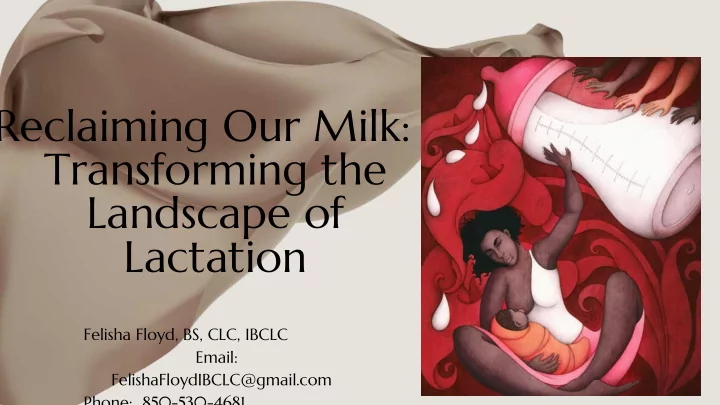
Reclaiming Our Milk: Transforming the Landscape of Lactation - - PowerPoint PPT Presentation
Reclaiming Our Milk: Transforming the Landscape of Lactation Felisha Floyd, BS, CLC, IBCLC Email: FelishaFloydIBCLC@gmail.com Phone: 850-530-4681 Objectives: Name two barriers which may hinder Black families from Breast/chest feeding.
Felisha Floyd, BS, CLC, IBCLC Email: FelishaFloydIBCLC@gmail.com Phone: 850-530-4681
Name two barriers which may hinder Black families from Breast/chest feeding. Describe systemic racism. Identify two tools/resouces to help towards achieving racial equity.
Stay engaged. Experience and discomfort that comes up as part of the learning process. Expect and accept non-closure. Assume best intentions, ask clarifying questions. Own and honor your own emotions. Listen for understanding.
Race is a social construct and is not biologically determined. Race is a fairly modern idea, meaning that ancient societies did not divide themselves by what we know understand to be “race”. Policy drives the social construction of race and has contributed to changing ideas and definitions of race over time. We did not choose this system but we have a responsibility to address it.
Structural Racism
Institutional Racism
Individual Racism
La Leche League International was formed in 1956. Breastfeeding rates in the US drop close to 20%; October 17, first meeting held at home of Mary White.
The Founding Mothers of LLLI were Mary Ann Cahill, Edwina Froehlich, Mary Ann Kerwin, Viola Lennon, Marian Tompson, Betty Wagner, and Mary White.
https://uslca.org/wp-content/uploads/2020/06/2019-Lactation-Care-Provider-Demographic- Survey.pdf
https://uslca.org/wp-content/uploads/2020/06/2019-Lactation-Care-Provider-Demographic- Survey.pdf
http://www.jpeds.com/article/S0022-3476(16)31096-4/abstract Sup optimal breastfeeding also impacts disparities to health outcomes for mother. Black mothers were 1.4xs higher risk of diabetes and hypertension.
Racism and implicit bias in healthcare. Experiences of institutionalized racism influenced breastfeeding initiation and duration. Structural level interventions are critical to close the gap of racial inequity in breastfeeding rates in the U.S. Black women’s labor participation rate of 60.2 percent is higher than the rate for all other
families, with 70.7 percent of Black mothers as sole breadwinners and 14.7 percent as co- breadwinners. Return to the workplace earlier than any other race.
The societal stigma of breastfeeding is heightened for Black people. Breastfeeding may be assoicated with lack of chocie due to historcal intergenerational trauma with forced wet nursing in slavery. Advocacy around breastfeeding has been primarily led by white, cis-gendered women, and consequently centered on issues specific to that group. The choice to breastfeed has been primarily available to upper-middle-class, cis-gendered white
Most importantly, the best way to change attitudes is to change behavior. Attitude change tends to follow behavior change. Requires both short and long-term approaches.
Blactavist Reaching Our Sisters Everywhere (ROSE) Black Mothers Breastfeeding Association (BMFA) Normalize Breastfeeding Blackmomsblog African American Breastfeeding Network Soulfood for your baby Black Women Do Breastfeed Uzazi Village