recommended book asymmetric public key encryption

Recommended Book ASYMMETRIC (PUBLIC-KEY) ENCRYPTION Steven Levy. - PowerPoint PPT Presentation

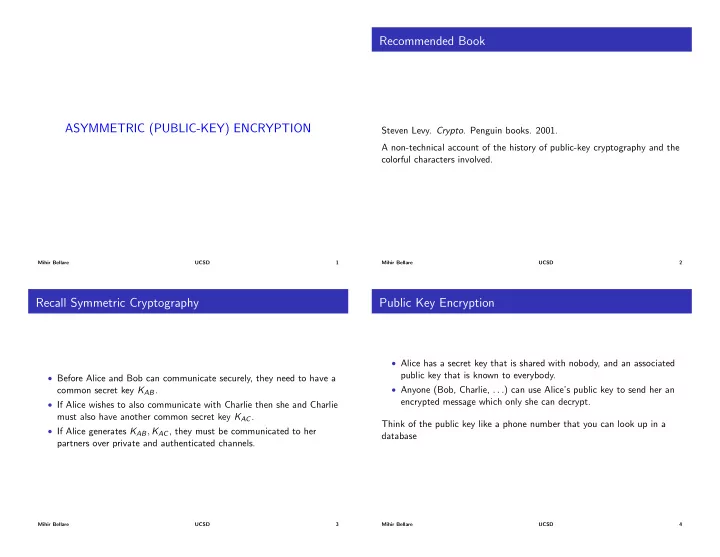
Recommended Book ASYMMETRIC (PUBLIC-KEY) ENCRYPTION Steven Levy. Crypto . Penguin books. 2001. A non-technical account of the history of public-key cryptography and the colorful characters involved. Mihir Bellare UCSD 1 Mihir Bellare UCSD 2


  1. Recommended Book ASYMMETRIC (PUBLIC-KEY) ENCRYPTION Steven Levy. Crypto . Penguin books. 2001. A non-technical account of the history of public-key cryptography and the colorful characters involved. Mihir Bellare UCSD 1 Mihir Bellare UCSD 2 Recall Symmetric Cryptography Public Key Encryption • Alice has a secret key that is shared with nobody, and an associated public key that is known to everybody. • Before Alice and Bob can communicate securely, they need to have a • Anyone (Bob, Charlie, . . . ) can use Alice’s public key to send her an common secret key K AB . encrypted message which only she can decrypt. • If Alice wishes to also communicate with Charlie then she and Charlie must also have another common secret key K AC . Think of the public key like a phone number that you can look up in a • If Alice generates K AB , K AC , they must be communicated to her database partners over private and authenticated channels. Mihir Bellare UCSD 3 Mihir Bellare UCSD 4

  2. Public Key Encryption Syntax of PKE A public-key (or asymmetric) encryption scheme AE = ( K , E , D ) consists of three algorithms, where • Alice has a secret key that is shared with nobody, and an associated pk K public key that is known to everybody. • Anyone (Bob, Charlie, . . . ) can use Alice’s public key to send her an encrypted message which only she can decrypt. sk Think of the public key like a phone number that you can look up in a database • Senders don’t need secrets M C C E D M or ? • There are no shared secrets A Mihir Bellare UCSD 5 Mihir Bellare UCSD 6 Correct decryption requirement How it works Step 1: Key generation Let AE = ( K , E , D ) be an asymmetric encryption scheme. The correct $ Alice locally computers ( pk , sk ) K and stores sk . decryption requirement is that Step 2: Alice enables any prospective sender to get pk . Pr[ D ( sk , E ( pk , M )) = M ] = 1 Step 3: The sender encrypts under pk and Alice decrypts under sk . for all ( pk , sk ) that may be output by K and all messages M in the We don’t require privacy of pk but we do require authenticity: the sender should be assured pk is really Alice’s key and not someone else’s. One message space of AE . The probability is over the random choices of E . could This simply says that decryption correctly reverses encryption to recover • Put public keys in a trusted but public “phone book”, say a the message that was encrypted. When we specify schemes, we indicate cryptographic DNS. what is the message space. • Use certificates as we will see later. Mihir Bellare UCSD 7 Mihir Bellare UCSD 8

  3. Security of PKE Schemes The games for IND-CPA Let AE = ( K , E , D ) be a PKE scheme and A an adversary. Game Left AE Game Right AE procedure Initialize procedure Initialize $ $ ( pk , sk ) K ; return pk ( pk , sk ) K ; return pk Same as for symmetric encryption, except for one new element: The procedure LR ( M 0 , M 1 ) procedure LR ( M 0 , M 1 ) adversary needs to be given the public key. $ $ Return C E pk ( M 0 ) Return C E pk ( M 1 ) We formalize IND-CPA accordingly. Associated to AE , A are the probabilities h i h i Left A Right A Pr AE ) 1 Pr AE ) 1 that A outputs 1 in each world. The ind-cpa advantage of A is h i h i Adv ind - cpa Right A Left A ( A ) = Pr AE ) 1 � Pr AE ) 1 AE Mihir Bellare UCSD 9 Mihir Bellare UCSD 10 IND-CPA: Explanations Building a PKE Scheme We would like security to result from the hardness of computing discrete logarithms. The “return pk ” statement in Initialize means the adversary A gets the Let the receiver’s public key be g where G = h g i is a cyclic group. Let’s public key pk as input. It does not get sk . let the encryption of x be g x . Then It can call LR with any equal-length messages M 0 , M 1 of its choice to get $ back an encryption C E pk ( M b ) of M b under sk , where b = 0 in game hard g x � � ! x Left AE and b = 1 in game Right AE . Notation indicates encryption |{z} E g ( x ) algorithm may be randomized. so to recover x , adversary must compute discrete logarithms, and we know A is not allowed to call LR with messages M 0 , M 1 of unequal length. Any it can’t, so are we done? such A is considered invalid and its advantage is undefined or 0. It outputs a bit, and wins if this bit equals b . Mihir Bellare UCSD 11 Mihir Bellare UCSD 12

  4. Building a PKE Scheme Key Encapsulation Mechanisms (KEMs) A KEM KEM = ( KK , EK , DK ) is a triple of algorithms We would like security to result from the hardness of computing discrete logarithms. pk KK Let the receiver’s public key be g where G = h g i is a cyclic group. Let’s let the encryption of x be g x . Then hard g x � � ! x sk |{z} E g ( x ) EK C a C a DK K so to recover x , adversary must compute discrete logarithms, and we know it can’t, so are we done? Problem: Legitimate receiver needs to compute discrete logarithm to K A decrypt too! But decryption needs to be feasible. Above, receiver has no secret key! K 2 { 0 , 1 } k is a key of some key length k associated to KEM Mihir Bellare UCSD 13 Mihir Bellare UCSD 14 KEM Security KEM IND-CPA security Let KEM = ( KK , EK , DK ) be a KEM with key length k , and A an adversary. Let KEM = ( KK , EK , DK ) be a KEM with key length k . Security requires that if we let Game Left KEM Game Right KEM $ ( K 1 , C a ) EK pk procedure Initialize procedure Initialize then K 1 should look “random”. Somewhat more precisely, if we also $ $ ( pk , sk ) KK ( pk , sk ) KK { 0 , 1 } k ; b $ $ generate K 0 { 0 , 1 } then return pk return pk procedure Enc procedure Enc { 0 , 1 } k ; ( K 1 , C a ) C a $ $ $ $ { 0 , 1 } k ; ( K 1 , C a ) K 0 EK pk K 0 EK pk A ? return ( K 0 , C a ) return ( K 1 , C a ) K b We allow only one call to Enc . The ind-cpa advantage of A is A has a hard time figuring out b h i h i Adv ind - cpa Right A Left A KEM ( A ) = Pr KEM ) 1 � Pr KEM ) 1 Mihir Bellare UCSD 15 Mihir Bellare UCSD 16

  5. Recall DH Secret Key Exchange The EG KEM: Idea The following are assumed to be public: A large prime p and a generator g of Z ⇤ p . We can turn DH key exchange into a KEM via Alice Bob • Let Alice have public key g x and secret key x Z p � 1 ; X g x mod p $ x • Bob picks y and sends g y to Alice as the ciphertext X � � � � � � ! • The key K is (a hash of) the shared DH key g xy = Y x = X y Z p � 1 ; Y g y mod p $ y Y � � � � � � The DH key is a group element. Hashing results in a key that is a string of K A Y x mod p K B X y mod p a desired length. • Y x = ( g y ) x = g xy = ( g x ) y = X y modulo p , so K A = K B • Adversary is faced with the CDH problem. Mihir Bellare UCSD 17 Mihir Bellare UCSD 18 The EG KEM: Specification From KEMs to PKE: Hybrid encryption Let G = h g i be a cyclic group of order m and H : { 0 , 1 } ⇤ ! { 0 , 1 } k a (public, keyless) hash function. Define KEM KEM = ( KK , EK , DK ) by Alg EK X Alg KK Alg DK x ( C a ) Given a KEM KEM = ( KK , EK , DK ) with key length k , we can build a Z m ; C a g y $ y $ Z C x x Z m a Z X y PKE scheme with the aid of a symmetric encryption scheme SE = ( KS , X g x K H ( C a k Z ) K H ( C a k Z ) ES , DS ) that also has key length k . Namely, define the PKE scheme AE return ( X , x ) return K return ( K , C a ) = ( KK , E , D ) via: Alg E pk ( M ) Alg D sk (( C a , C s )) $ y Z m x $ ( K , C a ) EK pk K DK sk ( C a ) $ M DS K ( C s ) C s ES K ( M ) g x C a = g y g xy g xy Return M Return ( C a , C s ) H H K K Mihir Bellare UCSD 19 Mihir Bellare UCSD 20

  6. Simplification: For PKE we can assume just one LR query Hybrid encryption works If the KEM and symmetric encryption scheme are both IND-CPA, then so is the PKE scheme constructed by hybrid encryption. In assessing IND-CPA security of a PKE scheme, we may assume A makes only one LR query. It can be shown that this can decrease its advantage Theorem: Let KEM KEM = ( KK , EK , DK ) and symmetric encryption by at most the number of LR queries. scheme SE = ( KS , ES , DS ) both have key length k , and let AE = ( KK , E , D ) be the corresponding PKE scheme built via hybrid encryption. Let A Theorem: Let AE be a PKE scheme and A an ind - cpa adversary making q be an adversary making 1 LR query. Then there are adversaries B a , B s LR queries. Then there is a ind - cpa adversary A 1 making 1 LR query such such that that Adv ind - cpa ( A )  q · Adv ind - cpa Adv ind - cpa ( A )  2 · Adv ind - cpa KEM ( B a ) + Adv ind - cpa ( A 1 ) ( B s ) . AE AE AE SE and the running time of A 1 is about that of A . Furthermore B a makes one Enc query, B s makes one LR query, and both have running time about the same as that of A . Mihir Bellare UCSD 21 Mihir Bellare UCSD 22 Benefits of hybrid encryption Proof of Theorem: Intuition Modular design and assurance via proof as above. $ $ $ { 0 , 1 } k ; ( K 1 , C a ) With b { 0 , 1 } ; K 0 EK pk Also speed . Game Challenge ciphertext Adversary goal Asymmetric cryptography is orders of magnitude slower than symmetric G 0 C a , ES K 1 ( M b ) Compute b cryptography. G 1 C a , ES K 0 ( M b ) Compute b An exponentiation in a 160-bit elliptic curve group costs about the same • A unlikely to win in G 1 because of security of symmetric scheme as 3000-4000 hashes or block cipher operations. • A is about as likely to win in G 1 as in G 0 due to KEM security So performance is improved by limiting the asymmetric operations as in hybrid encryption. Mihir Bellare UCSD 23 Mihir Bellare UCSD 24

Recommend


More recommend


Explore More Topics

Stay informed with curated content and fresh updates.