Recreational Beach Bacteria Modeling and Forecasting and the - - PowerPoint PPT Presentation

recreational beach bacteria modeling and forecasting and
SMART_READER_LITE
LIVE PREVIEW

Recreational Beach Bacteria Modeling and Forecasting and the - - PowerPoint PPT Presentation

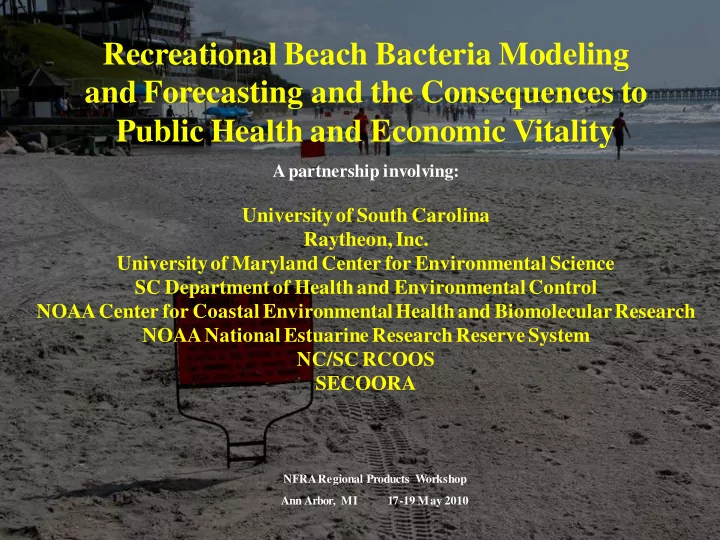
Recreational Beach Bacteria Modeling and Forecasting and the Consequences to Public Health and Economic Vitality A partnership involving: University of South Carolina Raytheon, Inc. University of Maryland Center for Environmental Science SC


slide-1
SLIDE 1

A partnership involving:

University of South Carolina Raytheon, Inc. University of Maryland Center for Environmental Science SC Department of Health and Environmental Control NOAA Center for Coastal Environmental Health and Biomolecular Research NOAA National Estuarine Research Reserve System NC/SC RCOOS SECOORA

NFRA Regional Products Workshop Ann Arbor, MI 17-19 May 2010

Recreational Beach Bacteria Modeling and Forecasting and the Consequences to Public Health and Economic Vitality

slide-2
SLIDE 2
  • Setting the stage
  • Water quality concerns
  • Implications of swimming advisories
  • Beach advisory modeling
  • Outcomes of integrative efforts

Outline:

NFRA Regional Products Workshop Ann Arbor, MI 17-19 May 2010

slide-3
SLIDE 3

Setting the stage

NFRA Regional Products Workshop Ann Arbor, MI 17-19 May 2010

  • State health agency

routinely (weekly, post rain event, repeat) samples water quality at ocean beaches

  • Results used to inform

public of potential health risk

Marissa Reilly, DHEC Region 7

In response to water quality concerns and associated public health concerns

slide-4
SLIDE 4

Setting the stage

NFRA Regional Products Workshop Ann Arbor, MI 17-19 May 2010

  • Enterococcus

– Direct measurement of pathogens is difficult and expensive – High Enterococcus counts = greater chance of human pathogens being present

  • 24-hr incubation
slide-5
SLIDE 5

Setting the stage

NFRA Regional Products Workshop Ann Arbor, MI 17-19 May 2010

Swimming advisories are issued if Enterococcus levels

  • >500 MPN/100mL

– Issue advisory

  • >104 MPN/100mL

– Resample

Today’s advisory is based on yesterday’s water quality

slide-6
SLIDE 6

Setting the stage

NFRA Regional Products Workshop Ann Arbor, MI 17-19 May 2010

Day 1 Bacteria Concentration (log) Day 2 Bacteria Concentration (log)

slide-7
SLIDE 7

Setting the stage

NFRA Regional Products Workshop Ann Arbor, MI 17-19 May 2010

Implications of swimming advisories

  • Error of commission
  • Issue advisory when water quality is good
  • Poor image / revenue loss (i.e. the Chamber of

Commerce is not happy)

  • Error of omission
  • Fail to issue advisory when water quality is poor
  • Public health risk
slide-8
SLIDE 8

Beach advisory modeling

NFRA Regional Products Workshop Ann Arbor, MI 17-19 May 2010

A potential improvement offered up to public health officials was that

  • Enterococcus concentrations can be

predicted with an accuracy adequate to assist decision-makers in the preemptive advisory process

slide-9
SLIDE 9

Beach advisory modeling

NFRA Regional Products Workshop Ann Arbor, MI 17-19 May 2010

Perceived bottlenecks preventing prediction or timely response to critical public health and environmental events:

  • Access and integrated use of distributed,

heterogeneous data

  • Insufficient density of appropriate data observations
  • Insufficient predictive model development
slide-10
SLIDE 10

Beach advisory modeling

NFRA Regional Products Workshop Ann Arbor, MI 17-19 May 2010

slide-11
SLIDE 11

Beach advisory modeling

NFRA Regional Products Workshop Ann Arbor, MI 17-19 May 2010

slide-12
SLIDE 12

NFRA Regional Products Workshop Ann Arbor, MI 17-19 May 2010

Beach advisory modeling

Parameter Source Bacteria density Monitoring Programs Air temperature Monitoring Programs / Observing Systems/ Remote Sensing Water temperature Monitoring Programs / Observing Systems/ Remote Sensing Salinity Monitoring Programs / Observing Systems Tide stage NOAA Weather conditions Weather Service/ Observing Systems/ Remote Sensing Wind direction Weather Service/ Observing Systems/ Remote Sensing Precipitation Weather Service/ Observing Systems/ Remote Sensing Solar radiation Observing Systems/ Remote Sensing River Flow River Forecasting Centers / USGS Soil Moisture Remote Sensing

slide-13
SLIDE 13

Modeling techniques used include

  • Multiple Linear Regression (MLR)
  • Classification and Regression Trees (CART)
  • Ensemble Models

NFRA Regional Products Workshop Ann Arbor, MI 17-19 May 2010

Beach advisory modeling

slide-14
SLIDE 14

NFRA Regional Products Workshop Ann Arbor, MI 17-19 May 2010

Beach advisory modeling

slide-15
SLIDE 15

Model complexity is dependent upon

Level 1 Level 2 Level 3

Cumulative Rainfall Rain Intensity Preceding Dry Days Weather Tidal Range Lunar Phase Station Cumulative Rainfall Rain Intensity Preceding Dry Days Weather Tidal Range Lunar Phase Station Wind Speed Wind Direction Cumulative Rainfall Rain Intensity Preceding Dry Days Weather Tidal Range Lunar Phase Station Wind Speed Wind Direction Current Salinity

NFRA Regional Products Workshop Ann Arbor, MI 17-19 May 2010

Beach advisory modeling

  • Location
  • Availability of data
  • Acceptable error
slide-16
SLIDE 16

Level 1

0% 10% 20% 30% 40% 50% 60%

NMB2 NMB3 MB1 MB2 MB3 MB4 SS GC

Percent Misclassification

Level 2

0% 10% 20% 30% 40% 50% 60%

NMB2 NMB3 MB1 MB2 MB3 MB4 SS GC

Percent Misclassification

Level 3

0% 10% 20% 30% 40% 50% 60%

NMB2 NMB3 MB1 MB2 MB3 MB4 SS GC

Percent Misclassification

Level 1

Model Validation

Level 2 Level 3

Beach advisory modeling

NFRA Regional Products Workshop Ann Arbor, MI 17-19 May 2010

Focusing on model validation and …

slide-17
SLIDE 17

Level 1

10 20 30 40 50 60 NMB2 NMB3 MB1 MB2 MB3 MB4 SS GC

Level 2

10 20 30 40 50 60 NMB2 NMB3 MB1 MB2 MB3 MB4 SS GC

Level 3

10 20 30 40 50 60 NMB2 NMB3 MB1 MB2 MB3 MB4 SS GC

% Type I Error (i.e. upsetting the Chamber of Commerce) % Type II Error (i.e. potential for increased health risks)

NFRA Regional Products Workshop Ann Arbor, MI 17-19 May 2010

Beach advisory modeling

Error assessment

slide-18
SLIDE 18
  • Models are now being used in support of

issuing beach advisories

  • Decreased decision error
  • Increased support from local government
  • Improved public health protection
  • One of first/few marine/Enterococcusmodels
  • One of first to use CART models

NFRA Regional Products Workshop Ann Arbor, MI 17-19 May 2010

Beach advisory modeling

slide-19
SLIDE 19

Outcomes of integrative efforts

  • Improving understanding of the role of technologies in

addressing priority environmental and public health issues

  • New observation infrastructure of additional real-time,

continuous observations

  • Improved knowledge of the data that exist to address

coastal zone management issues in the region

  • Rapid access to local data for managers, researchers, and

the public via the interactive website

____________________________________________________________________________________________________

  • Development of inter-agency “rapid response” efforts

addressing priority health and management issues

  • Improved coordination and communication among

diverse, complimentary group of coastal agencies and

  • rganizations supporting proactive efforts rather than

reactive response

NFRA Regional Products Workshop Ann Arbor, MI 17-19 May 2010

slide-20
SLIDE 20

Acknowledgements

  • USC – Madilyn Fletcher, Dwayne Porter, Dan Ramage,

Jay Poucher, Jeremy Cothran, Jeff Jefferson, James Hibbert, Virginia Shervette, Emily McDonald, Erica Johnson

  • Raytheon, Inc. – Carroll Hood
  • University of Maryland – Heath Kelsey
  • SCDHEC – Shannon Berry, Sean Torrens
  • UNCW – Lynn Leonard, Jen Dorton
  • Partners - NC/SC RCOOS, NI-WB NERR, NC NERR,

ACE Basin NERR, SECOORA

  • Funding: NOAA Geodetic Surveys and Services

NFRA Regional Products Workshop Ann Arbor, MI 17-19 May 2010

slide-21
SLIDE 21
slide-22
SLIDE 22
slide-23
SLIDE 23
slide-24
SLIDE 24
slide-25
SLIDE 25
slide-26
SLIDE 26
slide-27
SLIDE 27

GeoRSS

slide-28
SLIDE 28
slide-29
SLIDE 29
slide-30
SLIDE 30
slide-31
SLIDE 31
slide-32
SLIDE 32
slide-33
SLIDE 33
slide-34
SLIDE 34
slide-35
SLIDE 35

Marine Weather Portal

Jennifer Dorton, UNC Wilmington Dwayne Porter, Univ. of South Carolina Vembu Subramanian, Univ of South Florida Charlton Galvarino (??)

slide-36
SLIDE 36

MWP Project Goals

  • Provide 24/7 access to critical marine

information for the commercial & recreational marine communities.

  • Make NOAA data and other data provider

information more widely accessible on one website.

– With a consistent look and feel

  • Support NOAA’s Mission Goals of:

– Serving Society's Needs for Weather and Water Information – Supporting the Nation's Commerce with Information for Safe, Efficient, and Environmentally Sound Transportation.

slide-37
SLIDE 37

Carolinas Coast was a joint effort by NWS, CORMP & Caro- COOPS to consolidate

  • bserving data & NWS

products for the public.

slide-38
SLIDE 38
slide-39
SLIDE 39

2007 NOAA IOOS award allowed the project to expand from the Carolinas throughout the SE.

slide-40
SLIDE 40
slide-41
SLIDE 41

Data Acquired from:

  • NWS
  • NDBC Buoys and CMAN stations

– R-COOS stations – Federal & state agencies

  • NOS

– Water level stations – PORTS – Tide Predictions

  • NCEP – Storm Prediction Center & Tropical

Prediction Center

slide-42
SLIDE 42

Data Acquired from:

  • OPC and National Hurricane Center (offshore

waters forecasts)

  • National Estuarine Research Reserves
  • USGS – stream gauge station
  • USACE – Field Research Facility stations
  • MADIS Ship Observations
slide-43
SLIDE 43

MWP Technology

slide-44
SLIDE 44

General Architecture

  • Servers at USC and USF

– Collect data – Collect hazards – Create maps – Package information as HTML and PNG

  • Webfarm at NWS HQ

– Pulls packaged information from USC and USF – Serves the data & maps as webpages to the public

USC NWS HQ Webfarm USF

slide-45
SLIDE 45

Data Crunching at USC & USF

  • Meteorological and ocean observations

– Collect data from federal providers

  • NDBC : web scraping (includes RA’s and other OOSes)
  • NWS : Perl module (web scraping)
  • USGS : web scraping
  • NOS : SOAP services

– Store in a database (PostgreSQL / PostGIS)

  • Hazard & warnings

– Collect from several places (screen scraping) – Rue the days of teletypes!

GMZ270-275-012300- /O.EXT.KCRP.SC.Y.0022.000000T0000Z-090301T2300Z/ WATERS BAFFIN BAY TO PORT ARANSAS 20 TO 60 NM- WATERS PORT ARANSAS TO MATAGORDA SHIP CHANNEL 20 TO 60 NM- 309 PM CST SUN MAR 1 2009 ...SMALL CRAFT ADVISORY NOW IN EFFECT UNTIL 5 PM CST THIS AFTERNOON...

slide-46
SLIDE 46

More Data Crunching at USC & USF

  • Fetch and decode GRIB forecast products (sea surface

temperature, winds, air pressure).

  • Fetch offshore text forecasts.
  • Visualize many maps at many scales in many regions.
  • Create observation HTML ‘stub’ tables of in-situ

measurements.

slide-47
SLIDE 47

What’s Under the Hood

  • Data storage

– PostgreSQL database – PostGIS spatial engine

  • Visualization

– UMN MapServer – U Hawaii GMT, ImageMagick, Gnuplot – Google Maps (in the works)

  • Data exchange protocols

– WMS – KML – HTML

slide-48
SLIDE 48

What Works

  • Having fixed views: areas and scales.
  • Precache everything. And serve the bare

minimum only on demand.

  • Having a limited number of paths to retrieving
  • bservation, model, and forecast data.
  • Leaving the web load pressure to NWS HQ.
  • Having redundancy between USF and USC.
  • Interfacing with other NWS products (point

forecast).

  • Having a group of committed users and WFO

staff.

slide-49
SLIDE 49

What Could Be Better

  • Hazard/warning fetching and parsing

isn’t foolproof

  • The addition of new areas and
  • bservations requires finesse
  • There needs to be a content

management system in place for WFO’s to manage their own portlet

  • User experience.
slide-50
SLIDE 50

What Is in the Works

  • Keep up with the Joneses: migrate the

interface toward Google Maps for better or worse.

  • Move toward virtualization and packaging.
  • Further geographic expansion: breaking

down geographic and linguistic boundaries.

  • Enabling portal-like deployments for other

NOAA NWS regions

slide-51
SLIDE 51

Acknowledgements

  • NOAA IOOS

– NA07NOS4730220

  • University Partners:

– USC, USF, UNCW

  • Second Creek Consulting
  • NOAA NWS

– Office of the Chief Information Officer – Southern Region & Eastern Region – NWS Weather Forecast Offices in NC, SC, FL, AL, MS, LA & TX