SLIDE 1
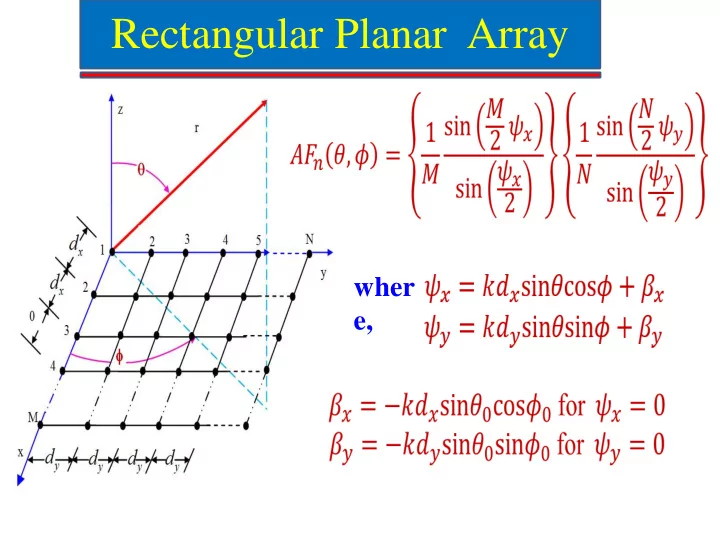
Rectangular Planar Array
wher e,
SLIDE 2
Rectangular Planar Array
where k = 2π/λ
The principal maximum(m = n = 0) and grating lobes can be located by:
an d m = 0, 1, 2,…. n = 0, 1, 2,….
SLIDE 3
Radiation Pattern of 5x5 Planar Array
SLIDE 4
Directivity of Planar Array
Directivity of Rectangular Array For Broadside Array: Directivity of Circular Array
SLIDE 5 Example: Calculate the array factor of a 7-elements hexagonal array (2 elements in first and third rows, 3 elements in the second row).
Group 2- 2x2 array Group 1- 3x1 array λ/2 λ/2
Hexagonal Array – 7 Elements
x y
Total Array Factor = Array Factor of (Group 1 + Group 2)
SLIDE 6
Array factor of Group 2: M = 2, N = 2 Array factor of Group 2: M = 3, N = 1
AF of Hexagonal Array – 7 Elements
Total Array Factor = AF1 + AF2
SLIDE 7 Example: Calculate the array factor of a 19-elements hexagonal array (3 elements in first and fifth rows, 4 elements in the second and fourth rows and 5 in the third row) Total Array Factor = Array Factor of (Group 1 + Group 2 + Group 3)
Hexagonal Array – 19 Elements
Group 3- 3x2 array Group 1- 5x1 array Group 2- 4x2 array λ/2 λ/2 x y
SLIDE 8
Array Factor of Group 1: M=5, N=1 Array Factor of Group 2: M=4, N=2
AF of Hexagonal Array – 19 Elements
SLIDE 9
Array Factor of Group 3: M=3, N=2
AF of Hexagonal Array – 19 Elements (Contd.)
Total Array Factor:
SLIDE 10
Circular Vs Hexagonal Array
Planar Circular Array Planar Hexagonal Array
SLIDE 11 Microstrip Antennas
Electrical Engineering Department, IIT Bombay
gkumar@ee.iitb.ac.in (022) 2576 7436
SLIDE 12 Rectangular Microstrip Antenna (RMSA)
Co-axial feed Side View r Ground plane h Top View L W X Y x
SLIDE 13
Microwave Integrated Circuits (MIC) vs MSA
Parameters MIC MSA Dielectric Constant (εr) Large Small Thickness (h) Small Large Width (W) Generally Small (impedance dependent) Generally Large Radiation Minimum (small fringing fields) Maximum (large fringing fields) Examples Filters, power dividers, couplers, amplifiers, etc. Antennas
SLIDE 14
Substrates for MSA
Substrate Dielectric Constant (εr) Loss tangent (tanδ) Cost Alumina 9.8 0.001 Very High Glass Epoxy 4.4 0.02 Low Duroid / Arlon 2.2 0.0009 Very High Foam 1.05 0.0001 Low/ Medium Air 1 NA
SLIDE 15 Advantages
- Light weight, low volume, low profile, planar
configuration, which can be made conformal
- Low fabrication cost and ease of mass production
- Linear and circular polarizations are possible
- Dual frequency antennas can be easily realized
- Feed lines and matching network can be easily
integrated with antenna structure
SLIDE 16 Disadvantages
- Narrow bandwidth (1 to 5%)
- Low power handling capacity
- Practical limitation on Gain (around 30 dB)
- Poor isolation between the feed and
radiating elements
- Excitation of surface waves
- Tolerance problem requires good quality
substrate, which are expensive
- Polarization purity is difficult to achieve
SLIDE 17 Applications
- Pagers and mobile phones
- Doppler and other radars
- Satellite communication
- Radio altimeter
- Command guidance and telemetry in
missiles
- Feed elements in complex antennas
- Satellite navigation receiver
- Biomedical radiator
SLIDE 18
Various Microstrip Antenna Shapes
SLIDE 19
MSA Feeding Techniques
SLIDE 20
Coaxial Feed
SLIDE 21
Microstrip Line Feed
SLIDE 22
Microstrip Feed (contd.)
SLIDE 23
Electromagnetically Coupled Feed
SLIDE 24
Aperture Coupled Feed
SLIDE 25 RMSA: Resonance Frequency
where m and n are orthogonal modes of excitation.
Fundamental mode is TM10 mode, where m =1 and n = 0.
L Le W We ~ x
SLIDE 26
RMSA – Characterization
SLIDE 27
RMSA: Design Equations
Smaller or larger W can be taken than the W obtained from this expression.
BW α W and Gain α W Choose feed-point x between L/6 to L/4.
SLIDE 28
RMSA: Design Example
Design a RMSA for Wi-Fi application (2.400 to 2.483 GHz)
Chose Substrate: εr = 2.32, h = 0.16 cm and tan δ = 0.001
= 3 x 10¹⁰ / ( 2 x 2.4415 x 109 x √1.66) = 4.77 cm. W = 4.7 cm is taken = 2.23 Le = 3 x 10¹⁰ / ( 2 x 2.4415 x 109 x √2.23) cm = 4.11 cm L = Le – 2 ∆L = 4.11 – 2 x 0.16 / √2.23 = 3.9 cm
SLIDE 29
RMSA: Design Example – Simulation using IE3D
L = 3.9 cm, W = 4.7 cm, x = 0.7 cm εr = 2.32, h = 0.16 cm and tan δ = 0.001 Zin = 54Ω at f = 2.414 GHz BW for |S11| < -10 dB is from 2.395 to 2.435 GHz = 40 MHz
Designed f = 2.4415 and Simulated f = 2.414 GHz % error = 1.1%. Also, BW is small.
SOLUTION: Increase h and reduce L