
SLIDE 1
Refactoring
REF-
Good design vs. Over design
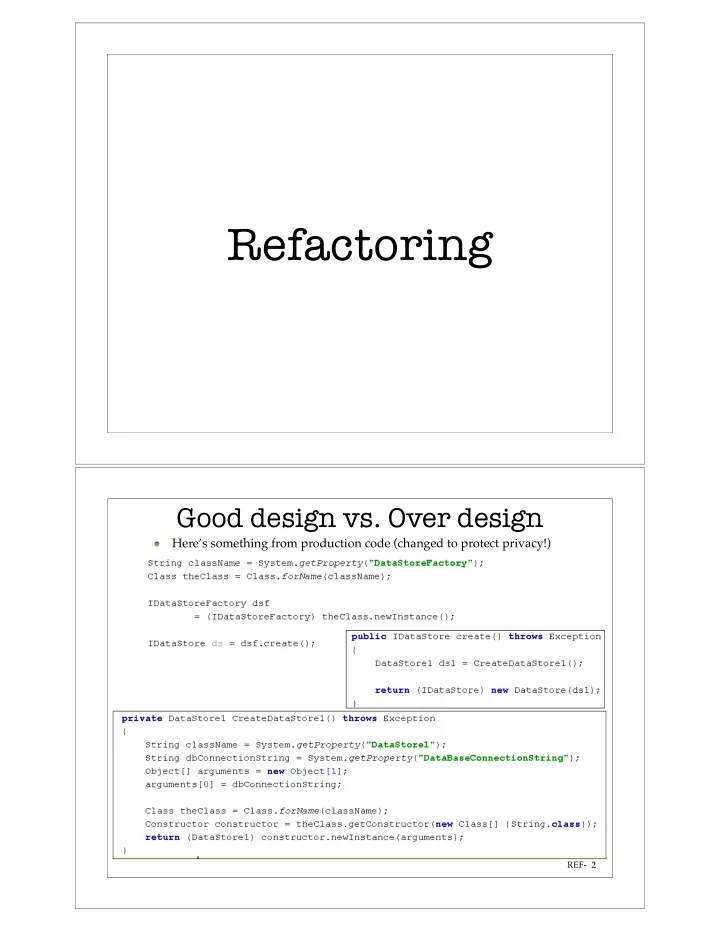
Here’s something from production code (changed to protect privacy!)
2
Refactoring Good design vs. Over design Heres something from - - PDF document
Refactoring Good design vs. Over design Heres something from production code (changed to protect privacy!) REF- 2 Do you see the smell in that code? Not quite obvious at first sight May make sense if extensibility is needed But, there
REF-
Here’s something from production code (changed to protect privacy!)
2
REF-
Not quite obvious at first sight May make sense if extensibility is needed But, there were exactly one implementation of each interface (one factory, one data source, etc). How about the following:
3 REF-
Let’s start with an example Here is code that works What do you think about it?
4
REF-
William Zinsser Wrote “On Writing Well” 25 years ago! He gives good principles for writing well These principles apply to programming as much as writing non-fiction Simplicity Clarity Brevity Humanity
5 REF-
6
REF-
7 REF-
“Design, rather than occurring all up-front, occurs continuously during development.” If the code is hard to understand, it is hard to Maintain improve Work with for evolutionary design
8
REF-
“Art of improving the design of existing code” “A process of changing a software system in such a way that it does not alter the external behavior of the code yet improves its internal structure”
9 REF-
Why fix what’s not broken? A software module Should function its expected functionality It exists for this It must be affordable to change It will have to change over time, so it better be cost effective Must be easier to understand Developers unfamiliar with it must be able to read and understand it
10
REF-
You are adding new functionality Fixing bugs Making new design enhancements Throwing away the ?#$*! code and rewriting Making too many changes all at once
11 REF-
Anytime we touch code, we may break things (inadvertently)
You don’t want one step forward and ten steps backward
Before you refactor, make sure you have solid automated self-checking unit tests for your code Approach refactoring in small steps so it is easy to find bugs or mistakes you introduce
12
REF-
Cohesion Encapsulation Don’t Repeat Yourself (DRY) Tell Don’t Ask (TDA)
13 REF-
Some of the techniques, you will find, are quite
Sometimes the wisdom tells you to go right, sometimes it tells you to go left You need to decide which is the right approach when
14
REF-
"Smell check" your code! Duplication Unnecessary complexity Useless or misleading comments Long classes Long methods Poor names for variables, methods, classes Code that’s not used Improper use of inheritance …
15 REF-
Let’s deodorize my code!
16
REF-
Several refactoring techniques exist You modify the code any time you think it will lead to Clarity Simplicity Better understanding
17 REF-
Long methods are problem
Lack cohesion Too complex
Refactoring techniques
Extract Method Inline Method Replace Temp with a Query Introduce Explaining Variable Replace Method with Method object Substitute Algorithm
18
REF-
Where does this method go?
Often it is the (victim) class that's visible in the IDE? Hard to get it right the first time
Refactoring techniques
Move Method Move Field Extract Class Inline Class Hide Delegate Remove Middle Man Introduce Foreign Method Introduce Local Extension 19 REF-
Many more refactoring techniques than we can cover here Refer to Martin Fowler’s celebrated book in references
20
REF-
To
Anytime you can cleanup the code To make it readable, understandable, simpler You are convinced about the change Before adding a feature or fixing a bug After adding a feature or fixing a bug
Not to
Not for the sake of refactoring When the change will affect too many things When change may render application unusable In the middle of adding a feature or fixing a bug When you don’t have unit tests to support your change 21