Reference XPath leashed, Michael Benedikt and Christoph Koch, TR, - - PDF document

reference
SMART_READER_LITE
LIVE PREVIEW

Reference XPath leashed, Michael Benedikt and Christoph Koch, TR, - - PDF document

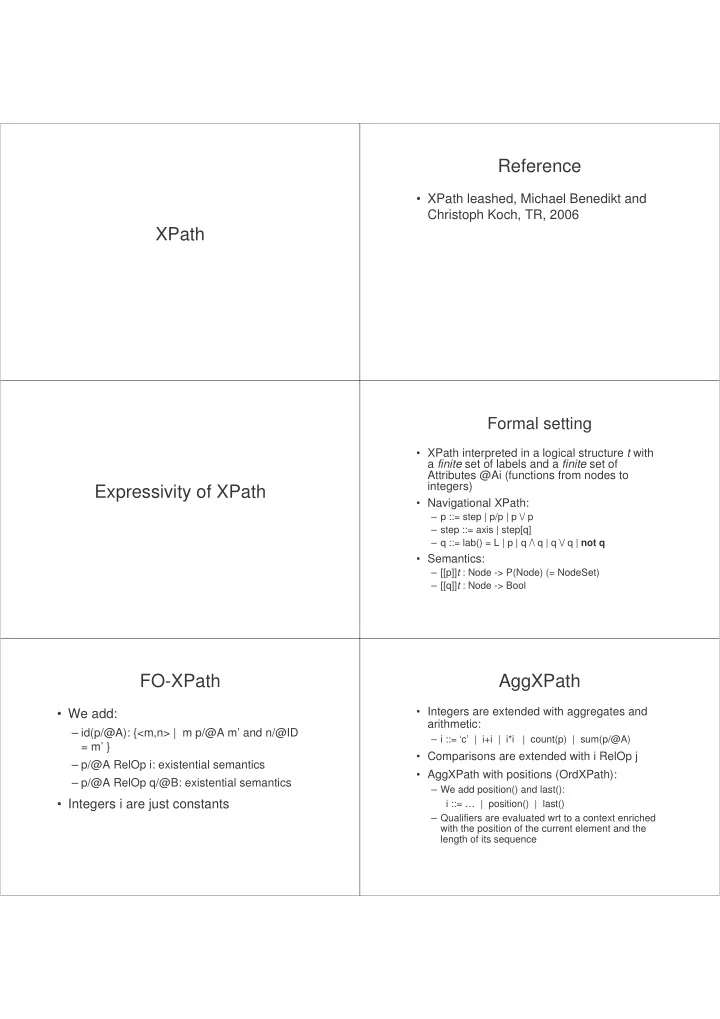
Reference XPath leashed, Michael Benedikt and Christoph Koch, TR, 2006 XPath Formal setting XPath interpreted in a logical structure t with a finite set of labels and a finite set of Attributes @Ai (functions from nodes to integers)


slide-1
SLIDE 1

XPath Reference

  • XPath leashed, Michael Benedikt and

Christoph Koch, TR, 2006

Expressivity of XPath

Formal setting

  • XPath interpreted in a logical structure t with

a finite set of labels and a finite set of Attributes @Ai (functions from nodes to integers)

  • Navigational XPath:

– p ::= step | p/p | p \/ p – step ::= axis | step[q] – q ::= lab() = L | p | q /\ q | q \/ q | not q

  • Semantics:

– [[p]]t : Node -> P(Node) (= NodeSet) – [[q]]t : Node -> Bool

FO-XPath

  • We add:

– id(p/@A): {<m,n> | m p/@A m’ and n/@ID = m’ } – p/@A RelOp i: existential semantics – p/@A RelOp q/@B: existential semantics

  • Integers i are just constants

AggXPath

  • Integers are extended with aggregates and

arithmetic:

– i ::= ‘c’ | i+i | i*i | count(p) | sum(p/@A)

  • Comparisons are extended with i RelOp j
  • AggXPath with positions (OrdXPath):

– We add position() and last(): i ::= … | position() | last() – Qualifiers are evaluated wrt to a context enriched with the position of the current element and the length of its sequence

slide-2
SLIDE 2

Restrictions:

  • P-X-XPath: no negation or disequality
  • Conjunctive query: positive, no

disjunction, no union

Expressiveness

  • NavXPath can be translated in linear

time as FO over Lab_L, R_axis where axis in: child, next-sibl, desc, foll-sibl:

(x,y) in book[title]/author: z,w. child(x,z) /\ Lab_book(z) /\ child(z,w) /\ <title>(w) /\ child(z,y) /\ <author>(y) (x,y) in parent::(book)/child::author:

  • z. child(z,x) /\ <book>(z) /\ child(z,y) /\

<author>(y)

NavXPath vs. FO

  • FO is more expressive:

– Exists a subsequence C-B*-C?

  • NavXPath = FO2 :

– qualifiers in NavXPath corresponds to FO2 (2-variables FO) with one free variable – NavXPath paths have a linear normal form

NavXPath and FO2

  • XPNF:

– z2 . . . zn−1. 1(z1) /\ 1(z1, z2) /\ 2(z2) /\ . . . /\ n−1(zn−1, zn) /\ n(zn) – i are FO2 formulas, and the i-1(zi−1, zi) are unions of binary atomic formulas over predicates from child, next-sibl, desc, foll-sibl

  • Theorem:

– NavXPath filters correspond to FO2 formulas – NavXPath relations correspond to expressions in XPNF

  • Key observation: any boolean combination of

steps, equality, inequality can be reduced to a union of steps

Proof

  • Key case: translate y (x, y), where is in

FO2 into qualifiers

  • Bring in DNF; every disjunct contains some

binary axes (including equality), maybe negated, and two unary FO2 formulas

  • Since axes are mutually exclusive, we can

assume that every disjunct is just:

– i(x) /\ Ri (x, y) /\ i(y)

  • Which becomes

– self[T(i)]/i[T(i)]

Closure of NavXPath

  • NavXPath includes union
  • NavXPath is closed under intersection:

– A NavXPath query is conjunctive – Conjunctive queries are intersection-closed – Conjunctive queries over trees can be transformed into unions of acyclic conjunctive queries – These can be expressed by NavXPath

slide-3
SLIDE 3

Closure of NavXPath

  • NavXPath predicates are closed under

complement

  • NavXPath relations are not closed under

complement

  • Proof sketch:

– with complement we can express Until (actually, all of FO) – NavXPath cannot express Until

  • A until B (where /\ and not are relational):

– desc[lab = B] /\ not(desc[lab != A]/desc)

NavXPath and tree patterns

  • Tree patterns: node- and edge-labeled

trees

  • Edges are labeled with forward axes
  • Nodes are labeled with either L or *
  • Boolean TP: one context node
  • Unary TP: context node + selected

node

Matching a tree pattern

  • Boolean: a homomorphism from the

pattern to the tree, that maps the context into the node

  • Unary: context is mapped into the first

node, selected into the second

  • Finite set of TPs: take the union of the

results

TPs and NavXPath

  • The following are equally expressive:

– P-NavXPath binary queries – Sets of unary patterns – Exists+ FO with child, next-sibl, desc, following- sibl

  • (1) and (2) into (3) is immediate
  • TP to XPath: every edge is a step
  • FO to TP: form the formula graph, then

remove the cycles (non trivial!)

From Ex+ FO to TP

  • Ex+ FO is the same as

union of (cyclic) conjunctive queries:

– y.desc(x,y), desc(x,z), following(y,z)

  • Every cycle can be

rewritten out

desc desc following x y z desc foll-sibl x y z d-o-s d-o-s

Some rules

  • d-o-s(x,z),d-o-s(y,z) ->

– d-o-s(x,z),d-o-s(y,x) \/ d-o-s(x,y),d-o-s(y,z) – Same for foll-sibl

  • child(x,z),d-o-s(y,z) ->

– (child(x, z) /\ y = z) \/ (child(x, z) /\ d-o-s(y, x)) – Same for next-sibl / foll-sibl

  • next-sibl(x,z),d-o-s(y,z)

– (next-sibl(x,z) /\ y = z) \/ (next-sibl(x, z) /\ desc(y, x)) – Same for NS+, NS*

slide-4
SLIDE 4

TP, Ex+, and P-NavXPath

  • From the previous theorem, a couple of

nice corollaries about P-NavXPath:

– Using EX-+: P-NavXPath is closed under …? – Using TP: only forward axes are needed for positive root-queries (Olteanu et al 2002)

Extending XPath to FO

  • Add path complement
  • Add Until

Back to FO-XPath

  • We add:

– id(p/@A): i nodi n tali che n/@ID = p/@A – i RelOp i – p/@A RelOp i: existential semantics – p/@A RelOp q/@B: existential semantics

  • Easy to translate in FO with the obvious

signature (Ai-Comp-Aj(x,y) + trans- navigation)

  • Is FO-XPath complete for FO?

Weakness of FO-XPath

  • Navigational query: does not depend on

attributes, but just on the tree structure

  • FO-XPath expresses the same

navigational queries as NavXPath

Back to Agg-XPath

  • Integers are extended with aggregates and

arithmetic:

– i ::= ‘c’ | i+i | i*i | count(p) | sum(p/@A)

  • Count can express Until
  • Hence: FO complete
  • Until(E2,E1) (where desc is not reflexive):

– desc[E2] and count(desc[not E1]/desc[E2]) != count(desc[E2])

Complexity of evaluation

slide-5
SLIDE 5

Complexity: reminder

  • Some classes I may name, and their

relationship

– LOGSPACE ⊆ PTIME ⊆ PSPACE ⊆ EXPTIME – LOGSPACE ⊆ NLOGSPACE ⊆ P(TIME) ⊆ NP(TIME) ⊆ PSPACE ⊆ EXPTIME – P ⊆ co-NP ⊆ PSPACE

  • Non-elementary: not bounded by

2^(2^…(2^n))

Data complexity and combined complexity

  • Assume that the evaluation of a query Q
  • n a structure T costs: O(|T|^|Q|)
  • How bad is that?

– Data complexity: it is in PTime: O(|T|^n) – Query complexity: ExpTime: O(n^|Q|) – Combined complexity: ExpTime: O(|In|^|In|)

  • MSO: data is linear, query is PSpace

Data complexity of XPath

  • Unary NavXPath has linear data

complexity

– Proof: boolean MSO is linear on trees

  • MSO does not help much with

combined complexity:

– MSO over trees is PSpace-complete for combined complexity

Combined complexity

  • NavXPath is PTime-hard
  • Full XPath 1.0 is in O(|Data|^5 *

|Query|^2)

Satisfiability

  • FO over trees is decidable, but is non-elementary
  • Satisfiability for NavXPath and for unnested

NavXPath is ExpTime complete:

– Reduction to Deterministic Propositional Dynamic Logic with Converse shows that NavXPath is in ExpTime (Marx – EDBT 04) – Hardness follows by hardness of containmens (Neven- Schwentick – ICDT 03) – An O(2^n) algorithm has been recently described, based on translation on mu-calculus with converse

  • Satisfiability for NavXPath with intersection is

NExpTime complete

– Etessami Vardi Wilke: FO2 can encode Unary Temporal Logic

XPath fragments

  • P-NavXPath: no negation, and = is the only relation
  • Benedikt – Fan – Geerte (PODS05:

– PNavXPath with downard axes: every expression is satisfiable – If we add upward, or sibling, or a DTD: NP-complete – P-FOXPath is still NP-complete

  • However (Geerts-Fan, DBPL05):

– Sat for FOXPath is undecidable

  • Reduction from halting of two-register machines
  • Borders of decidability are not well understood