Region 8 CLUIN Webinar November 26, 2018 Effectiveness of - - PowerPoint PPT Presentation

region 8 cluin webinar november 26 2018
SMART_READER_LITE
LIVE PREVIEW

Region 8 CLUIN Webinar November 26, 2018 Effectiveness of - - PowerPoint PPT Presentation

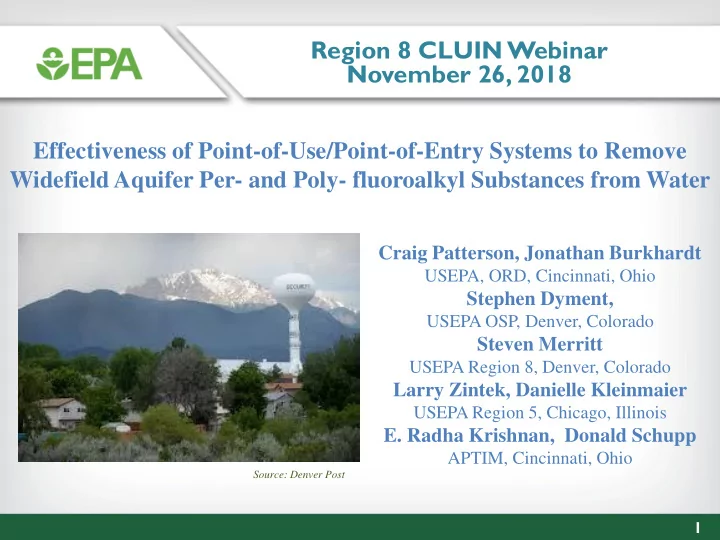
Region 8 CLUIN Webinar November 26, 2018 Effectiveness of Point-of-Use/Point-of-Entry Systems to Remove Widefield Aquifer Per- and Poly- fluoroalkyl Substances from Water Craig Patterson, Jonathan Burkhardt USEPA, ORD, Cincinnati, Ohio Stephen


slide-1
SLIDE 1

Craig Patterson, Jonathan Burkhardt

USEPA, ORD, Cincinnati, Ohio

Stephen Dyment,

USEPA OSP, Denver, Colorado

Steven Merritt

USEPA Region 8, Denver, Colorado

Larry Zintek, Danielle Kleinmaier

USEPA Region 5, Chicago, Illinois

  • E. Radha Krishnan, Donald Schupp

APTIM, Cincinnati, Ohio

1

Effectiveness of Point-of-Use/Point-of-Entry Systems to Remove Widefield Aquifer Per- and Poly- fluoroalkyl Substances from Water

Source: Denver Post

Region 8 CLUIN Webinar November 26, 2018

slide-2
SLIDE 2

Extent of PFAS Contamination

2

Source: Esri, HERE, Garmin, NGA, USGS, NPS Source: KRDO.com

slide-3
SLIDE 3

PFAS Contaminants

3

Unregulated Contaminant Monitoring Rule 3 (UCMR3) PFAS detected in the Widefield Aquifer:

  • Perfluorooctanoic Acid (PFOA)
  • Perfluorooctane Sulfonate (PFOS)
  • Perfluoroheptanoic Acid (PFHpA)
  • Perfluorobutane Sulfonate (PFBS)
  • Perfluorononanoic Acid (PFNA)
  • Perfluorohexane Sulfonic Acid

(PFHxS).

Aqueous Film Forming Foam (AFFF) was used to fight fires at Peterson Air Force Base. As of August of 2016, a new product Phos-Chek 3 with shorter chain molecules is now being used.

U.S. Air National Guard photo by Airman 1st Class Amber Powell

Potential health impacts: Cancer, liver, thyroid, pancreatic, kidney and fertility problems

slide-4
SLIDE 4

Response Actions and Alternative Water Sources

4

Source: Colorado Springs Gazette

  • Surface water is being blended from Pueblo Reservoir to

meet the PFOA/PFOS health advisory and PCE maximum contaminant levels (MCLs).

  • Bottled water stations and water coolers provide alternative

drinking water sources to residents living in the Widefield Aquifer region.

slide-5
SLIDE 5

Project Goal

5

To assess the removal effectiveness of target Per- and Poly- fluoroalkyl Substances (PFAS) using commercially available Point-of-Use (POU) and Point-of-Entry (POE) Reverse Osmosis (RO) treatment units and Granular Activated Carbon (GAC) adsorption systems for homes with private wells in Colorado’s Widefield Aquifer. To meet this goal, the project purchased commercially available household water systems and conducted treatability studies on representative test waters. Point-of-Use (POU) Kitchen sink, end-of-faucet, and pour-thru devices Point-of-Entry (POE) Whole House; typically installed in a hot water tank room or a heated garage

slide-6
SLIDE 6

R8 RARE Project Objectives

6

The project also documented:

  • Ease of use during installation,

startup, continuous and intermittent

  • peration based on manufacturer

instructions.

  • Operation and maintenance

schedules for replacement of RO units and GAC media based on manufacturer instructions and the representative test water quality.

Source: H2O Distributors

slide-7
SLIDE 7

NSF Standard P473

7

NSF Standard P473 for Drinking Water Treatment Units - PFOA and PFOS is a test method for point-of-use carbon-based and reverse osmosis treatment systems to determine their ability to reduce perfluorooctanoic acid (PFOA) and perfluorooctane sulfonate (PFOS) to below the EPA Healthy Advisory Level of 70 parts per trillion. Water treatment systems, including water filters, must verify that:

  • Contaminant reduction claims for PFOA and PFOS shown on the label are true
  • The system does not add anything harmful to the water
  • The system is structurally sound
  • The product labeling, advertising and literature are not misleading

NSF Std P473 Individual influent sample point limits Average influent challenge Maximum effluent concentration μg/L μg/L μg/L PFOS and PFOA 1.5 ± 30% 1.5 ± 10%, added as 1.0 μg/L PFOS and 0.5 μg/L PFOA 0.07

slide-8
SLIDE 8

Widefield Aquifer PFAS

8

Maximum Widefield Aquifer PFAS Concentrations (ng/L) Sample Dates PFBS PFHxS PFNA PFHpA PFOA PFOS PFOS+ PFOA 2013-2016 260 970 150 200 200 1600 1800 Average Widefield Aquifer PFAS Concentrations (ng/L) Sample Dates PFBS PFHxS PFNA PFHpA PFOA PFOS PFOS+ PFOA 2013-2016 71 203 16 24 43 137 180 Source: Colorado Department of Public Health and Environment website.

slide-9
SLIDE 9

T est Water Target PFAS Composition

9

CAS Number PFAS Compounds Carbon Chain Length Target Concentration 375-95-1 Perfluorononanoic Acid (PFNA) C9 200 ng/L 335-67-1 Perfluorooctanoic Acid (PFOA) C8 *800 ng/L 1763-23-1 Perfluorooctane Sulfonate (PFOS) C8 1,600 ng/L 375-85-9 Perfluoroheptanoic Acid (PFHpA) C7 200 ng/L 3871-99-6 Perfluorohexane Sulfonate (PFHxS) C6 1,000 ng/L 375-73-5 Perfluorobutane Sulfonate (PFBS) C4 300 ng/L *To align with the NSF P473 specified 2:1 PFOS:PFOA ratio, the PFOA feed concentration was increased from 200 ng/L to 800 ng/L.

slide-10
SLIDE 10

Widefield Aquifer WQ (1992-2016)

10

BDL= BELOW DETECTABLE LIMIT MCL = MAXIMUM CONTAMINANT LEVEL MSL = MAXIMUM SUGGESTED LEVEL NLE = NO LIMITS ESTABLISHED

PARAMETER MCL MAX VALUE UNITS PARAMETER MCL MAX VALUE UNITS 2,4,-D 0.07 0.10 mg/L MAGNESIUM MSL = 125 mg/L 18 mg/L ALKALINITY TOTAL NLE 220 mg/L as CaCO3 MANGANESE MSL = 0.05 mg/L BDL mg/L ANTIMONY 0.006 0.00 mg/L MERCURY 0.002 0.000 mg/L ARSENIC 0.01 0.06 mg/L MOLYBDENUM NLE BDL mg/L BARIUM 2 0.90 mg/L N_NITRATE / NITRITE 10.0 mg/L 7 mg/L BERYLLIUM 0.004 0.000 mg/L NICKEL NLE 0.01 mg/L CADMIUM 0.005 0.000 mg/L NITRATE 10 9.8 mg/L CALCIUM NLE 170 mg/L as CaCO3 NITRITE 1 BDL mg/L CHLORIDE MSL = 250 MG/L 23 mg/L PCE (TETRACHLOROETHYLENE) 0.005 0.033 mg/L CHROMIUM (TOTAL) 0.1 0.08 mg/L PENTACHLOROPHENOL 0.001 0.040 mg/L COLOR (TRUE, APPARENT) MSL=15 Color Units <5.0 pt/Co Units pH 6.5-8.5 6.25 to 8.17 s.u. CONDUCTIVITY NLE 470 uhm/Cm PHOSPHATE, PHOSPHORUS NLE 0.07 mg p/H COPPER Action Level=1.3 mg/L 25 mg/L SELENIUM 0.05 0.01 mg/L CYANIDE 0.2 0.000 mg/L SODIUM NLE 57 mg/L DI(2- ETHYLHEXYL)PHTHALATE 0.006 0.0025 mg/L TOTAL DISSOLVED SOLIDS (TDS) MSL = 500 mg/L 490 mg/L EPICHLOROHYDRIN NLE 3.1 mg/L SPECIFIC CONDUCTIVITY NLE 470 umhos FLUORIDE 4.0 2.6 mg/L SULFATE MSL=250 mg/L 116.00 mg/L GROSS ALPHA 15 14 pCi/L TEMPERATURE NSF P473 20 ± 3 °C 13 to 15

  • deg. C

HARDNESS CALCIUM NLE 230 mg/L THALLIUM 0.002 0.000 mg/L HARDNESS TOTAL NLE 290 mg/L as CaCO3 TOTAL ORGANIC CARBON (TOC) NLE 1.19 mg/L IRON MSL = 0.3 mg/L BDL mg/L TOTAL SOLIDS NLE 433 mg/L LANGLIER INDEX NLE

  • 0.34 to -0.5

TURBIDITY 1 NTU <0 NTU LEAD Action Level=0.015 0.012 mg/L ZINC MSL = 5.0 mg/L BDL mg/L
slide-11
SLIDE 11

T est Water Target Water Quality Characteristics

11

General Chemistry Water Parameters Temperature (°C) RO: 25 ± 1°C, GAC: 20 ± 2.5°C pH (pH Units) 8.2 ± 0.5 Turbidity (NTU) <1 NTU Free chlorine (mg/L) <0.2 mg/L TOC (mg/L) RO: not specified (not adjusted) GAC: >1 mg/L (added as dehydrated NOM) TDS (mg/L) RO and GAC: 500 mg/L (added as NaCl) Hardness (mg/L) RO: 300 mg/L CaCO3 (added as potassium chloride [KCl], magnesium sulfate [MgSO4], sodium bicarbonate [NaHCO3] and calcium sulfate [CaSO4·2H2O]), GAC: not specified.

slide-12
SLIDE 12

Sample Collection, Handling and Preservation

12 Analyte Lab Container Preservation Holding Time Per-and poly-fluoroalkyl substances (PFAS) R5 15 mL Polypropylene Container Cool <6°C 28 days Temperature blank R5 One 40 mL Vial Cool <6°C Measure temperature upon receipt Total Organic Carbon (TOC) T&E 100 mL Amber Glass Cool <6°C, No headspace H3PO4, pH<2; 28 days Total Dissolved Solids (TDS) T&E 1 L HDPE Amber Cool <6°C 7 days Turbidity T&E 100 mL HDPE or glass jar

  • r beaker

Cool <6°C 48 hours Hardness T&E 250 mL HDPE or glass jar pH <2, HNO3 6 months Free Chlorine T&E 40-50 mL / Glass beaker None Analyze Immediately pH T&E 40-50 mL / Glass beaker None Analyze Immediately Temperature T&E 40-50 mL / Glass beaker None Analyze Immediately

slide-13
SLIDE 13

PFAS in Feed Water

13

GAC PFAS Target Stability Test GAC Test 1 GAC Test 2 PFOA (ng/L) 800 870-1150 926-1030 859-1070 PFOS (ng/L) 1600 139-288 1670-2740 1500-5210 PFHpA (ng/L) 200 240-296 277-332 267-287 PFBS (ng/L) 300 Non-Detect 360-405 347-379 PFHxS (ng/L) 1000 974-1180 999-1140 1020-1120 PFNA (ng/L) 200 208-304 245-310 231-448 RO PFAS Target Stability Test RO Test 1 RO Test 2 RO Test 3 PFOA (ng/L) 800 899-967 878-1080 799-2580 800-1030 PFOS (ng/L) 1600 130-163 1370-2680 1100-6770 1290-2920 PFHpA (ng/L) 200 233-277 330-384 315-470 240-271 PFBS (ng/L) 300 Non-Detect 316-380 361-382 333-362 PFHxS (ng/L) 1000 889-1070 964-1150 844-1930 927-1130 PFNA (ng/L) 200 207-242 219-381 192-967 192-199 5000 Gallon Mix Tank 55 Gallon Drum

slide-14
SLIDE 14

WQ Results Summary

14

RO Test WQ Parameters Target Stability Test RO Test 1 RO Test 2 RO Test 3 pH (s.u) 7.7-8.7 8.54-8.64 8.44-8.61 8.34-8.58 8.48-8.61 Temperature (°C) 24-26°C 24.9-29.1°C 22.0-23.1°C 21.8-23.1°C 22.0-24.4°C TDS (mg/L) 500 mg/L 523-549 mg/L 514-576 mg/L 507-540 mg/L 446-456 mg/L HARDNESS (mg/L) 300 mg/L 263-296 mg/L 285-323 mg/L 277-300 mg/L 240-298 mg/L GAC Test WQ Parameters Target Stability Test GAC Test 1 GAC Test 2 pH (s.u) 7.7-8.7 8.56-8.63 8.58-8.61 8.61-8.68 Temperature (°C) 17.5-22.5°C 20.9-26.5°C 20.7-22.3°C 19.6-20.3°C FAC (mg/L) < 0.2 mg/L 0.01 mg/L 0.02 mg/L 0.01 mg/L TDS (mg/L) 500 mg/L 528-563 mg/L 466-466 mg/L 471-471 mg/L TOC (mg/L) > 1.0 mg/L 1.41-1.54 mg/L 2.35-2.52 mg/L 2.37-2.55 mg/L

slide-15
SLIDE 15

Reverse Osmosis Systems

15

POU/POE treatment tests on three RO systems (500-1000 gal/day):

  • iSpring RCS5T (0.35 gpm)
  • Hydrologic Evolution (0.7 gpm)
  • Flexeon LP-700 (0.5 gpm)

iSpring Hydrologic Sample Collection Flexeon

slide-16
SLIDE 16

Summary of RO System Specifications

16

A Pressure and efficiency depend on the temperature and pressure of the feed water.

RO system iSpring RCS5T HydroLogic Evolution RO1000 Flexeon LP-700 Rated CapacityA 500 GPD (0.35 gpm) 1,000 GPD (0.7 gpm) 700 GPD (0.5 gpm) Filters Included Sediment filter Carbon pre-filter Sediment filter Carbon pre-filter 2 RO membranes Carbon pre-filter CTO filter 2 RO membranes RO membrane Carbon post-filter Carbon post-filter System RecoveryA 50% 50%, using 1:1 fitting 38% Booster Pump Yes No No Connections 3/8” Inlet ½” Inlet 3/8” Inlet and Outlet ¼” Outlet 3/8” Outlet (tubing not included) (tubing included) (tubing included) Self-Supporting Yes Yes No Size (L x W x H) 8.5” x 15” x 18.5” 20.5” x 11” x 10” 18” x 10.5” x 32” Weight 31 lbs 16 lbs 38 lbs

slide-17
SLIDE 17

RO System Replacement Filters and Membranes

17

RO system iSpring RCS5T HydroLogic Evolution RO1000 Flexeon LP-700 Sediment filter #FP15 (3-6 months) Not Part of System #200627 (12 months) Carbon pre-filter #FG15 (6 months) #22043 (2,000 gallons of purified water) #200658 (12 months) Carbon block filter #FC15 (6 months) Not Part of System Not Part of System RO membranes #MS5 (24 months) #220445 (6 – 24 months) #208802 (24 months) (requires 2) (requires 2) Carbon post- filter #FT15 (12 months) Not Part of System #200658 (12 months)

slide-18
SLIDE 18

Reverse Osmosis T est Unit

18

Rotameter with Valve (1-3 L/min) Heat Chiller 5000 Exchanger Gallon Tank RO Test Unit Clean Recirculation (Sample) Pump Reject to Drain Sample Port to Drain Sample Ports – Influent from 5000 gallon tank line and Effluent from RO permeate line.

slide-19
SLIDE 19

RO System Sampling Plan

19

* No samples collected

Day # Day of Week Time of Day Sample Hour Time of Day Sample Hour Time of Day Sample Hour Day 1 Tues AM Startup* Noon 4 hr PM 8 hr Day 2 Wed AM 24 hr Noon 30 hr PM 36 hr Day 3 Thurs AM 48 hr Noon 54 hr PM 60 hr Day 4 Fri AM 72 hr Noon 78 hr PM 84 hr Day 5 Sat 2 Day Stagnation Period* Day 6 Sun Day 7 Mon AM 144 hr PM 148 hr PM Shutdown* Day 8 Tues Ship

slide-20
SLIDE 20

20

All effluent PFAS results were non-detect

PFAS Removal vs. Time iSpring RO#1

slide-21
SLIDE 21

21

PFAS Removal vs. Time Hydrologic RO#2

6 of 42 PFAS results were greater than non-detect

slide-22
SLIDE 22

22

RO T est 2 PFAS Results > Non-Detect

PFC Time (hr) Influent Conc. (ng/L) Effluent Conc. (ng/L) Removal Efficiency (%) PFOS 8 1100 22 98.0 PFOS* 144 1360 77 94.3 PFOA* 144 799 21 97.3 PFHxS 144 844 11 98.7 PFNA 144 210 49 76.7 PFOS 148 1330 20 98.5

* Exceeded the 70 ng/L PFOS+PFOA EPA Health Advisory Level

slide-23
SLIDE 23

23

All effluent PFAS results were non-detect

PFAS Removal vs. Time Flexeon RO#3

slide-24
SLIDE 24

24

1/8" or 1/4" SS Tubing To sink (depending on pump fittings) Carbon column 0 - 200 psi 3/8" x 6" 55-gallon SS tubing Stainless Steel 0.28125" ID Drum Pressure To sink Gear Relief Pump Valve (200 psi)

M PI

GAC T est Unit

Rapid Small Scale Column Test (RSSCT)

Sample Ports – Influent from 55 gallon drum, Effluent from SS tubing every 30 min for 8 hrs.

slide-25
SLIDE 25

25

GAC Characteristics and RSSCT Design Parameters

Parameter Test 1 Test 2 GAC Evoqua 1230CX Calgon Filtrasorb 600 AR+ Source Coconut Bituminous Coal Density 0.45 g/cm3 0.62 g/cm3 Porosity 0.47 0.39 Mesh Size 12 x 30 12 x 40 EBCTLC 10 min 10 min dp,LC 1.150 mm 1.063 mm dp,SC 0.0825 mm 0.0825 mm Scaling Factor 194.3 165.9 QSC 10 mL/min 10 mL/min VSC 0.515 mL 0.603 mL MSC 0.2294 g 0.3742 g

slide-26
SLIDE 26

GAC RSSCT Media

26

Commercially available GAC media tested:

  • Evoqua 12x30 Mesh

RSSCT 170x200 Mesh

  • Calgon 12x40 Mesh

RSSCT 170x200 Mesh

Grinding and Sieving GAC to meet RSSCT Mesh Screen Sizes GAC

slide-27
SLIDE 27

27

Maximum PFAS Concentrations vs. Time Evoqua GAC#1

slide-28
SLIDE 28

28

Maximum PFAS Concentrations vs. Time Calgon GAC#2

slide-29
SLIDE 29

Modeling of GAC Results

29

  • To investigate the impact of PFAS influent concentrations on GAC

(bed volumes to breakthrough at 70 ng/L PFOS+PFOA), the AdDesignS™ model (Michigan Tech. Univ., v1.0, 1999) was used to predict GAC lifetime based on average PFOA (43 ng/L) and PFOS (137 ng/L) concentrations based on historic records (2013–2016) found in Widefield Aquifer region water samples.

  • The PFOS+PFOA concentration in the influent was approximately

3,000 ng/L for the worst-case scenario and 180 ng/L for the average day (a 16-17x reduction). For the maximum day, the model predicted an exceedance of the PFOS+PFOA Health Advisory Level (HAL) of 70 ng/L after approximately 3,400 bed volumes for Evoqua GAC#1 and approximately 2,700 bed volumes for Calgon GAC#2, which is consistent with the experimental values.

slide-30
SLIDE 30

30

Average PFAS Conc. vs. Bed Volumes Evoqua GAC#1

Model results of PFOS and PFOA effluent concentrations

  • Predicted Max. PFOS+PFOA >

HAL of 70 ng/L after 3,400 BVs (24 days of operation)

  • Predicted Avg. PFOS+PFOA >

HAL of 70 ng/L after 115,000 BVs (2.2 years of operation)

slide-31
SLIDE 31

31

Average PFAS Conc. vs. Bed Volumes Calgon GAC#2

Model results of PFOS and PFOA effluent concentrations

  • Predicted Max. PFOS+PFOA >

HAL of 70 ng/L after 2,700 BVs (19 days of operation)

  • Predicted Avg. PFOS+PFOA >

HAL of 70 ng/L after 79,000 BVs (1.5 years of operation)

slide-32
SLIDE 32

25” 28” $360 64#

RO Modification for Point-of-Entry Use

32

6’2” 31” $280 67# 225 Gallons

$2000 before installation, Weight: 150 lbs Requires at least a 4’x4’ Room. May require a re- mineralization cartridge.

Requires Electricity for Well, RO Booster and Water Storage Tank Pumps RO = $500 RO Booster Pump = $880

slide-33
SLIDE 33

Typical Household GAC System

33

Typical 4-5 GPM Non-Backwashing Whole House Carbon Filter with 5 and 1 micron pleated sediment cartridges (Source: H2O Distributors)

slide-34
SLIDE 34

Large Whole House Carbon Tanks Required for PFAS Removal (10 min EBCT each)

34

Two Large Whole House Backwashing Carbon Water Filter ($3990) 65”(H) x 16”(D) tank with 240 lbs (8 cu ft) of GAC (Source: H2O Distributors) One 4-5 GPM Non-Backwashing Whole House Carbon Water Filter ($539) 35”(H) x 9”(D) tank with 30 lbs (1 cu ft) of GAC (Source: H2O Distributors)

62#

165# 165#

slide-35
SLIDE 35

GAC Modification for PFAS Removal

35

5’5” 16” 16” $1995 165# 30 Gallons

$4000 before installation, Weight: 330 lbs

$1995 165# 30 Gallons

Well Water Flow must be restricted to 5 gpm

slide-36
SLIDE 36

25” 28” $360 64#

Small GAC System for PFAS Removal

36

6’2” 31” $280 67# 225 Gallons

$1200 before installation, Weight: 200 lbs

35” $540 62# 9”

Requires at least a 4’x4’ Room

*Requires more frequent GAC replacement

Well Water Flow must be restricted to 0.5 gpm*

slide-37
SLIDE 37

Comparison of Household GAC and RO System Alternatives

37

Large GAC Adsorption System Small GAC Adsorption System RO System High capital and high maintenance costs Moderate capital and high maintenance costs Moderate capital and maintenance costs Large footprint and heavy components Large footprint and awkward components Large footprint and awkward components Higher flow rate (4-5 gpm). No water storage tank required Lower flow rate (0.5 gpm) requires water storage tank Lower flow rate (0.3-0.7 gpm) requires water storage tank Requires backwash wastewater lines and periodic carbon replacement Fewer connections, but requires more frequent carbon replacement Requires high system pressure, reject wastewater lines and periodic membrane replacement

slide-38
SLIDE 38

38

GAC Adsorption System RO System Issues with logistical, cost and safety

  • f carbon replacement

Issues with sanitizing components and replacing cartridges & tubing Cold water temperature less affected in flow through carbon tanks Residents may complain about “cold” water at room temperature in water storage tank May not be effective on short-chain PFAS Treats both long- and short- chain PFAS System could experience contaminant breakthrough if the carbon change-out schedule is not followed. Less likely to have contaminant breakthrough even if scheduled maintenance is not performed. Corrosion control in household plumbing may be an issue for point-of-entry water treatment.

Comparison of Household GAC and RO Systems

slide-39
SLIDE 39

Conclusions

39

  • The three RO systems tested successfully removed PFAS from

the influent water to below analytical detection for a majority

  • f the sampling events. However, long-term performance of

the membrane systems was not tested.

  • RSSCT data estimated that the coal-based Calgon F-600 GAC

would have a lifetime of 20 days compared to the coconut- based Evoqua GAC lifetime of 33 days based on maximum PFAS concentrations tested before exceeding the EPA’s HAL

  • f 70 ng/L for PFOS and PFOA.
  • Modeling the results for lower concentrations (average daily

concentrations) gave bed lives of 1.5 years for the Calgon F- 600 GAC and 2.2 years for the Evoqua Coconut carbon. However, additional pilot-tests should be performed to ensure the use of the best performing GAC for each application.

slide-40
SLIDE 40

Conclusions

40

  • If properly designed based on the source water

characteristics, POU/POE water systems can provide relatively inexpensive treatment barriers for PFAS removal in the home.

  • Analysis of PFAS samples is costly for homeowners and

can be a major hurdle in effective removal of PFAS from household water supplies.

  • Proper operation and maintenance and conservative

replacement of POU/POE components and media may be

  • ne way to circumvent the high cost of monitoring treated

household drinking water.

slide-41
SLIDE 41

The U.S. Environmental Protection Agency, through its Office of Research and Development, funded and managed, or partially funded or collaborated in, the research describe herein. It has been subjected to the Agency’s peer and administrative review and has been approved for external publication. Any opinions expressed in this paper are those of the author (s) and do not necessarily reflect the views of the Agency, therefore, no official endorsement should be inferred. Any mention of trade names or commercial products does not constitute endorsement or recommendation for use.

Disclaimer

41

slide-42
SLIDE 42

Office of Research and Development National Risk Management Research Laboratory – Water Supply and Water Resources Division

Photo image area measures 2” H x 6.93” W and can be masked by a collage strip of one, two or three images. The photo image area is located 3.19” from left and 3.81” from top of page. Each image used in collage should be reduced or cropped to a maximum of 2” high, stroked with a 1.5 pt white frame and positioned edge-to-edge with accompanying images.

Questions?

Patterson.Craig@epa.gov