Regional Integration of Public Transit - From the Perspective of a - - PowerPoint PPT Presentation

regional integration of public transit from the
SMART_READER_LITE
LIVE PREVIEW

Regional Integration of Public Transit - From the Perspective of a - - PowerPoint PPT Presentation

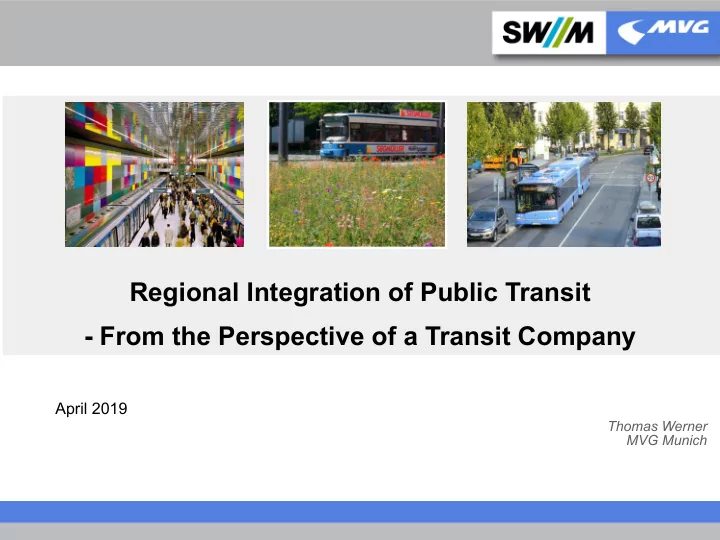
Regional Integration of Public Transit - From the Perspective of a Transit Company April 2019 Thomas Werner MVG Munich Facts about Munich Capital of the State of Bavaria Population: City ca. 1.5 million Greater Munich area: 3 million

slide-1
SLIDE 1

Regional Integration of Public Transit

  • From the Perspective of a Transit Company

Thomas Werner MVG Munich

April 2019

slide-2
SLIDE 2

Facts about Munich

§ Capital of the State of Bavaria § Population: City ca. 1.5 million § Greater Munich area: 3 million § Munich Metropolitain Area over 5 million § In the city almost 1 million jobs § Area: 310 km² (City) § Density: 5,000 inhabitants/km²

2

slide-3
SLIDE 3

1858: Population 137,000 Munich is the growing capital of the kingdom of Bavaria – limited by walking.

Transport as Key Factor for Munich‘s City Development

3

1908: Population 600,000 Munich can grow, because of the tram (electric operation since 1895)

slide-4
SLIDE 4

1940/1950: City Population 800,000 The car as new challenge.

Quick recovery after the war: Karlsplatz has heaviest traffic in all of Europe

Transport as Key Factor for Munich‘s City Development

4

1960s: Population 1,000,000 Decisions for urban underground system and suburban rail systems

slide-5
SLIDE 5

1971: Founding of MVV Verkehrsverbund (Founded by Munich‘s public transit department and German Railroad – represented by the Mayor of Munich and the Federal Minister for Railroads), regional buses operated by federal railroad and German Post Service were integrated Biggest obstacle: financing and distribution of farebox revenue First section of U-Bahn (municipal subway) starts operation

Transport as Key Factor for Munich‘s City Development

5

slide-6
SLIDE 6

1972, Olympic Games in Munich: Common Tariff gets into effect Suburban S-Bahn-system starts operation Principle: One network, one ticket, one time table In following years integration of private bus companies and bus lines

  • f surrounding counties

Transport as Key Factor for Munich‘s City Development

6

slide-7
SLIDE 7

Today: Population 1,550,000 – Growths 1970-2000 mainly in the suburbs, since 2000 strong growth (+20%) in city itself

Transport as Key Factor for Munich‘s City Development

7

slide-8
SLIDE 8

1950: Greater Munich Area, population around 1 million inhabitants (City 800,000, Surrounding area 200,000

  • 47,000 cars
  • Suburban Rail: 30

million passengers

  • Tram: 200 million

passengers

Transport as Key Factor for Munich‘s City Development

8

Today: Greater Munich – population 3 million (1.5 million within city, 1.5 million within surrounding area)

  • 1,400,000 cars
  • Suburban Rail: 250 million passengers per year
  • Tram: 120 million passengers
  • Metro: 410 million passengers
  • Bus: 210 million passengers (City)
  • Regional/suburban bus: 60 million passengers
slide-9
SLIDE 9
  • Munich City: 1 million jobs on 1.5 million

inhabitants

  • 45% of jobs occupied by commuters

Suburban Area (commuter rail) Munich

9

slide-10
SLIDE 10

City: Mobility without cars = 68 % (MVG research)

Mobility in Munich – Mostly Without Cars

10

MVV Area (total): 54% mobility without cars Suburban Area (only): 42% mobility without cars

slide-11
SLIDE 11

Owner: Municipal Enterprise, part of Stadtwerke/City Works Munich (electricity, water, gas and public transit) Responsible for: Metro, bus and tram, including network planning, building and timetable planning (except underground lines – planned and built by the municipality, handed over after construction to MVG) Number of Lines: 8 Metro, 13 Tram, 75 Bus Employees: 3,900 Annual Ridership: Metro 410 million, Tram 120 million, Bus 210 million Network: Metro: 95 km, Tram: 82 km, Bus: 505 km

Who is Who in Munich‘s Public Transit?

MVG: Münchner Verkehrsgesellschaft / Munich‘s Municipal Transit Company

11

slide-12
SLIDE 12

Owner: Deutsche Bahn AG / German national railroad Responsible for: S-Bahn (rapid rail commuter system connecting Munich with the region) Number of Lines: 10 Employees: 1,000 Annual Ridership: 250 million Network: 442 km

Who is Who in Munich‘s Public Transit?

S-Bahn München

12

slide-13
SLIDE 13

Owner: City of Munich, districts and communities around Munich, State of Bavaria Responsible for: Unified tariff, cooperation between transit companies, transit planning for region around Munich 710 million passengers yearly in service area (population 3 million) Service Area 5.530 square kilometers Average trip length: 10 km

Who is Who in Munich‘s Public Transit?

Münchner Verkehrs-und Tarifverbund (MVV):

13

slide-14
SLIDE 14

14

Who is Who in Munich‘s Public Transit?

Institutions involved in public transport within MVV area:

Federal government: provides money for regional rail transit to state government, State has own company to

  • rganize, finance and plan

regional rail transit and makes contracts with railroad companies City government: owns municipal transit company, municipal transit company provides subway, city bus and tram (costs covered by farebox revenue) Suburban Counties/districts: Finance suburban bus and define guidelines for planning, MVV plans suburban bus lines and makes contracts with different bus companies

slide-15
SLIDE 15

Public transit should be: ØFast ØReliable ØGoing where you want to go - and when you want to go ØComfortable ØEasy to use

When is public transit an alternative to the car?

Reasons for the Succes of Public Transit

15

slide-16
SLIDE 16

Integrated Rapid Rail System

Reasons for the Succes

16

Annual passengers overall in MVV-area doubled since 1972 (complete linked trips counted) Population within MVV rose from 2.1 million (1972) to 3 million (today) : +40 percent Passengers of suburban bus lines tripled within 20 years to 57 milion per year Commuter rail (S-Bahn) passenger growth in percent since 1972 till today 350% (from daily 240,000 to 840,000 now) (Passengers one year before integration in MVV: 160,000 daily)

slide-17
SLIDE 17

One ticket can be used for: Suburban Rapid Rail, Metro, bus and tram

  • Easy transfer between the systems
  • Most riders use monthly passes
  • Ticket machines in all city buses and trams
  • Boarding at all doors of city buses

One Ticket, One Tariff, One Timetable for All

Reasons for the Succes

17

slide-18
SLIDE 18
  • Metro in operation until 1:30 AM, on the weekend till 2:30 AM
  • Frequency of trains up to every 2 minutes during peak hours
  • Tram and bus network: 24 hours, day and night
  • Public transit stops always in walking distance

Frequent Service 24 hours a day

Reasons for the Succes

18

slide-19
SLIDE 19

S-Bahn / Suburban Rail: (Owner German National Railroad) Responsible for: rapid rail commuter system connecting Munich with its region, within 40 km around Munich Annual Ridership: 250 Million Network: 442 km

Direct Access from the Region to the Heart of Munich

…into the central tunnel …up into the pedestrian area From the region... every 10 to 20 minutes…

Reasons for the Succes

19

slide-20
SLIDE 20

20

Challenges

Integration of additional counties and cities to match changed commuter patterns and longer commuter distances

slide-21
SLIDE 21

21

Challenges

Second central tunnel under construction to expand capacity and integrate larger commuter area into S-Bahn-system (commuter rail)

slide-22
SLIDE 22

22

58 Verkehrsverbünde in Germany (population 82 million) First founded as HVV in Hamburg (1965) 70% of the area with 85% of population are covered by Verkehrsverbünde Financial aspects: In Germany 76% cost coverage of public transport In MVV-area over 80% by farebox revenue MVG (municipal) 100% of operational costs (tram, subway, city bus) covered by farebox revenue

Proposed expansion to South Bavarian Verkehrsverbund

slide-23
SLIDE 23

23

Challenges

The future of yesterday -1970ies:

(In the past, the future used to be better, too) Self driving electric cars Personal Rapid Transit/ Cabintaxi (Service on Demand) Hyperloop

Source: German children book from 1973

City of Hagen, Germany:

  • perating tram system (55 km length) was closed in 1976

in favor of projected PRT system (above: test track in Hagen 1972-1978)

slide-24
SLIDE 24

24

Thank you for your attention! Today are the good old days of the future…