Regular languages and CF grammars From lecture 7: S S 1 | S 2 - - PowerPoint PPT Presentation

regular languages and cf grammars
SMART_READER_LITE
LIVE PREVIEW

Regular languages and CF grammars From lecture 7: S S 1 | S 2 - - PowerPoint PPT Presentation

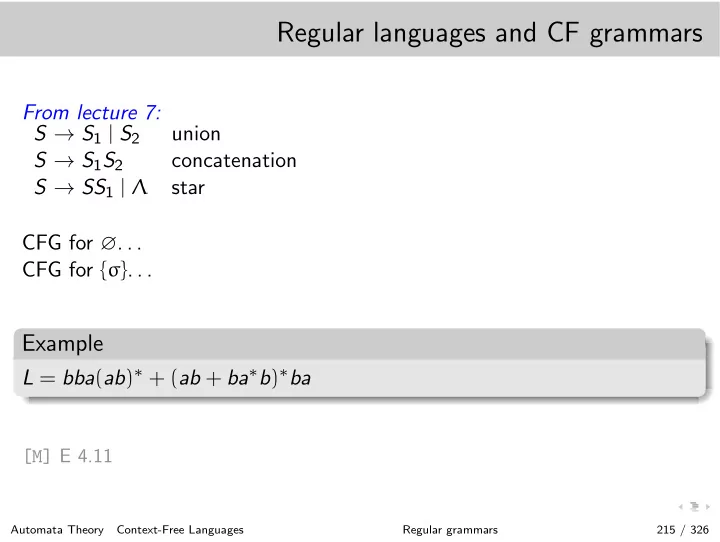
Regular languages and CF grammars From lecture 7: S S 1 | S 2 union S S 1 S 2 concatenation S SS 1 | star CFG for . . . CFG for { } . . . Example L = bba ( ab ) + ( ab + ba b ) ba [M] E 4.11 Automata Theory


slide-1
SLIDE 1

Regular languages and CF grammars

From lecture 7: S → S1 | S2 union S → S1S2 concatenation S → SS1 | Λ star CFG for ∅. . . CFG for {σ}. . .

Example

L = bba(ab)∗ + (ab + ba∗b)∗ba

[M] E 4.11

Automata Theory Context-Free Languages Regular grammars 215 / 326

slide-2
SLIDE 2

Regular languages and CF grammars

S → S1 | S2 union S → S1S2 concatenation S → SS1 | Λ star

Example

L = bba(ab)∗ + (ab + ba∗b)∗ba S → S1 | S2 S1 → S1ab | bba S2 → TS2 | ba T → ab | bUb U → aU | Λ

[M] E 4.11

Automata Theory Context-Free Languages Regular grammars 216 / 326

slide-3
SLIDE 3

above We have seen constructions to apply the regular operations (union, concatenation and star) to context-free grammars. These we can now use to build CFG for regular expressions. There is a better way to build CFG for regular languages. Use finite automata, and simulate these using a very simple type of context-free

  • grammar. These simple grammars are called regular.
slide-4
SLIDE 4

Regular languages and CF grammars

systematic approach

Example

S A B a b a b b a

Automata Theory Context-Free Languages Regular grammars 217 / 326

slide-5
SLIDE 5

Regular languages and CF grammars

systematic approach

Example

S A B a b a b b a axiom S initial state S → bA | aS transitions A → bA | aB B → bA | aS B → Λ accepting state

Automata Theory Context-Free Languages Regular grammars 218 / 326

slide-6
SLIDE 6

Definition

regular grammar (or right-linear grammar) productions are of the form – A → σB variables A, B, terminal σ – A → Λ variable A

Theorem

A language L is regular, if and only if there is a regular grammar generating L.

  • Proof. . .

[M] Def 4.13, Thm 4.14

Automata Theory Context-Free Languages Regular grammars 219 / 326

slide-7
SLIDE 7

Leftmost derivation

Definition

A derivation in a context-free grammar is a leftmost derivation, if at each step, a production is applied to the leftmost variable-occurrence in the current string. A rightmost derivation is defined similarly.

[M] D 4.16

derivation step α = α1Aα2 ⇒G α1γα2 = β for A → γ ∈ P The derivation step is leftmost iff α1 ∈ Σ∗ We write α

⇒ β

Automata Theory Context-Free Languages Regular grammars 220 / 326

slide-8
SLIDE 8

Expressions

S → a | S + S | S ∗ S | (S) Σ = {a, +, ∗, (, )} S ⇒ S+S ⇒ S+(S) ⇒ S+(S∗S) ⇒ S+(a∗S) ⇒ a + (a ∗ S) ⇒ a + (a ∗ a) Derivation tree. . .

[M] E 4.2, Fig 4.15

Automata Theory Context-Free Languages Expression, ambiguity 221 / 326

slide-9
SLIDE 9

Expressions

S S + S a ( S ) S * S a a S → a | S + S | S ∗ S | (S) Σ = {a, +, ∗, (, )} S ⇒ S+S ⇒ S+(S) ⇒ S+(S∗S) ⇒ S+(a∗S) ⇒ a + (a ∗ S) ⇒ a + (a ∗ a)

[M] E 4.2, Fig 4.15

Automata Theory Context-Free Languages Expression, ambiguity 222 / 326

slide-10
SLIDE 10

Expressions

S S + S a ( S ) S * S a a S → a | S + S | S ∗ S | (S) Σ = {a, +, ∗, (, )} S ⇒ S+S ⇒ S+(S) ⇒ S+(S∗S) ⇒ S+(a∗S) ⇒ a + (a ∗ S) ⇒ a + (a ∗ a) S

⇒ S + S

⇒ a + S

⇒ a + (S)

⇒ a + (S ∗ S)

⇒ a + (a ∗ S)

⇒ a + (a ∗ a)

[M] E 4.2, Fig 4.15

Automata Theory Context-Free Languages Expression, ambiguity 223 / 326

slide-11
SLIDE 11

Well-formed formula

ψ ::= p | (¬ψ) | (ψ ∧ ψ) | (ψ ∨ ψ) | (ψ → ψ) p q p q r ¬ (¬p) ∧ ((¬p) ∧ q) ¬ (¬r) ∨ (q ∨ (¬r)) ∧ (p ∧ (q ∨ (¬r))) → (((¬p) ∧ q) → (p ∧ (q ∨ (¬r))))

[H&R] Fig 1.3

Automata Theory Context-Free Languages Expression, ambiguity 224 / 326

slide-12
SLIDE 12

Well-formed formula

S ::= p | q | r | (¬S) | (S ∧ S) | (S ∨ S) | (S → S) parse tree vs. derivation tree2 p q p q r ¬ ∧ ¬ ∨ ∧ → S p S q S p S q S r S ¬ S ∧ S ¬ S ∨ S ∧ S → ( ) ( )( ) ( ) ( ) ( )

2with all brackets explicit Automata Theory Context-Free Languages Expression, ambiguity 225 / 326

slide-13
SLIDE 13

leftmost derivation ← → derivation tree

Theorem

If G is a context-free grammar, then for every x ∈ L(G), these three statements are equivalent:

1 x has more than one derivation tree 2 x has more than one leftmost derivation 3 x has more than one rightmost derivation

  • Proof. . .

[M] Thm 4.17

Automata Theory Context-Free Languages Expression, ambiguity 226 / 326

slide-14
SLIDE 14

Ambiguity

leftmost derivation ← → derivation tree

Theorem

If G is a context-free grammar, then for every x ∈ L(G), these three statements are equivalent:

1 x has more than one derivation tree 2 x has more than one leftmost derivation 3 x has more than one rightmost derivation

[M] Thm 4.17

Definition

A context-free grammar G is ambiguous, if for at least one x ∈ L(G), x has more than one derivation tree (or, equivalently, more than one leftmost derivation). Otherwise: unambiguous [M] D 4.18

Automata Theory Context-Free Languages Expression, ambiguity 227 / 326

slide-15
SLIDE 15

Ambiguity (1)

S S * S a S + S a a S S + S a S * S a a Σ = {a, +, ∗, (, )} S → a | S + S | S ∗ S | (S) a + a ∗ a S

⇒ S ∗ S

⇒ S + S ∗ S

⇒ a + S ∗ S

⇒ a + a ∗ S

⇒ a + a ∗ a S

⇒ S+S

⇒ a+S

⇒ a+S∗S

⇒ a+a∗S

⇒ a + a ∗ a leftmost derivation ← → derivation tree

Automata Theory Context-Free Languages Expression, ambiguity 228 / 326

slide-16
SLIDE 16

Ambiguity (2)

S S + S a S + S a a S S + S a S + S a a Σ = {a, +, ∗, (, )} S → a | S + S | S ∗ S | (S) a + a + a S

⇒ S + S

⇒ S + S + S

⇒ a + S + S

⇒ a + a + S

⇒ a + a + a S ⇒ S + S ⇒ S + S + S ⇒ a + S + S ⇒ a + a + S ⇒ a + a + a S

⇒ S + S

⇒ a + S

⇒ a + S + S

⇒ a + a + S

⇒ a + a + a leftmost derivation ← → derivation tree

Automata Theory Context-Free Languages Expression, ambiguity 229 / 326

slide-17
SLIDE 17

above This example is a little weird. In the derivation step S + S ⇒ S + S + S we cannot really see which S has been rewritten. In general we will assume that we know (without introducing extra notation to our definitions).

slide-18
SLIDE 18

(un)ambiguous grammars

Expr ambiguous: S → a | S + S | S ∗ S | (S)

[M] E 4.20

a + a ∗ a unambiguous: . . .

Automata Theory Context-Free Languages Expression, ambiguity 230 / 326

slide-19
SLIDE 19

(un)ambiguous grammars

Expr ambiguous: S → a | S + S | S ∗ S | (S)

[M] E 4.20

a + a ∗ a unambiguous: S → S + T | T T → T ∗ F | F F → a | (S)

[M] Thm 4.25

The proof of the unambiguity does not have to be known for the exam

Automata Theory Context-Free Languages Expression, ambiguity 231 / 326

slide-20
SLIDE 20

Expressions railroad diagram

Expression Terme + Terme Facteur × Facteur Variable ( Expression ) Variable X Y Z http://math.et.info.free.fr/TikZ/index.html Chapitre 7

Automata Theory Context-Free Languages Expression, ambiguity 232 / 326

slide-21
SLIDE 21

Equal number

AeqB = { x ∈ {a, b}∗ | na(x) = nb(x) } aaabbb, ababab, aababb, . . . S → Λ | aB | bA A → aS | bAA

A generates na(x) = nb(x) + 1

B → bS | aBB

B generates na(x) + 1 = nb(x)

S ⇒ aB ⇒ aaBB ⇒ aabSB ⇒ . . .

(different options)

(1) aabB ⇒ aabaBB ⇒ aababSB ⇒ aababB ⇒ aababbS ⇒ aababb (2) aabaBB ⇒ aababSB ⇒ aababB ⇒ aababbS ⇒ aababb (2’) aabaBB ⇒ aabaBbS ⇒ aababSbS ⇒ aababSb ⇒ aababb

[M] E 4.8

Automata Theory Context-Free Languages Expression, ambiguity 233 / 326

slide-22
SLIDE 22

above When a string has multiple variables, like aabSB in the above example, then we are not forced to rewrite the first variable, we can as well rewrite another one. Thus we can do aabSB ⇒ aabB, but also aabSB ⇒ aabSaBB, for instance. below In detail, two different derivation trees for the same string, corresponding to derivations (1) and (2,2’) respectively, together with two associated leftmost derivations. Given these to trees we conclude the grammar is ambiguous.

slide-23
SLIDE 23

Derivation tree & leftmost derivations

S1 a B2 a B3 b S4 Λ B5 a B6 b S7 Λ B8 b S9 Λ

S ⇒ aB ⇒ aaBB ⇒ aabSB ⇒ aabB ⇒ aabaBB ⇒ aababSB ⇒ aababB ⇒ aababbS ⇒ aababb

S1 a B2 a B3 b S4 a B5 b S6 Λ B7 b S8 Λ

S ⇒ aB ⇒ aaBB ⇒ aabSB ⇒ aabaBB ⇒ aababSB ⇒ aababB ⇒ aababbS ⇒ aababb

Automata Theory Context-Free Languages Expression, ambiguity 234 / 326

slide-24
SLIDE 24

Dangling else

S → if ( E ) S | if ( E ) S else S | . . . if ( E ) if ( E ) S else S

[M] E 4.19

Automata Theory Context-Free Languages Expression, ambiguity 235 / 326

slide-25
SLIDE 25

Dangling else

S → if ( E ) S | if ( E ) S else S | . . . S if ( E ) S if ( E ) S else S S if ( E ) S else S if ( E ) S

[M] E 4.19

Automata Theory Context-Free Languages Expression, ambiguity 236 / 326

slide-26
SLIDE 26

Dangling else

ambiguous: S → if ( E ) S | if ( E ) S else S | A | . . . unambiguous: S → S1 | S2 S1 → if ( E ) S1 else S1 | A | . . . (matched) S2 → if ( E ) S | if ( E ) S1 else S2 (open)

[M] E 4.19

Automata Theory Context-Free Languages Expression, ambiguity 237 / 326

slide-27
SLIDE 27

(un)ambiguous grammars

Balanced ambiguous: S → SS | (S) | Λ

(more or less the definition of balanced)

unambiguous: S → (S)S | Λ

[M] Exercise 4.45

Automata Theory Context-Free Languages Expression, ambiguity 238 / 326

slide-28
SLIDE 28

Exercise. Let G be a context-free grammar with start variable S and the following productions: S → aSbS | bSaS | Λ

  • a. Show that L(G) = AEqB = {x ∈ {a, b}∗ | na(x) = nb(x)}
  • b. Is G ambiguous? Motivate your answer.

Automata Theory Context-Free Languages Expression, ambiguity 239 / 326

slide-29
SLIDE 29

Ambiguous

Some cf languages are inherently ambiguous Ambiguity is undecidable

Automata Theory Context-Free Languages Expression, ambiguity 240 / 326