Relevant Financial Disclosures DO THE EXTRAOCULAR MUSCLES CAUSE - - PowerPoint PPT Presentation

relevant financial disclosures
SMART_READER_LITE
LIVE PREVIEW

Relevant Financial Disclosures DO THE EXTRAOCULAR MUSCLES CAUSE - - PowerPoint PPT Presentation

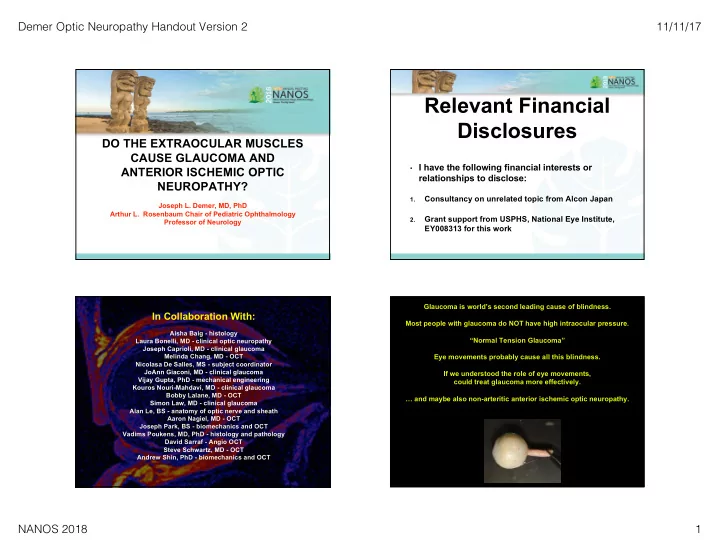
Demer Optic Neuropathy Handout Version 2 11/11/17 Relevant Financial Disclosures DO THE EXTRAOCULAR MUSCLES CAUSE GLAUCOMA AND I have the following financial interests or ANTERIOR ISCHEMIC OPTIC relationships to disclose: NEUROPATHY?


slide-1
SLIDE 1

Demer Optic Neuropathy Handout Version 2 11/11/17 NANOS 2018 1 DO THE EXTRAOCULAR MUSCLES CAUSE GLAUCOMA AND ANTERIOR ISCHEMIC OPTIC NEUROPATHY?

Joseph L. Demer, MD, PhD Arthur L. Rosenbaum Chair of Pediatric Ophthalmology Professor of Neurology

Relevant Financial Disclosures

  • I have the following financial interests or

relationships to disclose:

1.

Consultancy on unrelated topic from Alcon Japan

2.

Grant support from USPHS, National Eye Institute, EY008313 for this work

In Collaboration With:

Aisha Baig - histology Laura Bonelli, MD - clinical optic neuropathy Joseph Caprioli, MD - clinical glaucoma Melinda Chang, MD - OCT Nicolasa De Salles, MS - subject coordinator JoAnn Giaconi, MD - clinical glaucoma Vijay Gupta, PhD - mechanical engineering Kouros Nouri-Mahdavi, MD - clinical glaucoma Bobby Lalane, MD - OCT Simon Law, MD - clinical glaucoma Alan Le, BS - anatomy of optic nerve and sheath Aaron Nagiel, MD - OCT Joseph Park, BS - biomechanics and OCT Vadims Poukens, MD, PhD - histology and pathology David Sarraf - Angio OCT Steve Schwartz, MD - OCT Andrew Shin, PhD - biomechanics and OCT

Glaucoma is world’s second leading cause of blindness. Most people with glaucoma do NOT have high intraocular pressure. “Normal Tension Glaucoma” Eye movements probably cause all this blindness. If we understood the role of eye movements, could treat glaucoma more effectively. … and maybe also non-arteritic anterior ischemic optic neuropathy.

slide-2
SLIDE 2

Demer Optic Neuropathy Handout Version 2 11/11/17 NANOS 2018 2

Patient JH With Primary Open Angle Glaucoma Progressing IOP With 10-12 mmHg (Normal 10 - 21)

Take-Home Message

1. In everyone, the optic nerve sheath becomes taut in adduction and supraduction, consequently tethering the globe.

  • 2. Modeling suggests that tethering concentrates medial rectus muscle

reaction force at temporal peripapillary sclera, deforming the scleral canal and peripapillary region, and retracting the globe.

  • 3. Medial rectus reaction force is dissipated differently in some people:
  • A. Optic nerve and sheath elongation
  • B. Globe translation
  • 5. Reasons why peripapillary strain could be greater in normal tension

glaucoma.

  • A. Inner layer of optic nerve sheath stiffens with age.
  • B. Peripapillary sclera is softer than elsewhere.
  • 6. Repetitive strain in adduction may be a pressure-independent mechanism of
  • ptic neuropathy in glaucoma, and non-arteritic anterior ischemic optic

neuropathy.

  • 7. Extraocular muscle surgery might become an important treatment.

Eye Movements Incessant

People make more than 180,000 saccades daily, even during sleep. Eye-head gaze shifts include eye movements averaging 30°. Saccades of up to 40-45° occur during tabletop work. Peak extraocular muscle tension is 40 gm-f for 20° saccade and 52 gm-f for 30° saccade. Peripapillary phosphenes observed during ordinary saccades suggest deformation of the optic nerve head. Adduction is even greater than normal in esotropic patients. Model by: David A. Robinson and Joel Miller

NEGLECTED OPTIC NERVE

Adduction Abduction

Chang et al. AJO, 2016.

Optical Coherence Tomography Big Effect of Adduction!

slide-3
SLIDE 3

Demer Optic Neuropathy Handout Version 2 11/11/17 NANOS 2018 3

Wang, Y.X., et al., and Jonas J. B. Acute Peripapillary retinal pigment epithelium changes associated with acute intraocular pressure elevation. Ophthalmology. 122: 2022-2028, 2015. Fig. 2.

IOP 47 mmHg IOP 13 mmHg

Tiny Effect of IOP!

Multipositional Surface Coil MRI

Fiberoptic target fixation 312 micron resolution in plane 2 mm thick axial and quasi-coronal planes Digital image analysis

slide-4
SLIDE 4

Demer Optic Neuropathy Handout Version 2 11/11/17 NANOS 2018 4

Subjects

POAG Low IOP: 19 patients

Maximum IOP <20 mmHg Mean age 62 ± 10 (SD) years Mean deviation -8.2±1.2 dB

Controls: 35 normals verified by examination

Mean age 37± 19 yrs

Age-matched control subgroup: 14 normals

Mean age 63 ± 6 years (P = 0.71) All 3 groups had mean axial length 25.6 mm by MRI

POAG High IOP: 2 patients Esotropia: 31 patients

ON Length ~100% of Minimum Adduction -> ON Length >>100% of Minimum

<- Abduction

3-D Path

  • f Optic Nerve

3-D tracking of

  • ptic neve

area centroid Temporal ON Sheath Straightest In Adduction

slide-5
SLIDE 5

Demer Optic Neuropathy Handout Version 2 11/11/17 NANOS 2018 5

ON Straight Only In Adduction

~30° ~30°

Globe Retracts More In POAG Not Due to Age or Axial Length

Effect of Adduction Still Significant After Accounting for Globe Diameter

No Significant Effect of Age

slide-6
SLIDE 6

Demer Optic Neuropathy Handout Version 2 11/11/17 NANOS 2018 6

Optic Nerve Straightens Normal Globe Translates Mainly Nasally NTG Globe Translates More Posteriorly

Adduction ->

Temporal Sheath Taut Optic Nerve Head Tilts

Temporal

Scleral Stiffness

Optic Nerve Stiffness

Finite Element Modeling

6° Adduction Past Tethering Temporal Peripapillary Atrophy Nearly Universal

Finite Element Analysis of Strain in Adduction

ICP 130 mm H2O IOP 15 mm Hg

Andrew Shin, PhD

Finite Element Modeling of Strain in Lamina Cribrosa During Adduction

Temporal ->

<- Nasal

ICP 130 mm H2O IOP 15 mm Hg

slide-7
SLIDE 7

Demer Optic Neuropathy Handout Version 2 11/11/17 NANOS 2018 7

47 Intraocular Pressure Without Adduction -> Intracranial Pressure Without Adduction -> Intraocular Pressure With Adduction ->

Low Normal High

Strain in Lamina Cribrosa

Andrew Shin, PhD

Big Question

If optic nerve traction is pathologically significant, why do only some people get

  • ptic neuropathy from it?

Presumably because of individual variations in anatomy and tissue biomechanical properties.

Nerve Sheath Stiffness

Temporal

Scleral Stiffness

Optic Nerve Stiffness Stiffer Nerve Sheath With More Compliant Sclera?

Mean of 18 normal orbits.

Retrobulbar Anatomic Dimensions Measurement (mm) Mean

  • Std. Dev.

ErrError mm Optic Nerve Diameter 3.55 0.07 Fluid Gap Thickness 0.59 0.04 Sheath Thickness 0.74 0.02 Sheath Outer Diameter 6.16 0.12

We need human tissue biomechanical data!

slide-8
SLIDE 8

Demer Optic Neuropathy Handout Version 2 11/11/17 NANOS 2018 8

93 year old female

Cadaveric Studies

Le et al. ARVO, 2017

H-7 H-8, Age 57

slide-9
SLIDE 9

Demer Optic Neuropathy Handout Version 2 11/11/17 NANOS 2018 9

H-8, Age 57

Movie by Alan Le

Biomechanics

Shin and Park

ON Sheath OCT Scanner To Linear Motor To Force Sensor

Tensile Loading

47

Optic Nerve Tension in Range of 10 - 60 gm

slide-10
SLIDE 10

Demer Optic Neuropathy Handout Version 2 11/11/17 NANOS 2018 10

Shin et al., ARVO 2017

Aging Sclerosis (Hardening)

  • f Optic Nerve

Sheath

Conclusions and Speculations

  • 1. In everyone, medial rectus counterforce is transmitted to the optic nerve

head in adduction by the inner layer of the temporal optic nerve sheath, stretching the optic nerve by about the same ~3%.

  • 2. The globe retracts abnormally in adduction in normal tension glaucoma,

probably reflecting greater optic nerve sheath stiffness, maybe interacting with orbital connective tissues.

  • 3. The elastin content of the optic nerve sheath variably increases with age,

and maybe also with normal tension glaucoma. Greater force may be required to stretch the optic nerve sheath in normal tension glaucoma, and this force is applied to the soft, peripapillary sclera.

  • 4. Age-related stiffening of the optic nerve sheath may be an intraocular

pressure-independent mechanism of optic neuropathy.

  • 5. Low tension glaucoma might therefore result from repetitive strain injury

to the optic nerve head.

Possible Options For Therapy

  • 1. Scleral or pulley posterior fixation of the medial rectus to reduce

adduction range and force.

  • 2. Combined medial and lateral rectus muscle recession to reduce

adduction range and force.

  • 3. Aggressive correction of esotropia in all adults.
  • 4. Topical (glaucoma drops) or retrobulbar prostaglandin analog therapy to

induce exophthalmos by orbital fat atrophy.

  • 5. Orbital decompression by fat excision or orbital wall removal to induce

enophthalmos.

  • 6. Other ideas?