
SLIDE 1
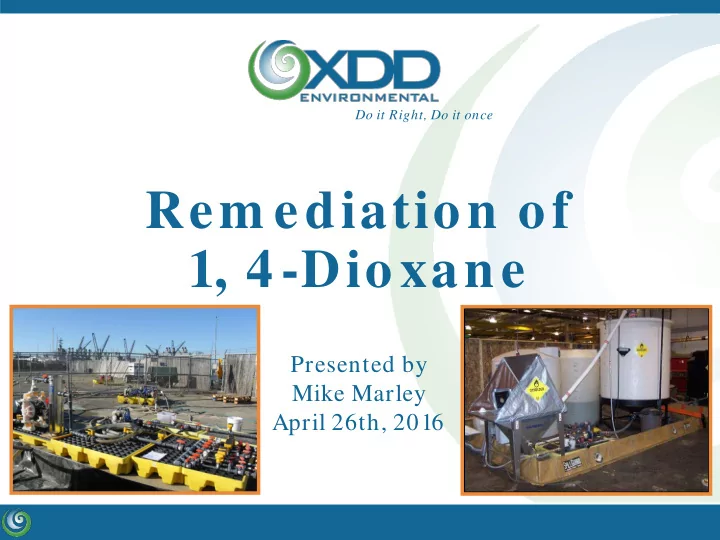
Rem ediation of 1, 4-Dioxane
Presented by Mike Marley April 26th, 2016
Do it Right, Do it once
Rem ediation of 1, 4-Dioxane Presented by Mike Marley April 26th, - - PowerPoint PPT Presentation
Do it Right, Do it once Rem ediation of 1, 4-Dioxane Presented by Mike Marley April 26th, 2016 Agenda Basic properties of 1,4-dioxane with respect to remediation A discussion of applicable reliable remedial technologies with case
Presented by Mike Marley April 26th, 2016
Do it Right, Do it once
▪ Basic properties of 1,4-dioxane with respect to remediation ▪ A discussion of applicable reliable remedial technologies with case studies
– Ex situ ▪ Advanced oxidation ▪ Sorption – In situ ▪ In situ chemical oxidation
▪ Promising remedial in situ technologies
– Phytoremediation – Air Stripping – Thermally enhanced soil vapor extraction – Bioremediation
▪ Analytical Methods to demonstrate destruction
2
3
From presentation by Pat Evans of CDM Sm ith
4
Compound Solubility (mg/L) Koc (cm3/g) Henry's Law Const. (unitless) Vapor Pressure (mmHg) Water Quality Criteria ug/L MtBE 51,000 7.26 0.025 245 13 PCE 200 155 0.753 24 5 Benzene 179 59 0.227 76 5 1,4-Dioxane miscible 17 0.0002 37 ~3*
▪ What do these properties mean?
– Volatile as a residual product – Very soluble in groundwater – When dissolved, not easily adsorbed, therefore is not readily retarded in soils – When dissolved, prefers to be in aqueous vs. vapor phase i.e. not easily stripped out of groundwater – TYPICALLY MEASURED ON LEADING EDGE OF PLUME
* = State specific guidelines, levels may be lowered e.g. NJDEP Interim Ground Water Quality Criteria is now 0 .4 ug/ L
▪Advanced oxidation
–key is formation of radical chemistry
▪Sorption
–key is synthetic materials
5
▪ Landfill leachate and groundwater extraction system (50- 100 gpm) ▪ 1,4-dioxane up to 322 ug/ L (has attenuated over time) ▪ Water is currently treated using powdered activated carbon/ sand filtration ▪ Advanced Oxidation Process (AOP) being added to address 1,4-dioxane that is not treated by PAC / filtration ▪ Complication: Bromide up to 1,300 ug/ L
▪ Reaction between H2O2 and O3 produces hydroxyl free radical (•OH) – proven effective on 1, 4- dioxane ▪ Bromate (BrO3
product
–Formed during common water treatment process (e.g., chlorination, direct ozonation, AOP, etc.) –Naturally occurring bromide ions (Br-) in the raw ground water/ surface water source is the pre-curser to bromate formation. –MCL for bromate is 10 ug/ L in drinking water
▪ The molar ratio of hydrogen peroxide to ozone (H2O2:O3) can be adjusted to minimize the formation of bromate. Typically, by increasing the amount of hydrogen peroxide relative to a fixed dose of ozone (i.e., increasing molar ratio of H2O2:O3), the
peroxide, and bromate formation will be reduced ▪ However, the trade-off is that the excess hydrogen peroxide can now react with the hydroxyl radicals (i.e., termed hydroxyl radical “scavenging”), which reduces the treatment efficiency of 1,4-dioxane ▪ Could use UV instead of ozone to avoid bromate but that has its
Test Scenario Impact on 1,4-Dioxane Impact on Bromate
High Spike, 240 ug/L 1,4-dioxane O3 Dose = 5, 10, 13, 20mg/L H2O2:O3 Ratio = 1.0 (all scenarios) 7 injection nozzles except the 20 mg/L ozone dose which used 9 nozzles. O3 (mg/L) H2O2 (mg/L)
Final 1,4- dioxane (ug/L)
O3 (mg/L) H2O2 (mg/L)
Final Bromate (ug/L)
5 3.6 48 5 3.6 64 10 7.1 6.6 10 7.1 190 13 9.2 1 13 9.2 290 20 14.2 1 20 14.2 430 Result: 1,4-dioxane destruction is more effective as ozone dose is increased. Result: Bromate conc. increased significantly as ozone dose increased. Conclusions: Hydrogen peroxide/ozone molar ratio requires optimization to reduce bromate formation. Also, likely to require more nozzle injection points to reduce bromate while achieving desired 1,4-dioxane destruction (7 to 9 nozzles used in Round 1, increased to 20 and 30 in Round 2).
Test Scenario Impact on 1,4-Dioxane Impact on Bromate
High Spike, 240 ug/L 1,4-dioxane O3 Dose = 10.7 mg/L H2O2 Dose = 19.0 and 30.4 mg/L H2O2:O3 Ratio = 2.5 and 4.0 20/30 injection nozzles Molar Ratio 2.5 4.0 Molar Ratio 2.5 4.0
Final 1,4-dioxane (ug/L)
Final Bromate (ug/L) 20 3.4 10.0 20 12 3 30 7.2 21.0 30 4.9 2.2 Result: 1,4-dioxane destruction is less effective as MR increases and as no. of injection nozzles increase. Result: Bromate concentration decreases as MR increases and as
Conclusions: Increasing the molar ratio of hydrogen peroxide to ozone reduces the bromate formation and bromate was reduced to below 10 ug/L in some scenarios. However, 1,4-dioxane destruction becomes less efficient. In addition, increasing the number of injection nozzles also reduces bromate, but reduces the 1,4-dioxane destruction.
liquids, vapor or atmospheric streams and be reused indefinitely
AMBERSORBTM 560
Slides courtesy of Steven Woodard, ect2
Case Study: St. Petersburg, FL 140 -gpm System
▪ Design Basis:
14
– Generally, key again is radical chemistry
▪ Source Area:
–30 x 60 feet area –15 feet thick –Silty sands – dual level system
▪ Located beneath active manufacturing plant ▪ Treatment Goal:
–Reduce groundwater to below 1 mg/ L in source –Goal based on protection of downgradient receptor
15
Compound Historical Max. Conc. (ug/ L) 1,1,1-TCA 101,000 PCE 20,000 1,4-Dioxane 3,000
▪ Selected Alkaline Activated Persulfate (AAP) for safety reasons
– Greater in-situ stability – Reduced potential for gas evolution
▪ Evaluated AAP on bench scale
– Soil buffering capacity – 2 to 4 g NaOH/ Kg Soil
▪ Two injection events
16
31,000 Kg Klozur (sodium persulfate) 15,300 Kg Sodium Hydroxide (NaOH)
NaOH Mass < Soil Buffering Capacity + acid generated by persulfate reaction
▪ 2-3 Orders Magnitude Reduction from baseline ▪ Target compounds remain below 1 mg/ L objective ▪ Target compounds dropped to low ug/ L level and remained over number years post treatment
17
Primary ISCO Polish ISCO Primary ISCO Polish ISCO Primary ISCO Polish ISCO
18
Cylinders – ESTCP- ER- 201324: funded Laboratory Study
– Peroxide / ozone systems – Ozone only systems? – Other catalyzed peroxide / Fenton's type systems
19
– primarily removal by transpiration
20
Slides courtesy of Mohamed Odah, ART
100 ppm
50 ppm 25 ppm 12.5 ppm 6.25 ppm 3.12 ppm 1.56 ppm 0.78 ppm
0.39 ppm
Approximate ART Efficiency 30% Air stripping 20% In-well sparging 50% Total
ART Well
MW-1 MW-2 Initial concentrations (µg/L) 25,000 28,000 90 days later (µg/L) 7,400 2,400 Percent reduction 76% 91%
Mass balance suggests partial biodegradation, partial stripping
24
Slides courtesy of Rob Hinchee, IS&T
ER 201326 Rob Hinchee Integrated Science & Technology, Inc.; Arizona State University; CO School of Mines; AECOM March 23, 2016
26
temperatures.
0.001 0.002 0.003 0.004 0.005 0.006
20 40 60 80 100
Henry's Constant (dimensionless) Temperature (˚C) This Study Park et al., 1987 Ondo et al., 2007 Henry’s Constants for Comparison (25˚C): TCE – 0.40 1,1,1-TCA – 0.70 1,1-DCE – 1.1
27
T SM SG T SM SG T SM T SM SG T SM SG T SM
30 40 50 60 70 80 VMW-4 Post-7 XSVE-1 Post-5 VMW-2
sand silty sand/sandy silt silt clay clay clay sand sand sand sand silt silt silt silt silty sand/sandy silt silty sand/sandy silt silty sand/sandy silt silty sand/sandy silt Screened Interval
28
Treatment Zone
29
Demonstration Objectives
Project Progress and Results
Mass removal estimates (~13 kg 1,4-dioxane at shutdown) consistent with before and after soil concentrations
5 10 15 20 25 50 100 150 200 250 300 350 400
Vapor Conc. (mg/m3) Time (days)
2 4 6 8 10 12 14 16 50 100 150 200 250 300 350 400
Cumulative Mass Removed (kg) Time (days)
30
–Few organisms use 1,4 dioxane as an energy source (CB 1190)- appears more difficult for remediation –THF/ Propane/ Toluene + others as energy source: co-metabolic processes – more reliable in remediation, but m ay need bioaugmentation –Activity common with monooxygenase enzymes
–SERDP ER-1422 Study in 2007 [Rob Steffan, CB&I]: no degradation - ?
31
32
Slides courtesy of David Lippincott, CB&I
A World of Solutions
TM33
1,4-Dioxane in Vandenberg AFB Microcosms
Time (Days)
2nd Bioaug. 200 400 600 800 1000 1200 50 100 150 200 250 O2 only (Live Control) O2 + Propane O2 + Propane + N2O Killed Control ENV425 Bioaug Anaerobic Methane + NH4PO4 Respike 1,4-D DAP added to Biostim Treatments
Goals
biodegradation of 1,4-D
limits (1 ppb) within deep zone
Results
microcosms bioaugmented with strain ENV425
culture eventually grown from site samples
Deep Zone
A World of Solutions
TM34
Startup and System Operation
A World of Solutions
TM35
1,4-Dioxane Treatment Results
Well Day 14 Day 245 % Degraded 48B (sparge) 113 ppb <1.0 ppb >99 % 47B 997 ppb 1.2 ppb >99% 2B 1090 ppb 1.1 ppb >99% 34B 135 ppb 7.3 ppb 95% 5B* 548 ppb 588 ppb <1% 5A (control) 346 ppb 323 ppb <1%
Sparge well (48B)
5B 34B 47B 2B
From Lippincott et al., 2015, Ground Water Monitoring & Remediation, 35, no. 2: 81-92 Supported by contract FA8903-11-C-8101 US Air Force Civil Engineer Center
(SERDP ER-2307: David T. Adamson et. al., ES&T, 2015, 49, 6510−6518)
▪ Data Source - CA GeoTracker + Air Force Sites / Wells
–Only 30% of 193 CA sites had a statistically significant source decay term –About 23% of CA sites had order of magnitude reduction in max. vs. recent 1,4 dioxane levels, very few with higher than 2 or 3 OoM reduction –30% of 441 AF wells with decreasing trends, 70% with stable, no trend or increasing trend (increasing was 9%) –AF wells : attenuation correlated positively with dissolved oxygen, and negatively for CVOCs and metals –Median half-Life 20-48 months for statistically significant attenuating sites / wells
36
▪ CSIA on 1,4-dioxane
– unequivocal proof of degradation – rates of degradation – potentially prove multiple sources
▪ CSIA Detection Levels for 1,4-dioxane
– δ13C = 1 ug/ l – δ2H = 20 ug/ l ▪ qPCR
– Dioxane monooxygenase (DXMO) and ALDH to assess aerobic metabolism by P. dioxanivorans CB1190 – Soluble methane monooxygenase (sMMO) and ring hydroxylating toluene monoxygenases (RMO, RDEG, PHE) to assess aerobic cometabolism
▪ Stable Isotope Probing (SIP)
– 13C “label” serves as a tracer – Quantification of 13C in biomass and CO2 demonstrates dioxane biodegradation
37
38
Presented by: Mike Marley Marley@xdd-llc.com 1-800-486-4411 www.xdd-llc.com Follow XDD:
States with XDD Projects