Renewable energy and Peter Cramton University of Cologne - PowerPoint PPT Presentation
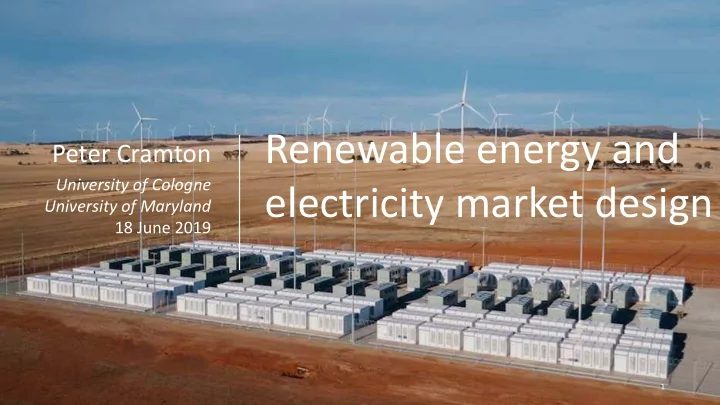
Renewable energy and Peter Cramton University of Cologne electricity market design University of Maryland 18 June 2019 1 Goal of electricity markets: Reliable electricity at least cost Short-run Long-run efficiency efficiency Least-cost
Renewable energy and Peter Cramton University of Cologne electricity market design University of Maryland 18 June 2019 1
Goal of electricity markets: Reliable electricity at least cost Short-run Long-run efficiency efficiency Least-cost Right quantity operation of and mix of existing resources resources
• Must balance supply and demand at every instant • Physical constraints of network and resources • Shocks in supply Challenges of – Transmission line or generator electricity markets outage – Intermittent resources: wind and solar • Absence of demand response • Climate policy 3
• Get the spot market right – Day ahead • Scheduling and unit commitment A successful market – Real time design • Bid-based security constrained economic dispatch • Forward trade to manage risk and support long-run investment 4
Day-ahead market Objective: maximize Unit commitment and Three-part offers from social welfare Virtual offers and bids scheduling fossil resources s.t. transmission and resource constraints Energy and Arbitrage day- Co-optimized ancillary services Startup cost ahead and real- energy and each hour of day time markets reserves Prices for energy Competitive and reserves; Minimum-energy equilibrium with financially cost locational binding marginal prices (marginal value of energy at each Energy offer location) curve
Day-ahead market Handling non- • If total cost of unit not covered by energy & reserve convexities, such as revenue, then unit gets make-whole payment for shortfall • Make-whole payments small in practice startup and minimum • LMPs are approximate supporting prices energy costs • Allows small generators to optimally schedule Procompetitive • Allows small participants to hedge real-time risk
• Generator submits operating plan for each Operating resource – Online/offline, constraints plan and • Until 60 minutes before operating hour, plan can be adjusted adjustment • System operator may commit additional period resources for reliability, but these have a high offer floor ($1500/MWh)
Ancillary services Address supply/demand uncertainty: • Regulation: online, responds in second • Reg up, Reg down to maintain frequency of 60 Hz • Responsive reserve: online, 10min response • Non-spinning reserve: offline, 30min response Need for reserves depends on market; products and quantities reviewed periodically
9 Source: Potomac Economics
10 Source: Potomac Economics
Real-time market Security constrained economic dispatch Determines optimal dispatch and prices every five minutes Financially and physically binding Allows efficient settlement from forward positions
Day-ahead and real-time markets highly liquid 12
13
14
• Reserves have value in avoiding load shedding • Marginal value of reserves depends on – Value of Lost Load, e.g. $9000/MWh Shortage pricing – Probability of Lost Load, e.g. 1 when start shedding load • Load’s implicit preference for reliability given by operating reserve demand curve 15
Operating reserve demand curve 16
17 Source: Potomac Economics
• Forward contracts are essential to manage risk – California energy crisis 2000-2001 – Forward provides hedge for load Forward – Generator + fuel contract provides physical hedge for supply contracts • Shortage pricing motivates forward contracts • Forward contracting improves bidding incentives
19 Source: Potomac Economics
20 Source: Potomac Economics
21 Source: Potomac Economics
Investment 22
23 Source: Potomac Economics
24 Source: Potomac Economics
25 Source: Potomac Economics
26 Source: Potomac Economics
• ERCOT is “energy only”; many others have a capacity market (PJM, ISO-NE, …) • Good capacity markets rely on shortage pricing, just like energy-only market • Buy enough in advance – Conducted several years in advance, so new entry can compete before costs are sunk Capacity market – Product is ability to deliver energy during shortage – Strong performance obligation • Financial obligation to provide energy during shortage • Provides hedge to load from shortage prices – Coordinated investment to ensure adequate resources 27
28 Source: Potomac Economics
Transformation to renewables 29
Source: IRENA
• Last year 60% of new capacity in US is wind and solar • Coal hasn’t been built in years • Intermittent supply, zero marginal cost, no inertia – More uncertainty, worse price formation, faster response needed – Also best sites not where load is; transmission issues • Today’s design easily handles moderate share of wind 33
34 Source: Potomac Economics
35 Source: Potomac Economics
36 Source: Potomac Economics
• But what if >80% renewable • Core design still works well • More flexibility needed – Demand response (smart homes) Solution looking – Battery storage forward Need to encourage technology-neutral solutions! 37
Greater need for flexibility ⇒ efficient price signals increasingly important • Nodal pricing – Price reflects scarcity at time and location – Pretending no congestion does not work • German redispatch cost of €1.5 billion in 2018 • Wrong price signal; poor location incentives • Shortage pricing – Motivate those to provide flexibility 38
• Each customer has smart meter • System operator estimates demand of customer • System operator buys forward estimated demand Enable demand • Real-time deviations settled response with good at real-time price default retail contract • Customer can opt out of default 39
• Policy built on myriad of changing subsidies and emission restrictions makes planning Incoherent difficult • Uncertainty harms investment and unstable • Policy based on carbon price would greatly climate policy reduce uncertainty • Carbon price is a critical input in investment and retirement decision
Carbon dividend (pending US legislation) • Carbon price, increasing each year until goal met • Revenue rebated back to citizens • Replaces inefficient regulations • Carbon border adjustments for reciprocity Widely supported (4-1 overall) Good basis for climate club e.g. US, Europe, and China 41
• Electricity good example of the power of market design – Highly efficient spot market – Supporting extensive forward contracting – Competitive retail market to foster Conclusion demand response • Good governance remains important to make sure market design continues to improve and addresses new challenges like the transition to renewables 42
Recommend
More recommend
Explore More Topics
Stay informed with curated content and fresh updates.