Report ESRF and ILL summer school 2017 Introduction As a - - PDF document

β–Ά
report esrf and ill summer school 2017
SMART_READER_LITE
LIVE PREVIEW

Report ESRF and ILL summer school 2017 Introduction As a - - PDF document

Synne Myhre ESRF and ILL summer school 2017 Report ESRF and ILL summer school 2017 Introduction As a conclusion of my participation to the ESRF and ILL summer school, this rapport will summarize the practical part of my stay. I participated in


slide-1
SLIDE 1

Synne Myhre ESRF and ILL summer school 2017 1

Report ESRF and ILL summer school 2017

Introduction

As a conclusion of my participation to the ESRF and ILL summer school, this rapport will summarize the practical part of my stay. I participated in the work done at the ID02 at the ESRF. ID02 is a beamline for investigating soft matter. It combines wide angle x-ray scattering (WAXS) to ultra small angle x-ray scattering (USAXS) to explore all dimensions of soft matter

  • systems. The non-equilibrium dynamics of soft matter and related systems can be explored

down to a sub-millisecond range at this beamline.

.

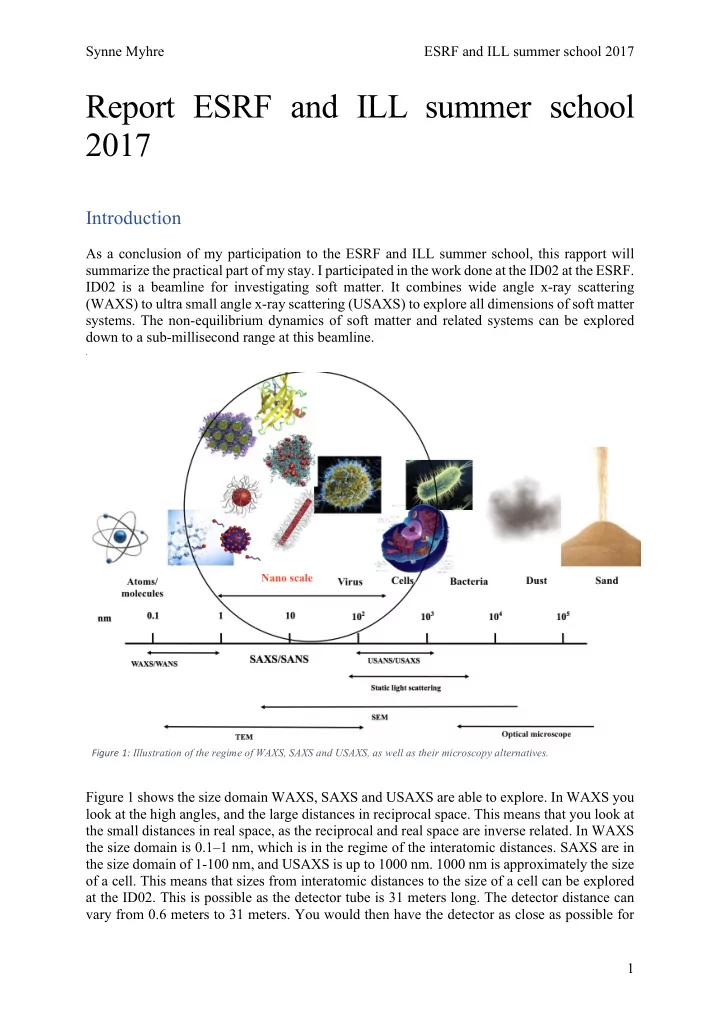
Figure 1 shows the size domain WAXS, SAXS and USAXS are able to explore. In WAXS you look at the high angles, and the large distances in reciprocal space. This means that you look at the small distances in real space, as the reciprocal and real space are inverse related. In WAXS the size domain is 0.1–1 nm, which is in the regime of the interatomic distances. SAXS are in the size domain of 1-100 nm, and USAXS is up to 1000 nm. 1000 nm is approximately the size

  • f a cell. This means that sizes from interatomic distances to the size of a cell can be explored

at the ID02. This is possible as the detector tube is 31 meters long. The detector distance can vary from 0.6 meters to 31 meters. You would then have the detector as close as possible for

Figure 1: Illustration of the regime of WAXS, SAXS and USAXS, as well as their microscopy alternatives.

slide-2
SLIDE 2

Synne Myhre ESRF and ILL summer school 2017 2 WAXS, and as far away as possible for USAXS. Figure 1 also shows the regime the competing microscopy methods are able to explore. The small angles in SAXS means that you look at angles below 6Β°. Advantages of WAXS/SAXS/USAXS over microscopy methods is that they can be done in situ in solution, and that you get an average over the whole sample, and not just information about parts of it.

  • 2. Theory and methods

Theoretical background The theory explained in this section is found here ( [1] [2] [3] [4]). Scattering

Figure 1: Illustration of the scattering of a sample into a detector.

In a scattering experiment the incident beam hits the sample with a given wavelength. SAXS is an elastic scattering technique, which means that no energy is lost in the scattering process. The incident wave of photons makes the electrons in the sample oscillate due to their electromagnetic field, and in this process the oscillating electrons will emit photons. In an elastic scattering process, the modulus of the wave vector of the incident and scattered beam is the same. 𝑙" =

$% &'

  • Eq. 1

𝑙( =

$% &)

  • Eq. 2

In Eq. 1, and Eq. 2, k is the wave vector and πœ‡ is the wavelength. As 𝑙( = 𝑙" for an elastic process, this means that πœ‡" = πœ‡(. The intensity measured at the detector as counts per seconds per pixel is given by 𝐽- = 𝑗/π‘ˆ

1πœβˆ†π›» 56 57

  • Eq. 3
slide-3
SLIDE 3

Synne Myhre ESRF and ILL summer school 2017 3 where 𝑗/ is the incident flux of X-ray photons, π‘ˆ

1 is the transmission, 𝜁 is the efficiency, βˆ†π›» is

the solid angle and

56 57 is the differential scattering cross section. The differential scattering

cross section iIs the only variable that is not fixed in the equation, and therefore what we

  • measure. The differential scattering cross section is the probability of a particle of the incident

beam being scattered out from the unit sample into the solid angle. 𝐽 π‘Ÿ =

59 57 = : ;

)<=>

56 57

  • Eq. 4
  • Eq. 4 is the differential scattering cross section normalized to volume sample (π‘Š

(@AB), and is

illustrated in Figure 2. In the following a derivation from the wave vectors ks and ki into the well know relation 𝑅 =

D% & sin H $ will be done.

Q is the momentum transfer and is equal to 𝑅 = 𝑙( βˆ’ 𝑙"

  • Eq. 5

so 𝑅 = 𝑙( βˆ’ 𝑙"

  • Eq. 6

Figure 2: Illustration of the differential scattering cross section. An incoming particle is scattered out from the scattering center into a solid angle.

slide-4
SLIDE 4

Synne Myhre ESRF and ILL summer school 2017 4

Figure 3: The scattering of the incoming photon with demonstration of the vectors ki as ku

i in the figure, ks as ku f and πœ„ as the

angle between them.

If we take the square of this we get 𝑅 $ = 𝑙( βˆ’ 𝑙"

$ = 𝑙( $ βˆ’ 2𝑙(𝑙" + 𝑙" $

  • Eq. 7

The angle between the two wave vectors is given by πœ„, as shown in Figure 3. From simple geometry, we then have that 𝑅 $ = 𝑙(

$ βˆ’ 2 𝑙(𝑙" 𝑑𝑝𝑑 πœ„ + 𝑙" $

  • Eq. 8

From the assumption that we have elastic scattering we have that 𝑙( = 𝑙" so we can rewrite to 𝑅 $ = 2 𝑙"

$ βˆ’ 2 𝑙" $ 𝑑𝑝𝑑 πœ„ = 2 𝑙" $(1 βˆ’ 𝑑𝑝𝑑 πœ„)

  • Eq. 9

from Eq. 1 and Eq. 2 we have the formula for the wave vector which gives us 𝑅$ =

$ $% S &S

(1 βˆ’ 𝑑𝑝𝑑 πœ„)

  • Eq. 10

From geometry, we have that 1 βˆ’ cos πœ„ = 2 sin$ H

$, so

𝑅$ =

$ $% S &S

2 π‘‘π‘—π‘œ$ H

$

  • Eq. 11

𝑅 =

D% & βˆ— π‘‘π‘—π‘œ H $

  • Eq. 12

which is the expression for the scattering vector. This is inversely related to the distance by 𝑒 =

$% Y

  • Eq. 13
slide-5
SLIDE 5

Synne Myhre ESRF and ILL summer school 2017 5 The intensity we measure is given by 𝐽 𝑅 =

: ; βˆ— 56 57 = π‘œ βˆ— βˆ†πœ βˆ— π‘Š$ βˆ— 𝑄 𝑅 βˆ— 𝑇(𝑅)

  • Eq. 14

where

: ; βˆ— 56 57 is the differential scattering cross section normalized to volume, V. n is the particle

number density, βˆ†πœ is the difference in contrast. For x rays, this is the difference in the electron density between the particles and the solvent. π‘Š is the volume of the sample, 𝑄 𝑅 is the form factor of the particles, and 𝑇(𝑅) is the structure factor. The form factor tells about the size and shape of the scattering object, while the structure factor tells about the interactions between the particles in the sample. The density of the material is given by 𝜍 =

]' ;^=_>'<`a

  • Eq. 15

where 𝑐"is the scattering length and is given by Eq. 16, and π‘Š

cA1B"@de is the molecular volume

  • f the sample.

𝑐" =

eS D%fg-a@S βˆ— 𝑔 :

  • Eq. 16

In Eq. 16, e is the electron charge, 𝜁/ is the permittivity of free space, 𝑛e is the electron mass, c is the speed of light and 𝑔

: is the is the real part of the atomic scattering factor.

Each point of the particle gives rise to a scattered wave which can be expressed as 𝑓"k1, where q is expressed as a vector and r position vector of the point under consideration. In order to get the full scattering amplitude for the particle, one has to add up all the waves. The intensity is then the absolute square of the scattering amplitude. Because what we measure is the intensity, which is the amplitude squared, the phase information is lost. This means that there is not possible to go back the same way, by finding the amplitude, then do a Fourier transform to find the electron density, as shown in Figure 4. Therefore, one needs to make a model for the system, and fit it to the experimental data.

slide-6
SLIDE 6

Synne Myhre ESRF and ILL summer school 2017 6 Based on the shape and size of the particles in the sample, they will scatter the incoming x rays differently. This is what is meant by the form factor. Figure 5 shows the scattering pattern of a sphere. Based on how the intensity varies with Q, we can find what kind of shape and size the particles have in dilute solutions. We want to find the form factor in dilute solutions, as the distances between the particles then are so long so that they do not interact. The structure factor shown in Eq. 14 is then set to 1. When doing a scattering experiment, the results should be reduced to only contain scattering from the particles in the solution.

Figure 5: Snapshot from a frame taken at ID02. Figure 4: Illustration of the real space quantities electron density and autocorrelation function, and the inverse space quantities scattering amplitude and scattering intensity. The figure also shows in which direction Fourier transform is possible. Illustration taken from β€œIlavsky_SAXS_Introduction_ACA-2.pdf”. Figure 6: Illustration of dividing up the scattering contributions from a sample into the scattering from the container, solvent and particles.

slide-7
SLIDE 7

Synne Myhre ESRF and ILL summer school 2017 7 To be able to compare data, the time must be normalized. The transmission needs to be corrected for, as not all the incoming x rays goes through the sample and to the detector. Then the external background needs to be corrected for. The external background is scattering from the sample container as well as natural radiation in the room. Then the internal background needs to be removed. The internal background is the solvent. Then you are left with only the scattering from the particles, as illustrated in Figure 6. Soft matter systems The theory explained in this section is found here ( [5] [6] [7]). Small angle scattering (WAXS, SAXS, USAXS) is a powerful tool to investigate soft matter systems, as it enables the investigation of the structure and dynamics for the size that these structures are in. Examples of soft matter systems is shown in Figure 7.

Figure 7: Examples of soft matter systems. The degree of hierarchical structures increases from bottom and up.

These systems self-assemble, and have many levels of hierarchy. This means for instance that the molecular structure induces one type of secondary structure which controls the overall shape

  • f the molecule. A certain molecule in the same concentration in a certain solvent, will always

make the same structure. This is the way nature is built up, and this is the motivation to explore these kinds of systems. Proteins, DNA and cells are built up this way, so if we are able to understand the simpler systems, like for instance micelles and nanotubes, we are one step closer to a deeper understanding of how nature works. To be able to understand and do research the simpler structures can also be beneficial for medical applications, as they could function as drug delivery systems, or they can explain diseases in our body.

slide-8
SLIDE 8

Synne Myhre ESRF and ILL summer school 2017 8 The forces that controls the overall structure are the weak intermolecular

  • forces. These forces are hydrogen

bonding, hydrophobic effect, electrostatic interactions, aromatic interactions like 𝜌 βˆ’ 𝜌 stacking and the Van der Waals

  • forces. The structure of a micelle is

shown in Figure 9. For micelle formation, the driving force is often the hydrophobic effect. When a certain concentration of the micellar building blocks is reached, the water molecules must arrange themselves to a large extent

around the hydrophobic part of the building blocks, and thus, the system loses entropy. To be

able to form as many hydrogen bonds to other water molecules, and to move as freely around as possible, the systems packs the hydrophobic part of the micellar building blocks away. This creates the micelles. Another common structure is particles made up of a bilayer, as shown in Figure 8. This can be arranged into a spherical shape, which is called a vesicle, or it can be

  • rganized to make a nanotube. If there is a lot of hydrogen bonding between the molecular

building blocks, this has been shown to induce 𝛾-sheet formation [8]. Salt, surfactants and temperature are common external tunable parameters for controlling the shape and size of the final structure. Addition of salts can mask the electrical double layer, which can make the particles come closer and aggregate or elongate into longer structures. Addition of surfactants can have the same effect, or can cause less repulsion between the building blocks which can induce a lower curvature as they can be closer

  • together. Increase in temperature can for instance

cause the polymer building block to have less favorable interaction with water and the water will then be dehydrated from the polymers. This can also lead to an elongation as the polymers in the corona can be closer together.

Figure 9: Illustration of micelle formation from a surfactant. Figure 8: Illustration of the structure of a bilayer. This is a bilayer in a polar solvent, as the hydrophobic chains are facing inwards and the polar heads are facing out towards the water. In an apolar solvent the structure can be reversed.

slide-9
SLIDE 9

Synne Myhre ESRF and ILL summer school 2017 9 Methods

Figure 10: Illustration of a theoretical SAXS curve. Taken from β€œIlavsky_SAXS_Introduction_ACA-2.pdf”.

Figure 10 shows how a theoretical graph for a sphere would look like. By using a model-free approach one can deduce some important parameters very efficiently. In the Guinier regime the radius of gyration (𝑆o) can be found, regardless of the shape of the particle. The radius for a sphere can be found in the first minimum, and information about the interface can be found in the Porod regime. Finding the radius The Guinier law tells that for discrete objects, regardless of their shape and structure, the intensity is given by 𝐽 = 𝐽/𝑓pq

rβˆ—kSβˆ—st S

  • Eq. 17

where I is the intensity, 𝐽/ is for forward scattering, and Rg is the radius of gyration. This correlation is valid for π‘†π‘Ÿ β‰ͺ 1, isotropic solutions, dilute solutions and when the background is removed. From the equation one can see that a plot of ln 𝐽 π‘Ÿ versus π‘Ÿ$ will give –

st x as the

  • slope. The correlation between the radius of gyration (𝑆o), and the radius of a sphere (R) is

given by 𝑆o

$ = x y 𝑆$, so in this way both the radius and the radius of gyration can be found.

slide-10
SLIDE 10

Synne Myhre ESRF and ILL summer school 2017 10 The Guinier law only holds up for low values of q, because of the condition π‘†π‘Ÿ β‰ͺ 1. Another way to find the radius is by looking at the first minimum. The radius by this method is given by 𝑆 =

D.D{x k|'_)>}'~

  • Eq. 18

This method originates from comparing the first minimum to where the Bessel function for a sphere is equal to 0. The 4.493 factor can then be regarded as a conversion factor between the Bessel function for a sphere, and the experimental data. In this way the radius can be obtained. The Porod regime is the q-range where the interface between the particle and the solvent is. By looking at the slope in this region, one can therefore deduce information about the interface. The different slopes and shapes are presented in Figure 11.

Figure 11: Illustration of different interfaces and what slope they will have in the Porod regime based on their structure. Ilavsky_SAXS_Introduction_ACA-2.pdf

Smearing of the oscillations There are mainly three reasons for smearing of the oscillations. The first is polydispersity. On the basis of the last section, where it is shown that the radius can be extracted from the fist minimum, it is given that for several different radii, the minima will differ. This will then cause the graphs to overlap, and not have a distinct minimum, which gives rise to smearing. The second reason is instrument resolution, which will always give a smearing contribution. The third reason is multiple scattering.

slide-11
SLIDE 11

Synne Myhre ESRF and ILL summer school 2017 11

Experimental

Nanotube project The samples where pre-prepared by Thomas Zinn. The samples contained different weight percent (wt%) of the peptide A6K. A6K contains 6 alanine residues, and one lysine residue. The measured samples where 2 days old, 10 days and 1 month old. The 2 days and 10 days old samples were 11 wt. %, while the 1 month old sample was 4 wt. %. The samples were measured at a detector distance of 31 meter, and 1,5 meter. Water measurements were also done for background removal. Silica catalytic activity project The samples where pre-prepared by Lewis Sharpnack. The samples contained silica particles, in which some where coated by nickel and gold on one side, for catalytic activity. XPCS were done to investigate the activity and dynamics of the particles. I will not include this in this report as I did not participate in this part of the project. SAXS data were obtained for these particles at a detector distance of 10 meter. Water measurements were also done for background removal.

Results

Nanotube project

Figure 12: SAXS results of A6K nanotubes obtained at a detector distance of 1.5m and 31 m.

00

33

00

32

00

30

00

34

00

33

00

32

00

30

00

sssss0sssss00sssss sssss30sss2sssss sssss30sss00sssss sssss0sssss2sssss sssss0ssss0sshhhh sSdsWs))) ]s]]]] )s]Γ…

30]

slide-12
SLIDE 12

Synne Myhre ESRF and ILL summer school 2017 12 Figure 12 shows the data obtained in the nanotube project. The purple and red line is for the nanotube which is 10 days old. The oscillations clearly show that the nanotubes have been formed in this sample. The two green lines are for the sample that were made 2 days before the measurements were done. Here the nanotubes are not properly formed yet. We can see this from the graph by the fact that the oscillations are starting to appear for this sample, but is not as defined as the 10 days old sample. This is because the system is still not in equilibrium, and the structure is still forming. The blue line is the one month old sample. This sample is made below the critical assembly concentration, so no nanotubes have been formed here. We see that the green and purple line is still increasing in the low q regime, this means that the nanotubes are longer than the regime of the USAXS, which is 1000 nm. We can also see that all the graphs look similar in the high q regime. This is because this is the regime of the structure of the peptide, which is the same for all the samples. A further analysis of the data was not done during my stay.

Silica catalytic activity project

Figure 13: SAXS data obtained for silica colloidal particles at a detector distance of 10 m.

Figure 13 shows the scattering of the silica particles. A gradient has been added with a slope of π‘ŸpD to show what kind of interface they have. As the π‘ŸpD fit to the graph in this regime, this means that the interface is sharp, as described in Figure 11.

00

22

00

20

00

20

00 00 00

2

aaaaaaa attatattt tSdtWa))) ]a]]] )a]Γ…

20]

slide-13
SLIDE 13

Synne Myhre ESRF and ILL summer school 2017 13

Figure 14: Guinier plot made from the data for the silica particles.

The radius of the silica particles has been found by the first minimum and by the Guinier law, as shown in Figure 14. An overview of the data is shown in Table 1: Overview over parameters

  • btained for the silica particles.

Table 1: Overview over parameters obtained for the silica particles.

Method Size R given by looking at π‘Ÿβ€’"1(B-"€ 128 nm Radius of gyration, 𝑆o 98,9 nm R given by the 𝑆o 127 nm

y = -3261,3x + 6,2192 RΒ² = 0,9929

5,3 5,4 5,5 5,6 5,7 5,8 5,9 6 6,1 6,2 0,00005 0,0001 0,00015 0,0002 0,00025 0,0003

ln (I(q)) q2 [Γ…-2]

Guinier plot

slide-14
SLIDE 14

Synne Myhre ESRF and ILL summer school 2017 14

Figure 15: Data for the silica particles with graphs that show how the data will look like for different particle radiusΒ΄.

Figure 15 shows the effect of polydispersity on the data.

Discussion

Previous research shows that the nanotubes are formed by the A6K forming a bilayer, which takes a 𝛾-sheet formation. The sheets gets a bit twisted, so they form long helical structures, which with time form nanotubes. The project at ID02 is to explore the reaction mechanism and kinetics for this process. This is to get a better fundamental understanding of soft matter systems with many levels of hierarchy, and also in regard to understand 𝛾-amolyid fibrils. There is a lot

  • f research on the 𝛾-amolyid fibrils as there are research that links fibrilization of the 𝛾-amolyid

in the brain to Alzheimer’s disease. In this rapport, it has been shown how the β€œmodel free” interpretation of spherical SAXS data easily can extract important parameters about the

  • particles. The model for the nanotubes was not ready during my stay, so these data has not been

further analyzed at this point. This rapport shows what my practical part of the summer school has been like. We spent a significant amount of time of the theoretical background, and some time at the beamline obtaining data. The rest of the time was spent by learning how to analyze data and present them.

00

22

00

20

00

20

00 00 00

2

aaaaaaa amm020amm amm0m0amm amm0m0mm amm000mm dSddWa))) ]a]]] )a]Γ…

20]

slide-15
SLIDE 15

Synne Myhre ESRF and ILL summer school 2017 15

Acknowledgements

I want to thank Theyencheri Narayanan and Thomas Zinn, as well as the rest of the ID02 staff for teaching me throughout my stay. I would also like to thank the organizers of the summer school, Patrick Bruno, Paul Steffens, Laurence Tellier and Serge Claisse. At the end I would like to thank the rest of my fellow summer school students, for a great month together in Grenoble.

Bibliography

[1]

  • T. Zinn, Lectures: Fundamentals of small angle scattering, Summer School 2017.

[2]

  • P. L. a. T. Zemb, Neutrons, X-Rays and Light: Scattering Methods Applied to Soft Condensed

Matter, North Holland , 2002. [3]

  • T. Narayanan, Lecture: Soft matter studies with x-Rays, Summer School 2017.

[4] Illavansky, "http://meetings.chess.cornell.edu/ACABioSAS/TrackB/Ilavsky_SAXS_Introduction_ACA.pdf," [Online]. [Accessed 20 10 2017]. [5]

  • d. P. Atkins, Atkins' Physical Chemistry, vol. 2014, OUP Oxford.

[6]

  • C. H. Dehsorkhi, "Self-assembling amphiphilic peptides," Journal og Peptide Science , 2014.

[7]

  • A. P. ValΓ©ry, "Peptide nanotubes: molecular organisations, self-assembly mechanisms and

applications," Soft Matter, 2011. [8]

  • I. W. Hamley, "The Amyloid Beta Peptide: A Chemist’s Perspective. Role in Alzheimer’s and

Fibrillization," Chemical reviews , 2012.