Report on experimental results for metal-ion beams Report: - - PDF document

report on experimental results for metal ion beams report
SMART_READER_LITE
LIVE PREVIEW

Report on experimental results for metal-ion beams Report: - - PDF document

Deliverable D7.3 WP 7 JRA01 ARES Report on experimental results for metal-ion beams Report: JRA01-ARES-MS84 1) Oven development 2) Sputter development 3) MIVOC development 4) Hot liner 5) New innovations 6) Production efficiency with


slide-1
SLIDE 1
  • H. Koivisto, JYFL, 9th Oct.2012

Deliverable D7.3 WP7– JRA01 – ARES

Report on experimental results for metal-ion beams Report: JRA01-ARES-MS84

1) Oven development 2) Sputter development 3) MIVOC development 4) Hot liner 5) New innovations 6) Production efficiency with different methods

  • H. Koivisto, JYFL, 9th Oct.2012

Deliverable D7.3 WP7– JRA01 – ARES

1) Oven development:

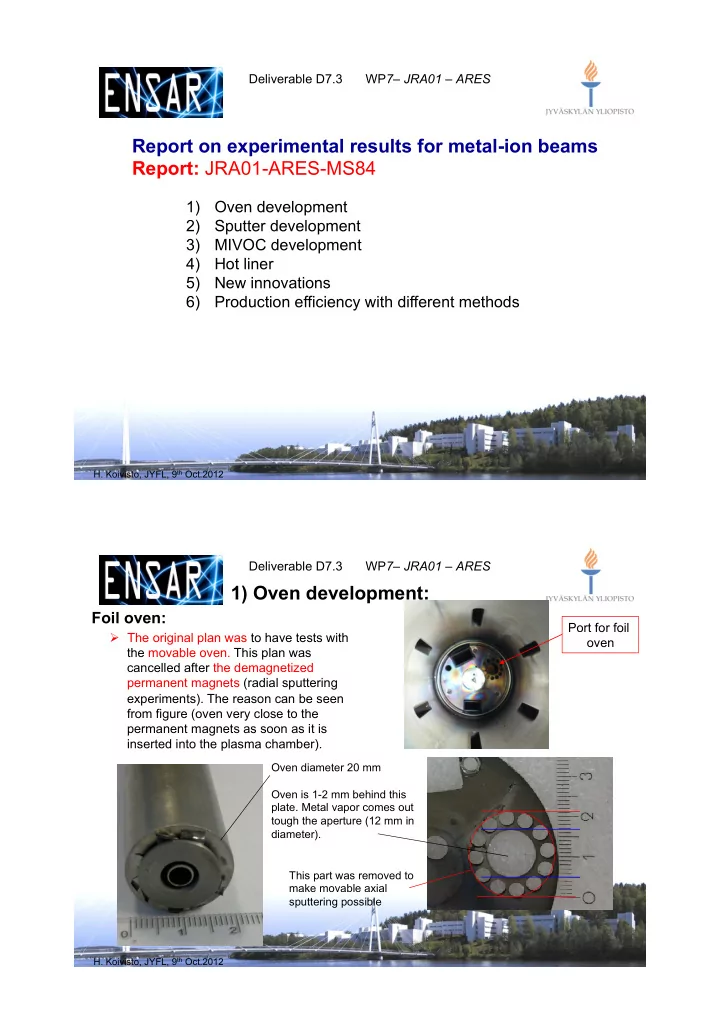
Foil oven:

! The original plan was to have tests with the movable oven. This plan was cancelled after the demagnetized permanent magnets (radial sputtering experiments). The reason can be seen from figure (oven very close to the permanent magnets as soon as it is inserted into the plasma chamber). Port for foil

  • ven

Oven is 1-2 mm behind this

  • plate. Metal vapor comes out

tough the aperture (12 mm in diameter). Oven diameter 20 mm This part was removed to make movable axial sputtering possible

slide-2
SLIDE 2
  • H. Koivisto, JYFL, 9th Oct.2012

Deliverable D7.3 WP7– JRA01 – ARES

Foil oven modifications

Support structure was added to make rod structure more rigid

Connection system was made more tight

Cu Mo

Problem was identified: Cu has much higher T

  • coefficient. Connection gets loose when T increases!!

Earlier experiment with induction oven (late 2008) T(oven) was 1460˚C, Oxygen mixing gas.

During Oct. 2013 – Jan. 2014 foil oven was slightly modified to improve the reliability (not inserted into the chamber). The intensity

  • f 7.6 µA for Cr8+ was obtained with the

helium mixing (Ioven was 59 A). If the earlier T calibration can be trusted after these small modifications the oven temperature was slightly higher than 1500˚C. This oven has potential to go remarkably higher in T.

  • H. Koivisto, JYFL, 9th Oct.2012

Deliverable D7.3 WP7– JRA01 – ARES

MoO3 with oven

! MoO3 has the vapor pressure

  • f 1 mbar at 800˚C

! Has several isotopes (92Mo: 14.84 %, 94Mo: 9.25 %, 95Mo: 15.92 %, 96Mo: 16.68 %, 97Mo: 9.55 %, 98Mo: 24.13 %, 100Mo: 9.63 % )

INFN: 92MoO3

EU classification Carc. Cat. 3 Harmful (Xn) Irritant (Xi)

slide-3
SLIDE 3
  • H. Koivisto, JYFL, 9th Oct.2012

Deliverable D7.3 WP7– JRA01 – ARES

Oven experiments at GANIL: ! Oven capable of covering evaporation temperatures from Ca to Ni ! Movable (any tests?) ! Strong heating by RF/plasma. Limiting the performance for high charge state Ca beams (Ca16+) ! He vs O2 vs N2 has negligible effect on total ionization efficiency (which is ≈ 5 %)

High intensity Ni19+ beam

  • H. Koivisto, JYFL, 9th Oct.2012

Deliverable D7.3 WP7– JRA01 – ARES

A-A ( 1 : 2 )

1 2 3 4 5 6 C C D D

Ä

Ä Ä Ö ö ö

Ä Ä

New design: Intensities were lower than earlier (Ti11+ : ≈ 20 µA " less than 10 µA). This indicates that we have had sputtering + heating. The question comes up: can we arrange this resonant heating safely?

Sputter sample (V ≈ - 1kV Permanent magnets

High intensity Ti11+ ion beam was obtained using radial sputtering. Caused the damage of PM

  • structure. New cooled

design was constructed.

2) Sputter development: Radial sputtering

slide-4
SLIDE 4
  • H. Koivisto, JYFL, 9th Oct.2012

Deliverable D7.3 WP7– JRA01 – ARES

2) Axial sputtering

Axial sputtering: two versions, two separate experimental weeks, not yet successful.

Port for axial sputtering This part was removed to make insertion possible Bias disk This point very close to the wall

Version 1: Heat shielding is very close to the wall when sputter sample is inserted into the plasma chamber. To avoid any contact (possibly causes a local heat load on permanent magnet) we decided to limit insertion to 15 mm. We saw some tens of nA of Zr12+ beam (without high confidence!) Version 1 Version 2

Heat radiation shield Zr sample

  • H. Koivisto, JYFL, 9th Oct.2012

Deliverable D7.3 WP7– JRA01 – ARES

Version 2: we were able to get up to 0.5 µA of Zr12+ beam. During the short time we see more (close to 2 µA) but we were not able to get it back. The intensity is far behind the requested (≈ 20 µA). ! The insertion had a big effect as is seen from the current of sputter voltage. ! We should have enough sputtering (sputter current high enough) ! Conclusion: sputter products do not reach the plasma.

Pois%on'[mm]' Spu.er'voltage'[kV]' Spu.er'current'[mA]' :10' 3' '0.21' :20' 3' '0.45' :20' 4' '0.52' :40' 4' '1.04'

Typical sputter voltage in the case of radial sputtering is 1-2 kV Zero level corresponds to inner surface of pc

Axial sputtering

slide-5
SLIDE 5
  • H. Koivisto, JYFL, 9th Oct.2012

Deliverable D7.3 WP7– JRA01 – ARES

Axial sputtering

More axial sputtering experiments were performed at ATOMKI: Results: Au20+: 1 µA (very stable, O2 buffer) Ca8+: 2 µA Si5+: 2 µA This looks more promising!! Has to be on plasma flux area? Closer to plasma? More experiments have to be performed.

  • H. Koivisto, JYFL, 9th Oct.2012

Deliverable D7.3 WP7– JRA01 – ARES 50Ti ion beams

Ti spectrum (MIVOC, 2002) The first Ti ion beams using MIVOC were produced using commercial compound: ((trimethyl)pentamethylcyclo pentadienyltitanium)

3) MIVOC development:

slide-6
SLIDE 6
  • H. Koivisto, JYFL, 9th Oct.2012

Deliverable D7.3 WP7– JRA01 – ARES

50Titanium beam production

at GANIL with the ECR4 ion source ! Using C5(CH3)5Ti(CH3)3 ! 50Ti10+ beam of 10-25 µA ! Nuclear physics experiment of 15 days

50Tiq+'

9+' 10+' 11+' 12+' I'[µA]' '14.9' '16.8' '19.4' '14.8'

50Titanium beam production

at JYFL with the ECRIS2 ion source ! Using C5(CH3)5Ti(CH3)3 ! 50Ti11+ beam of 15-20 µA ! Nuclear physics experiment of several weeks

Successful synthesis of Ti compound makes the Ti isotopes of 46, 47 and 49 available.

  • H. Koivisto, JYFL, 9th Oct.2012

Deliverable D7.3 WP7– JRA01 – ARES

4) Hot liner R & D

Hot liner at GSI: ! Passively heated by plasma ! Works nicely for Ca ! Production efficiency similar to gases was reached: 13 % for Ca10+, overall efficiency > 40 % (measured after dipole) ! Long term stability

slide-7
SLIDE 7
  • H. Koivisto, JYFL, 9th Oct.2012

Deliverable D7.3 WP7– JRA01 – ARES

Hot liner at GANIL: ! ??

  • H. Koivisto, JYFL, 9th Oct.2012

Deliverable D7.3 WP7– JRA01 – ARES

Hot liner at INFN: ! Temperature distribution of liner as a function of microwave power was simulated ! Ca consumption rate decreased ≈ 40 %

slide-8
SLIDE 8
  • H. Koivisto, JYFL, 9th Oct.2012

Deliverable D7.3 WP7– JRA01 – ARES

5) New innovations

Production of sputter target from elements available in powder form (especially for refractory elements)

Melting by electron beam

  • H. Koivisto, JYFL, 9th Oct.2012

Deliverable D7.3 WP7– JRA01 – ARES

Use of low thermal conductivity

During the development work of axial sputtering we realized that even a low power load can result

  • n substantial increase of T if

material has a low thermal

  • conductivity. This might be useful

when the geometry has been

  • ptimized for this idea.

3 mm (in diameter) stainless steel rod, 60 cm in length, load 10 W

'' Depends'on'T' '' '' Material' Thermal'conduc%vity'@25˚C'[W/m/K]' Mel%ng'point'[˚C]' Thermal'expansion'E:6'[1/K]' Ti' '21.9' 1668' '8.6' SS" 16" 1510' 15' Cu' 400' 1084' '16.5' Zr" "22.7" 1855' '5.7' Mo' 139' 2623' '4.8' Ta" 57" 3017' '6.3'

! Optimal geometry ! Optimal combination of materials

slide-9
SLIDE 9
  • H. Koivisto, JYFL, 9th Oct.2012

Deliverable D7.3 WP7– JRA01 – ARES

0.1 1.0 10.0 9 10 11 12 13 14 15 16 17 18 19 20 21 22 23 24

Efficiency [%] Charge state

Kr 0.1 mg/h Mn 0.27 mg/h with oven Ti 0.22 mg/h with MIVOC

6) Production efficiency with different methods

MIVOC method has much higher production efficiency than oven method (JYFL miniature oven): ! Gaseous form (at RT) not condensation on the walls ! Capture of slow molecule (by plasma) might be more efficient