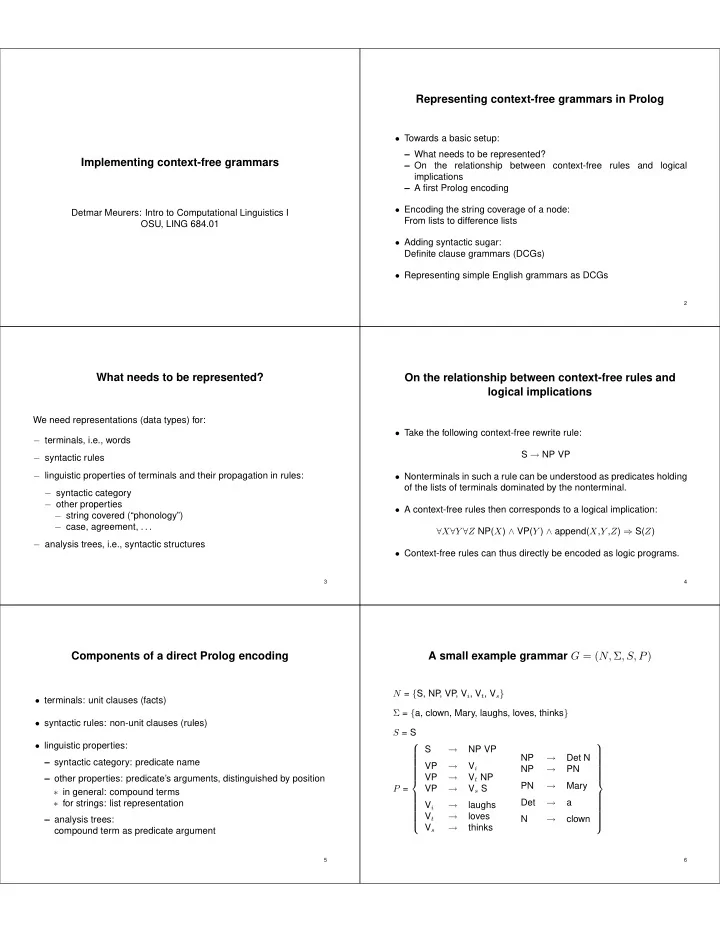

Implementing context-free grammars
Detmar Meurers: Intro to Computational Linguistics I OSU, LING 684.01
Representing context-free grammars in Prolog
- Towards a basic setup:
– What needs to be represented? – On the relationship between context-free rules and logical implications – A first Prolog encoding
- Encoding the string coverage of a node:
From lists to difference lists
- Adding syntactic sugar:
Definite clause grammars (DCGs)
- Representing simple English grammars as DCGs
2
What needs to be represented?
We need representations (data types) for: − terminals, i.e., words − syntactic rules − linguistic properties of terminals and their propagation in rules: − syntactic category − other properties − string covered (“phonology”) − case, agreement, . . . − analysis trees, i.e., syntactic structures
3
On the relationship between context-free rules and logical implications
- Take the following context-free rewrite rule:
S → NP VP
- Nonterminals in such a rule can be understood as predicates holding
- f the lists of terminals dominated by the nonterminal.
- A context-free rules then corresponds to a logical implication:
∀X∀Y ∀Z NP(X) ∧ VP(Y ) ∧ append(X,Y ,Z) ⇒ S(Z)
- Context-free rules can thus directly be encoded as logic programs.
4
Components of a direct Prolog encoding
- terminals: unit clauses (facts)
- syntactic rules: non-unit clauses (rules)
- linguistic properties:
– syntactic category: predicate name – other properties: predicate’s arguments, distinguished by position ∗ in general: compound terms ∗ for strings: list representation – analysis trees: compound term as predicate argument
5
A small example grammar G = (N, Σ, S, P)
N = {S, NP , VP , Vi, Vt, Vs} Σ = {a, clown, Mary, laughs, loves, thinks} S = S P = S → NP VP VP → Vi VP → Vt NP VP → Vs S Vi → laughs Vt → loves Vs → thinks NP → Det N NP → PN PN → Mary Det → a N → clown
6