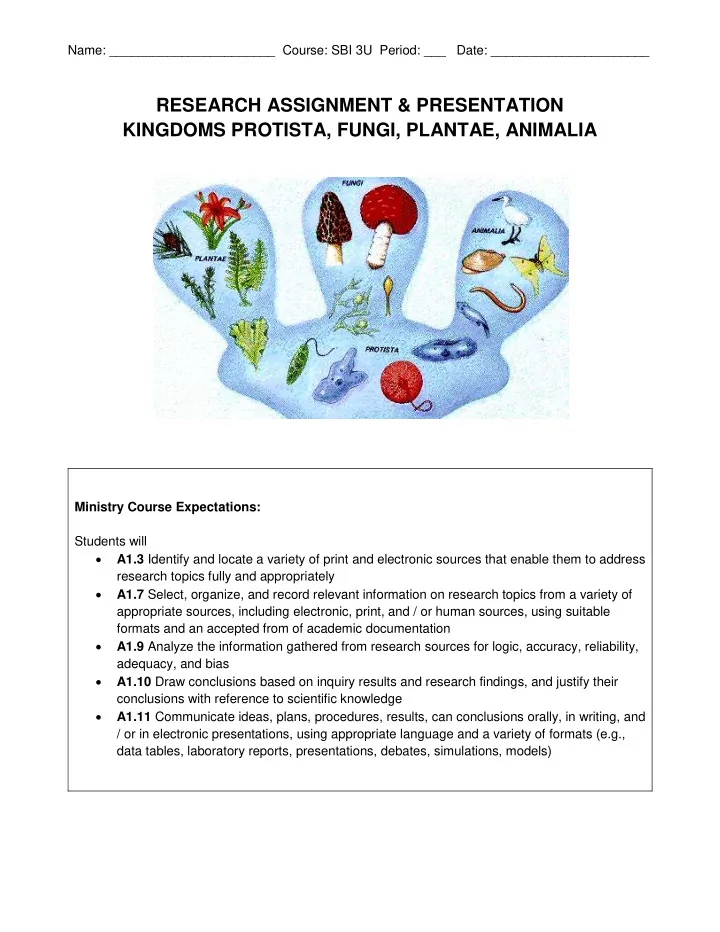
RESEARCH ASSIGNMENT & PRESENTATION KINGDOMS PROTISTA, FUNGI, - - PDF document

research assignment amp presentation kingdoms protista
SMART_READER_LITE
LIVE PREVIEW

RESEARCH ASSIGNMENT & PRESENTATION KINGDOMS PROTISTA, FUNGI, - - PDF document

Name: _______________________ Course: SBI 3U Period: ___ Date: ______________________ RESEARCH ASSIGNMENT & PRESENTATION KINGDOMS PROTISTA, FUNGI, PLANTAE, ANIMALIA Ministry Course Expectations: Students will A1.3 Identify and locate


slide-1
SLIDE 1

Name: _______________________ Course: SBI 3U Period: ___ Date: ______________________

RESEARCH ASSIGNMENT & PRESENTATION KINGDOMS PROTISTA, FUNGI, PLANTAE, ANIMALIA

Ministry Course Expectations: Students will

  • A1.3 Identify and locate a variety of print and electronic sources that enable them to address

research topics fully and appropriately

  • A1.7 Select, organize, and record relevant information on research topics from a variety of

appropriate sources, including electronic, print, and / or human sources, using suitable formats and an accepted from of academic documentation

  • A1.9 Analyze the information gathered from research sources for logic, accuracy, reliability,

adequacy, and bias

  • A1.10 Draw conclusions based on inquiry results and research findings, and justify their

conclusions with reference to scientific knowledge

  • A1.11 Communicate ideas, plans, procedures, results, can conclusions orally, in writing, and

/ or in electronic presentations, using appropriate language and a variety of formats (e.g., data tables, laboratory reports, presentations, debates, simulations, models)

slide-2
SLIDE 2

Task

  • Working individually:
  • Read the section of the textbook that covers your topic
  • Find current information in the news related to your topic using at least 2 sources. Sources

must be current (within last 2 years), accurate and authoritative (e.g. newspapers, science journals or science magazines). Avoid articles which repeat the same information that is already provided by the textbook.

  • Prepare and present a 5 - 8 minute PowerPoint slideshow to the rest of the class
  • Prepare a short quiz, consisting of 10 True or False questions that focus on the main ideas of

your presentation. Include an answer key in the notes section.

  • Google Slide or PowerPoint presentation
  • Contains 5 – 8 slides

➢ First slide should be title slide ➢ Second last slide should contain True or False quiz (10 questions) ➢ Last slide should be References cited in APA style (2 sources in addition to textbook)

  • Each slide must contain both text and visuals

➢ Text only contains key words and ideas. ➢ Details, explanations, background info as well as interesting trivia are provided in the notes section under each slide. Information should be written in your own words. Do NOT simply copy and paste. ➢ Summary of news articles related to your topic should be provided in point form in your

  • wn words in notes section under applicable slide.

➢ Visuals must be relevant. They should add meaning to the text and help the audience understand the topic better. When explaining the slide orally, you should be referring to the pictures and relating them to your key ideas.

  • You are encouraged to add a short video clip or animation to better explain your topic. If used,

the video or animation should be no longer than 2 minutes.

  • Present your topic to the rest of the class.
  • Thoroughly explain your topic, covering all of the information in the textbook and

incorporating the new research information you found in newspapers, science magazines, etc.

  • Maintain eye contact
  • Discuss your topic. Do not read your slide to the class!
  • Encourage student attention and participation
  • Use sound effects, pictures, video footage, animations, role play, etc. to stimulate interest.
  • Stay within your time limit!

Sources of information:

  • Textbook
  • At least 2 articles from newspapers, science magazines or journals (print or online)
  • References (APA style) needed for the current information related to your topic
  • See PETHS Library website (http://www.yrdsb.ca/schools/trudeau.hs/library/Pages/Research-

Tools.aspx) for more information about APA citations Your Google Slide or PPT must be submitted by: Wed, Jan 10, 2018 Your 10 True or False Questions must be submitted as a Word doc by: Wed, Jan 10, 2018

slide-3
SLIDE 3

UNIT 3 DIVERSITY PRESENTATIONS Sign-up Sheet

Presentation Date Topics McGraw-Hill Ryerson pages Student Sign-Up Fri, Jan 12 Introduction to Protists (general characteristics, 3 major groups) 72 Fri, Jan 12 Animal-like Protists, the Cercozoans and the Ciliates 72-73 Fri, Jan 12 Animal-like Protists: the Flagellates and the Sporozoans 74 Fri, Jan 12 Fungus-like Protists 75 Fri, Jan 12 Plant-like Protists: Diatoms, Dinoflagellates, Euglenoids 76-77 Mon, Jan 15 Introduction to Algae, Brown Algae, Red Algae, Green Algae 90-92 Mon, Jan 15 Shift to land: Adaptations to life on land: plant embryos, vascular tissue, leaves and roots, alternation of generations 93-94 Mon, Jan 15 Plant Kingdom: Non-vascular plants: Bryophytes 96-97 Mon, Jan 15 Seedless Vascular Plants; Fern Life Cycle 98-99 Mon, Jan 15 Seed-Producing Vascular Plants: Introduction to Gymnosperms and Angiosperms; Gymnosperm Diversity; Angiosperm Diversity 100-101 Tue, Jan 16 Angiosperm Characteristics: Flowers, Fruits; Angiosperm Classification: Monocots and Dicots 102-103

slide-4
SLIDE 4

Tue, Jan 16 Fungus Kingdom; Structure of Fungi 105 Tue, Jan 16 Fungal Nutrition & Fungal Reproduction 105-106 Tue, Jan 16 Fungal Classification: Fungi Imperfecti & Chytrids 107 Tue, Jan 16 Zygospore Fungi & Sac Fungi 108 Wed, Jan 17 Club Fungi & Lichens 109 Wed, Jan 17 The Animal Kingdom; What is an Animal? Characteristics used to classify animals; Levels of

  • rganization; Number of body layers; Symmetry

and body plans; Body cavities; Segmentation; Movement; Reproduction 111-114 (2 students) Wed, Jan 17 Invertebrate animals: Sponges and Cnidarians; Worms 114-115 Wed, Jan 17 Molluscs and Echinoderms 116-117 Wed, Jan 17 Arthropods 118 Thur, Jan 18 Vertebrate Animals: Fish 119 Thur, Jan 18 Amphibians and Reptiles 120-121 Thur, Jan 18 Birds 122 Thur, Jan 18 Mammals 123

slide-5
SLIDE 5

RESEARCH ASSIGNMENT & PRESENTATION EVALUATION RUBRIC

This project is worth 4% of your final mark (2% Communication and 2% Application).

PART A: CURRENT INFO ON YOUR TOPIC Needs improvement (<50%) Adequate Good Excellent Mark Application (2% of final mark)

At least 2 sources of information not including the textbook are used. Fewer than 2 different sources

  • used. Sources are poor quality.

At least 2 different sources

  • used. Sources are somewhat

authoritative, credible, current, unbiased and accurate. At least 2 different sources

  • used. Sources are mostly

authoritative, credible, current, unbiased and accurate. At least 2 different sources

  • used. Sources are

authoritative, credible, current, unbiased and accurate.

/ 5

Works Cited list is done accurately and in the correct format in APA style as shown in class. All researched information is cited. Many mistakes in the citations. Less than 50% of the information was cited. Citations were somewhat complete, accurate and in the correct format. 50% or more of the information was cited. Citations were mostly complete, accurate and in the correct

  • format. Most information was

cited. Complete, accurate citations done in correct format. All info was cited.

/ 5

Researched information is current (within last 2 years), accurate, interesting and relevant. Student explains information competently and confidently. Researched information is lacking in currency, accuracy, interest and / or relevance. Student lacks competence and / or confidence when explaining information. Researched information is somewhat current, accurate, interesting and relevant. Student explains information somewhat competently and confidently. Researched information is mostly current, accurate, interesting and relevant. For the most part, student explains information competently and confidently. Researched information is current, accurate, interesting and relevant. Student explains information competently and confidently.

/ 10

Deduction (-0.4 mark per day to a maximum of -2 marks)

TOTAL / 20

slide-6
SLIDE 6

PART B: ORAL PRESENTATION

Needs improvement (<50%) Adequate Good Excellent Mark

Communication (2% of final mark)

Explanation of topic is clear, current and in sufficient detail. Interesting and relevant facts, statistics, quotes from experts, and / or case studies, etc. are given. Explanation of topic is inadequate. More details are needed. Explanation of topic is somewhat clear and current. Some details have been provided. A few interesting and relevant facts, statistics, quotes from experts, and / or case studies, etc. are given. Explanation of topic is mostly clear and current. Many details have been provided. Some interesting and relevant facts, statistics, quotes from experts, and / or case studies, etc. are given. Explanation of topic is clear, current and in sufficient detail. Interesting and relevant facts, statistics, quotes from experts, and / or case studies, etc. are given.

/ 5

Audiovisual aspects (Pictures, text, animations, video footage, music, etc.) of presentation Audiovisual aspects are often irrelevant, uninteresting or

  • distracting. They rarely help the

audience to understand Some of the audiovisual aspects (e.g. graphics & text, animations, video footage, music, etc.) of presentation are relevant, creative and stimulating. They sometimes enhance the audience’s understanding of the topic. Most of the audiovisual aspects (e.g. graphics & text, animations, video footage, music, etc.) of presentation are relevant, creative and stimulating. They usually enhance the audience’s understanding of the topic. Audiovisual aspects (e.g. graphics & text, animations, video footage, music, etc.) of presentation are relevant, creative and stimulating. They enhance the audience’s understanding of the topic.

/ 5

Organization and delivery of Information Organization of information is

  • unclear. Presentation is

challenging to understand. Delivery is often unclear and shows a lack of knowledge or confidence on the part of the presenter. Presenter

  • ften spoke too quickly or slowly, or

at a poor volume. Presenter rarely maintained eye contact, and heavily relied on their notes. Audience is

  • ften not engaged.

Some information is logically

  • sequenced. There are some

lapses of understanding. Delivery sometimes falters in clarity and

  • confidence. Presenter sometimes

spoke too quickly or slowly, or too loudly or softly. Presenter sometimes maintained eye contact, but relied on their notes a lot. Presenter is somewhat knowledge and sometimes engages the audience. Most information is organized in a clear, logical way and easy to

  • understand. Delivery is mostly

clear and confident. Presenter mostly spoke at a good rate and

  • volume. Presenter mostly

maintained eye contact, but relied

  • n their notes a fair amount.

Presenter is knowledgeable and engages the audience most of the time. Information is organized in a clear, logical way. Delivery is clear and

  • confident. Presenter spoke at a

good rate, volume and with good

  • grammar. Presenter maintained

eye-contact while using, but not reading their notes. Presenter is very knowledgeable and engages the audience. Presentation is easy to follow and understand. Audience was very engaged.

/ 5

True or False Quiz Questions 10 True or False Questions rarely cover the main ideas. A large portion of the presentation was not

  • covered. The meaning of many

questions is unclear or ambiguous. Difficulty level of the questions is

  • ften too hard or too easy. Answer

key has significant inaccuracies. 10 True or False Questions some

  • f the main ideas. Questions cover

some parts of the presentation more than other parts. The meaning of the questions is at times unclear. Difficulty level of the questions is sometimes too hard and sometimes too easy. The answer key is mostly accurate. 10 True or False Questions concern mostly the main ideas. Questions cover the most of the

  • presentation. The meaning of the

questions is clear. Difficulty level of the questions is mostly at the Grade 11 level. An accurate answer key has been provided. 10 True or False Questions concern the main ideas. Questions cover the entire presentation. The meaning of the questions is clear. Difficulty level of the questions is at the Grade 11 level. An accurate answer key has been provided.

/ 5

Deduction (- 0.4 mark per day late to a maximum deduction of -2 marks)

TOTAL / 20