Research Needs for Inclusive ASF Market Development in Feed the - - PowerPoint PPT Presentation

research needs for inclusive asf market
SMART_READER_LITE
LIVE PREVIEW

Research Needs for Inclusive ASF Market Development in Feed the - - PowerPoint PPT Presentation

Research Needs for Inclusive ASF Market Development in Feed the Future Countries Jim Yazman, PhD. Livestock Sciences Specialist USAID Bureau for Food Security Washington, DC Key messages : Rapid urbanization in developing countries is


slide-1
SLIDE 1

Jim Yazman, PhD. Livestock Sciences Specialist USAID Bureau for Food Security Washington, DC
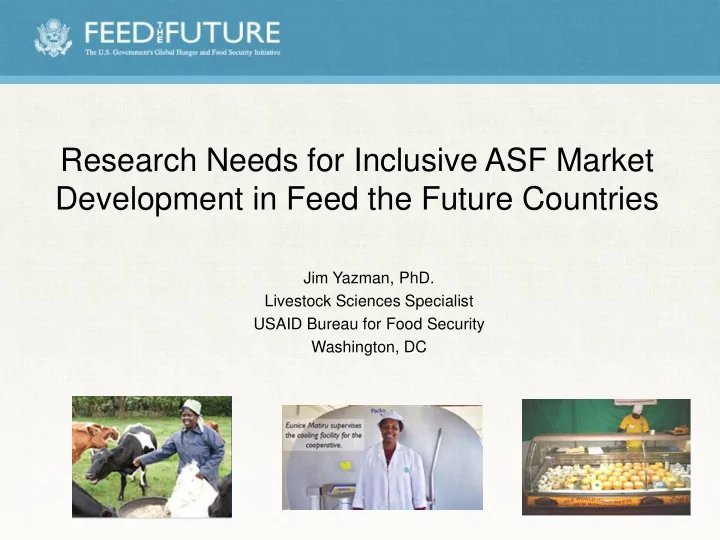
Research Needs for Inclusive ASF Market Development in Feed the Future Countries

slide-2
SLIDE 2

Key messages:

  • Rapid urbanization in developing countries is

creating a rapidly-expanding demand for ASFs.

  • Pressure on producers, investors, governments,

partner donors to address concerns of equity, food safety, environmental protection, animal welfare.

  • Pro-poor ASF market systems can (must) be

competitive.

  • Need for research - scalable technologies and

management systems.

slide-3
SLIDE 3

Why does USAID invest in ASF market systems?

  • Target HHs have the animals. They already contribute to income,

nutrition, resiliency

  • ASF markets can be inclusive – poor HH (SHs and pastoralists),

women, youth, PLWHAs, other marginalized groups.

  • Transforming ASF market systems essential for protecting resources

and for climate change adaptation.

  • Increased availability of ASFs underpins improved nutrition in the

1000 days.

  • Demand for ASFs is growing rapidly with income and urbanization.
  • Governments, private sector see potential for intra-regional and

export markets.

slide-4
SLIDE 4

Principles Underpinning Inclusive ASF market development

Opportunities for individuals from all populations of interest to engage in ASF markets. But….. Inclusiveness that enhances and doesn’t compromise value chain competitiveness. Broad scaling of impact and long-term sustainability of

  • ur investment are as important as short-term
  • utcomes.
slide-5
SLIDE 5

Rapid Urban Population Growth Across the Developing World

  • Urbanization in LDC 13% in 1970, est. 35% in 20201
  • Urbanization associated with changes in income and

diet.

  • Result is an increased demand for ASFs = an
  • pportunity for inclusive market development.

1: Satterwhite, et. al. 2010

slide-6
SLIDE 6

Urban diets are higher in ASFs

Source: IFPRI, 2010

slide-7
SLIDE 7

With higher income ASF consumption rises

Source: Maxwell and Levin, 2000

slide-8
SLIDE 8

Rural Populations Continue to Grow

  • Rural families – young people – require jobs.
  • Competitive ASF markets require skilled workers

in jobs attractive to youth, women.

  • Opportunities for employment-creating SMEs at

different stages of the ASF value chain.

slide-9
SLIDE 9

Challenges in ASF Market Development

  • As markets grow, local firms face competition from often

lower-cost, higher-quality imports.

  • Transaction costs – aggregating from small volumes,

geographically dispersed.

  • Poorly developed input and services sectors
  • Poorly capitalized producers and other VC actors.
  • Lack of private investment.
  • Lack of public infrastructure – electrical grid, water, roads
  • Consumer concerns for food safety – Social media!
slide-10
SLIDE 10

Partners Need to Address Concerns

  • Food safety
  • Impact of over-consumption of ASFs on diet and health
  • Deforestation, over-grazing, water and air pollution
  • Inefficient use of scarce water resources and crop land
  • GHG generation by livestock, manure, processing waste
  • Animal welfare – potential impact should not be minimized!!
slide-11
SLIDE 11

USAID Seeks Competitive ASF Markets

  • On-going, adequate investment in technology generation and

extension

  • Well-capitalized, “right-sized” farms utilizing “best science”,

information, etc., delivering raw product under strict public health regulations and buyer quality standards.

  • National products recognized for taste, safety, convenience, price
  • Make unnecessary NTT barriers to protect markets.

Competitiveness contributes to increases in:

  • Availability (affordability) of ASFs
  • Investment, private and public
  • SH\pastoralist HH income
  • Employment all along the value chain
slide-12
SLIDE 12

Case study: African Dairy Sector

  • Many groups are livestock keepers
  • Milk and dairy foods a traditional part of diets
  • Recognized as food important in 1000 days
  • Positive gender implications – women control milk income.
  • Milk marketing underpins household economy and resilience
  • Crossbreeding/upgrading proven way to capitalize families.
  • Dairy production and marketing has arisen out of traditional

crop-livestock systems

slide-13
SLIDE 13

Growth Opportunities: East Africa dairy market

Source: Makoni, et.al. 2014

slide-14
SLIDE 14

Distribution of employment in “traditional” dairy value chains Production

Inputs and Services Processing Retailing

slide-15
SLIDE 15

Changes in employment with dairy value chain “transformation”

Traditional – Limited “upstream” employment

Production

Inputs and Services

Processing and Distribution

Retailing

Transformed – Major part of employment is upstream

Production

With transformation and increased competitiveness, total employment grows but % at production level declines. New technology enables this process.

slide-16
SLIDE 16

African Dairy Markets Transforming

  • Urbanized populations, growing middle class population driving

interest of regional and global dairy firms.

  • Regional trade agreements open cross-border trade.
  • Land and water resources available.
  • With donor support, raw milk supply increasing.
  • Global players see pathway to regional markets (Middle East).
  • Supermarkets are creating a channel to urban middle class

consumers.

slide-17
SLIDE 17
slide-18
SLIDE 18

Meeting the Opportunities in the Dairy Sector

  • Reduce transaction costs, expand raw milk supply
  • Productive, appropriate breeds, good breeding management –

reduce supply depressions.

  • High-quality raw milk: low SCC, free of contaminants
  • Certified healthy cows
  • Raw milk prices defined by end market product prices
  • Technology and information flow up and down the value chain
  • Producers rewarded with higher prices for meeting specifications
slide-19
SLIDE 19

Filling a need for appropriate technology: PortCheck Mastitis Detection T est Strips

slide-20
SLIDE 20

Research to Transform the Dairy Value Chain

slide-21
SLIDE 21

Thanks!