SLIDE 1
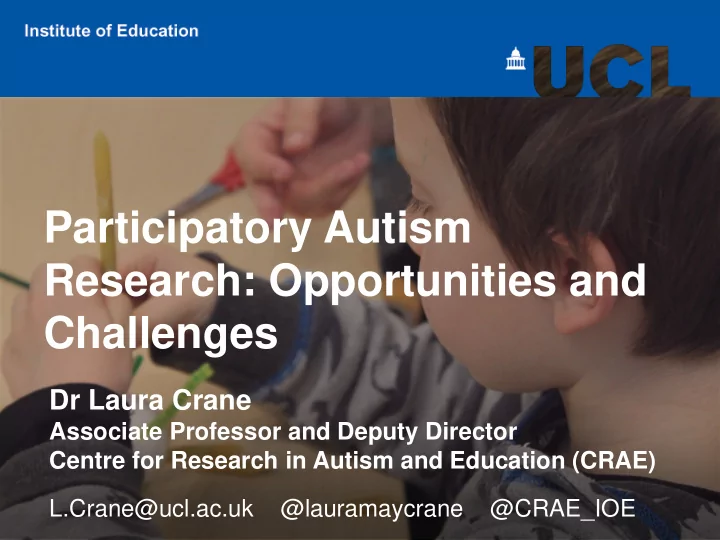
Dr Laura Crane
Associate Professor and Deputy Director Centre for Research in Autism and Education (CRAE) L.Crane@ucl.ac.uk @lauramaycrane @CRAE_IOE
Participatory Autism Research: Opportunities and Challenges
SLIDE 2 Centre for Research in Autism and Education (CRAE) – Our Mission
- Conduct high quality scientific research that has a positive
impact on the lives of autistic children, young people and adults
- Meaningfully engage with the autistic and broader autism
communities to shape the future direction of autism research
SLIDE 3
SLIDE 4
Dramatic rise in autism publications
...but still a huge ‘translational gap’
SLIDE 5 A Future Made Together
- To describe the current landscape of UK autism
research
- To compare the nature of research with the
views and perspectives of the autism community
- To understand the nature and extent of
community involvement in research
SLIDE 6
A role for participatory research?
SLIDE 7
SLIDE 8
SLIDE 9
SLIDE 10
SLIDE 11 Research questions
- How do young autistic people interpret “normal” mental
health?
- Does a person’s “normal” change when they are experiencing
mental health problems; if so, how?
- What are young autistic people’s experiences of accessing
support for their mental health problems?
SLIDE 12 Participants - eligibility
- 16 to 25 years of age
- Have received a formal diagnosis of an autism
spectrum condition
SLIDE 13 Participants and Methods
- Online survey (n=109)
- Semi-structured interviews (n = 21)
- Limited our sample to those with good spoken or written
language – unsurprising that many in our sample were diagnosed with Asperger syndrome, had gained educational qualifications, and were currently in employment/education
SLIDE 14
Survey – key findings
1)‘Normal’ is negative for young autistic people 2)High rates of mental health problems 3)Poor mental health literacy
SLIDE 15 1) ‘Normal’ is negative for young autistic people
Strikingly high rates of young autistic people reporting that they were feeling… Unhappy and depressed Worthless Under strain
Unable to overcome difficulties
Unable to face up to problems Lacking in confidence
SLIDE 16
2) High rates of mental health problems
SLIDE 17 3) Poor mental health literacy
How does “normal” mental health change when experiencing mental health problems? Unhappy and depressed Worthless Under strain
Unable to overcome difficulties
Unable to face up to problems Lacking in confidence
SLIDE 18
Know Your Normal Toolkit
Download for free at www.knowyournormal.co.uk
SLIDE 19
SLIDE 20
SLIDE 21
Interview results – four themes
1)(Not) understanding my “normal” 2)Stigma 3)Barriers to support 4)Trusting relationships
SLIDE 22 1) (Not) understanding my “normal”
- Many young autistic people were unsure
whether the difficulties they were experiencing were due to their autism or their mental health problems
SLIDE 23
SLIDE 24
2) Stigma
Mental health
Autism
SLIDE 25 3) Barriers to support
- Lack of available services
- Delays
- Not tailored to individual needs
- No other options available
- Disjointed services
- Poor transitions
SLIDE 26
4) Trusting relationships
“What I’d like is someone I can trust, someone to talk to, and someone who understands autism; a professional person”
SLIDE 27 Recommendations
- More initiatives to reduce
stigma of autism and mental health
professionals
- Greater autistic involvement in
service design and delivery
SLIDE 28
SLIDE 29
SLIDE 30
‘Early career’ and ‘established’ researchers’ views on participatory autism research
SLIDE 31 Participatory research is…?
- Growth of participatory research
- It “makes me do better science”
- But what actually is it? What ‘counts’?
SLIDE 32 Need for support…
- Barriers and challenges
- Need (1) good mentoring, (2) development
- f more trusting relationships with autistic
co-researchers
- How do I start? (need for templates/exemplars)
SLIDE 33
Working in partnership
www.shapingautismresearch.co.uk
SLIDE 34
Coming soon…
The Research Passport
SLIDE 35
Thank you!
SLIDE 36
Dr Laura Crane
Senior Lecturer and Deputy Director Centre for Research in Autism and Education (CRAE) L.Crane@ucl.ac.uk @lauramaycrane @CRAE_IOE
Thank you for listening