Researching the International in International Tax Law Cline - - PowerPoint PPT Presentation

researching the international in international tax law
SMART_READER_LITE
LIVE PREVIEW

Researching the International in International Tax Law Cline - - PowerPoint PPT Presentation

Researching the International in International Tax Law Cline Braumann Department of European, International and Comparative Law, University of Vienna Sour urce ce:H :H. Armstr trong ng R Roberts ts, engraving ng 1 16 Decembe


slide-1
SLIDE 1

Researching the ‘International’ in International Tax Law

Céline Braumann Department of European, International and Comparative Law, University of Vienna

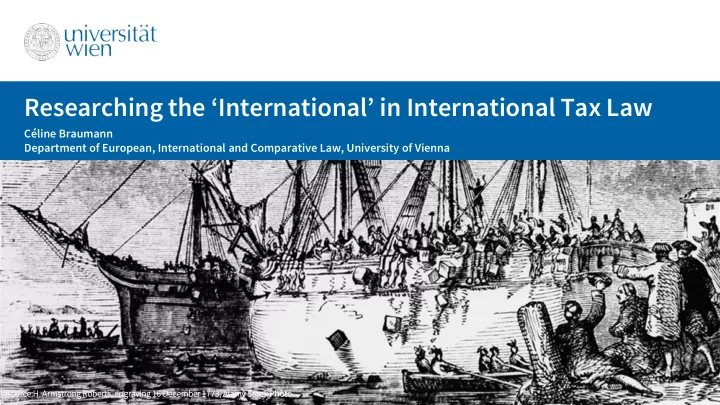
Sour urce ce:H :H. Armstr trong ng R Roberts ts, engraving ng 1 16 Decembe mber 1773 1773, Alamy my Stock P Photo to

slide-2
SLIDE 2

1. 1. The e Gener eneral I l Idea ea 2. 2. Theore

  • retic

ical Fo Foundations ns

a. Customary international law (CIL) in int‘l tax law (ITL) b. General principles of law (GP) in ITL

3. 3. Method

  • dology

4. 4. Pr Preli elimina nary Fi Findings

26/11/2019 Céline Braumann - celine.braumann@univie.ac.at Page 2

Overview

slide-3
SLIDE 3

Theoretical Foundations

Page 3

Source: Alamy Stock Photo

slide-4
SLIDE 4

State B

26/11/2019 Céline Braumann - celine.braumann@univie.ac.at Page 4

International Tax Law

State A (residence) (source)

  • 3000 bilateral doub

uble e tax ax trea eatie ies

  • highly similar/identical
  • OECD or UN Model Tax Conventions
slide-5
SLIDE 5

= ‘unwritten law deriving from practice accepted as law.’ (ILC definition)

  • 2018 ILC Conclusions on the Identification of CIL
  • two-element approach: State practice + opinio juris

Customary International Law

26/11/2019 Céline Braumann - celine.braumann@univie.ac.at Page 5

slide-6
SLIDE 6
  • 1. Practice may take a wide range of forms. It includes both ph

physical a and d verb rbal a acts

  • ts. It may, under certain circumstances, includ

ude i inaction.

  • 2. Forms of State practice include, but are not limited to: diplomat

atic acts ts and correspond ndenc ence; conduct ct in co conn nnection wi with r resolutions adopted by an international organization or at an intergovernmental conference; conduct i t in connection w with th tre treaties; executive conduct, including

  • perational conduct “on the ground”; leg

legisla lative a ve and nd administrative ve acts; and decision

  • ns o
  • f national court

rts.

26/11/2019 Céline Braumann - celine.braumann@univie.ac.at Page 6

Types of Evidence for State practice (Conclusion 6)

slide-7
SLIDE 7
  • 2. Forms of evidence of acceptance as law (opinio juris) include, but are not

limited to: public statements made on behalf of States; official al p publications; gover vernm nment ent leg legal o l opini nions ns; diplomatic correspondence; decision

  • ns o
  • f

nat atio ional al c cou

  • urts; tre

treaty ty p pro rovisions; and co cond nduct i in co connect ction w n with resolut utions adopted by an international organization or at an intergovernmental conference.

  • 3. Failure to

to re react ct over time to a practice may serve as evidence of acceptance as law (opinio juris), provided that States were in a position t to re react and the circ rcumstances c called fo for so r some re reacti tion.

26/11/2019 Céline Braumann - celine.braumann@univie.ac.at Page 7

Types of Evidence for Opinio Juris (Conclusion 10)

slide-8
SLIDE 8
  • 1. A rule set forth in a tre

reaty m may ay re reflect a rule of customary international law if it is established that the treaty rule: (a) codifi fied a rule o

  • f customary

ary intern rnat ational al l law existing at the time when the treaty was concluded; (b) has led to to the the c crystallization o

  • f a rule o
  • f customary i

inte ternati tional l law that had started to emerge prior to the conclusion of the treaty; or (c) has given ri rise to a g a genera ral prac ractice that at is acc accepted as as l law aw (opinio juris), thus generat ating a a new ru rule of customary international law.

  • 2. The fact that a rule is set forth i

in a numb mber o

  • f trea

eaties m es may, , but d does es not nece cessari rily, i indicat cate that the treaty rule refl flect cts a a rule o

  • f customary

ry i intern rnat ational al law. w.

26/11/2019 Céline Braumann - celine.braumann@univie.ac.at Page 8

Treaties as Historic Evidence for CIL (Conclusion 11)

slide-9
SLIDE 9
  • Baxt

xter er Paradox

  • Int‘l tax law lopsided: OECD

OECD/B /BRICS S States dominate the field

 Selection b bias in data

26/11/2019 Céline Braumann - celine.braumann@univie.ac.at Page 9

Treaties as Historic Evidence for CIL

slide-10
SLIDE 10

‘General principles of law recognized by [civilized] nations’ (Art 38 ICJ Statute)

  • require comparative legal analysis
  • of domestic rules applied by most States in their international relations (eg.

proceedings against foreigners)

26/11/2019 Céline Braumann - celine.braumann@univie.ac.at Page 10

General Principles of Law

slide-11
SLIDE 11

Methodology

26/11/2019 Céline Braumann - celine.braumann@univie.ac.at Page 11

Source: Pieter Brueghel, The Tax-Collector’s Office, ca. 1615.

slide-12
SLIDE 12

Type pes o

  • f Ev

Evide idence f for CIL: 1. conduct in connection with trea reaties es 2. 2. dom

  • mesti

tic p practi ctice: domestic court decisions, administrative and legislative acts 3. 3. st stat atements b by st stat ates (eg. model DTTs, Mutual Agreement Procedures [?], diplomatic acts and correspondence [?]) 4. State conduct within int interna nationa nal o

  • rgani

nizations ns (esp. League of Nations, OECD and UN Tax Committee) Ev Evid idenc nce fo for Ge General al Pr Princ incipl ples:

  • dom
  • mesti

tic p practi ctice: domestic court decisions, administrative and legislative acts

26/11/2019 Céline Braumann - celine.braumann@univie.ac.at Page 12

Empirical Part: Inductive, Mixed-Method Approach

slide-13
SLIDE 13
  • Legal families of tax law (Thuronyi):

1. Commonwealth: UK 2. US American: USA 3. French: France 4. Latin American: Mexico 5. Northern Europe: Austria 6. Southern Europe: Spain 7. “Transition countries”: Russia; China 8. Japan/Korea: South Korea 9. Misc.: Iran, Indonesia

26/11/2019 Céline Braumann - celine.braumann@univie.ac.at Page 13

1st Stage: Comparative analysis

slide-14
SLIDE 14
  • conduct in connection with trea

reaties es

  • state

tements ts by st stat ates (eg. model DTTs, Mutual Agreement Procedures [?], diplomatic acts and correspondence [?])

  • State conduct within int

interna nationa nal o

  • rgani

nizations ns (esp. League of Nations, OECD and UN Tax Committee)

 mostly secondary literature

26/11/2019 Céline Braumann - celine.braumann@univie.ac.at Page 14

2nd Stage: ‘Traditional’ Analysis of Evidence for CIL

slide-15
SLIDE 15
  • Data collection (confidentiality issues, accessibility, etc)
  • Language barrier
  • Comparability for the coding of convergence

26/11/2019 Céline Braumann - celine.braumann@univie.ac.at Page 15

Anticipated Obstacles

slide-16
SLIDE 16

Customary I y Internat ational L Law:

  • Empirics of jurisdiction to tax – truly only source/residence?
  • Prim

imac acy of

  • f s

sour

  • urce-based

ed taxation for

  • business profits
  • or all types of active income
  • or all types of income
  • Definition of source

ce/perm rmanent esta stablishment Gener eneral l Pr Principles es o

  • f La

Law: w:

  • Abuse of rights/process

26/11/2019 Céline Braumann - celine.braumann@univie.ac.at Page 17

Testing the Normative Quality of:

slide-17
SLIDE 17

Th Than ank y k you

  • u - I

I am am look

  • oking f

for

  • rwar

ard to

  • your
  • ur f

feedbac ack! k!

26/11/2019 Céline Braumann - celine.braumann@univie.ac.at Page 19