Reset your economy: building a green stimulus package Thursday 10 - - PowerPoint PPT Presentation

reset your economy building a green stimulus package
SMART_READER_LITE
LIVE PREVIEW

Reset your economy: building a green stimulus package Thursday 10 - - PowerPoint PPT Presentation

Reset your economy: building a green stimulus package Thursday 10 September 2020, 14:00 BST SPEAKERS Dr Steffen Jenner Dr George Dibb Mr Dan Markham Dr Laura Altinger Sir Suma Chakrabarti Head of Industrial National Leader, Asset Regional


slide-1
SLIDE 1

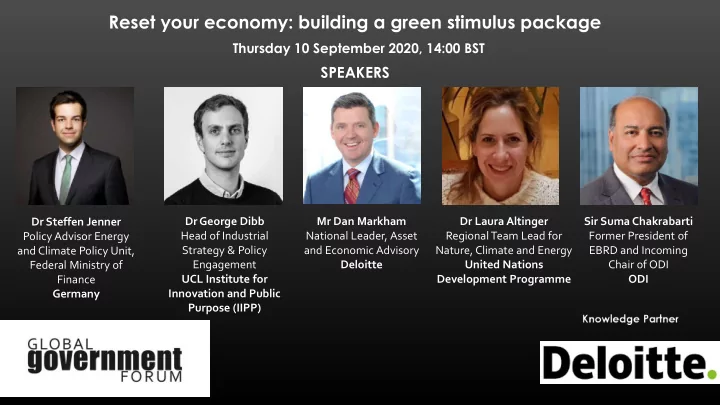
Reset your economy: building a green stimulus package

Thursday 10 September 2020, 14:00 BST

SPEAKERS

Dr Steffen Jenner Policy Advisor Energy and Climate Policy Unit, Federal Ministry of Finance Germany Dr George Dibb Head of Industrial Strategy & Policy Engagement UCL Institute for Innovation and Public Purpose (IIPP) Mr Dan Markham National Leader, Asset and Economic Advisory Deloitte Dr Laura Altinger Regional Team Lead for Nature, Climate and Energy United Nations Development Programme Sir Suma Chakrabarti Former President of EBRD and Incoming Chair of ODI ODI

slide-2
SLIDE 2

Nature Climate Energy

INTEGRATED OFFER FOR GREEN ECONOMIC GROWTH

Global Government Forum Reset your economy: Building a Green Stimulus Package 10 September 2020

slide-3
SLIDE 3
  • COVID19 has triggered deepest economic recession since Great Depression (OECD, World Bank)
  • Global growth projected at –4.9 percent in 2020 (IMF)
  • Worst jobs crisis since Great Depression: nearly half of global workforce at risk (ILO)
  • Real danger that crisis will increase poverty and widen inequalities, with impact felt for years to come
  • Recognition of climate risks and biodiversity loss
  • IPCC SR15 shows that we are already seeing consequences of 1°C of global warming through more extreme weather,

rising sea levels and diminishing Arctic sea ice

  • Shift of investments away from fossil fuels to renewables to achieve 1.5ºC will cost $900bn in ‘stranded energy assets’

— or 1/3 of current value of big oil/gas companies (FT)

  • Dissatisfaction with socio-economic, racial and gender inequalities
  • Inequality is growing for >70% of global population (UN)
  • “Income disparities and a lack of opportunities are creating a vicious cycle of inequality, frustration and discontent across

generations.” – UN Secretary-General Guterres

Tipping Points for Global Shift Towards the Green

slide-4
SLIDE 4

47% 7% 10% 23% 13%

FOSSIL UNCONDITIONAL FOSSIL CONDITIONAL OTHER CLEAN CONDITIONAL CLEAN UNCONDITIONAL France, Germany and China lead public money commitments to clean energy recovery packages, as of 26 August 2020

G20 has committed at least USD 382.14 billion to COVID-19 recovery to date

The Wrong Kind of Tipping Point.. Share of stimulus to fossil fuels

Source: energypolicytracker.org/region/G20 26 Aug 2020 At least At least Per capita Per capita Supporting fossil fuel energy Supporting clean energy

$204.08 billion $138.55 billion $44.51 $30.21

slide-5
SLIDE 5
  • Strengthen NDCs to raise ambition (through target setting) and

fully integrate energy efficiency, RE, adaptation priorities, nature- based solutions and sub-national/cities’ climate action

  • Improve costing of NDCs, introducing green taxonomies (e.g. EU

SF taxonomy) and methodologies

  • Align these to long-term climate change/net-zero strategies to

become Paris-aligned and integrate into national planning frameworks

  • Strengthen policy dialogue on fossil fuel subsidy reform and

enabling environment for the green transition

  • Improve existing national climate finance platforms (e.g. green

national DFIs or dedicated climate trust funds) and design new climate investment platforms to implement the plans and catalyze private sector finance through blended finance

  • Reorient financial sector to become Paris-aligned: green bond

standards, ESG integration, TCFD recommendations, financial regulatory measures to provide green incentives

  • Elaborate on social protection measures for ‘Just transition’

Priorities for UNDP NCE green recovery / economy

slide-6
SLIDE 6

UNDP’s Climate Promise on NDC enhancement

BUILD POLITICAL WILL AND SOCIETAL OWNERSHIP AT NATIONAL AND SUB- NATIONAL LEVELS REVIEW, ALIGN AND UPDATE EXISTING TARGETS, POLICIES AND MEASURES INCORPORATE NEW SECTORS AND/OR GREENHOUSE GASES ASSESS COSTS AND INVESTMENT OPPORTUNITIES MONITOR PROGRESS & STRENGTHEN TRANSPARENCY

5 Main Service Offers

A contribution to the NDC Partnership Delivered in collaboration with FAO, IRENA, UNEP, UNICEF, UN-HABITAT, and World Bank With support from the European Union and the governments of Sweden, Germany, Spain, Italy, and others

Objective: To support 100 countries to enhance their Nationally Determined Contributions by 2020, with demonstrated increase in ambition

112 government requests [13 High Emitters, 37 LDCs, 28 SIDS] 112 Promise workplans 100+ under implementation 5 enhanced NDC submitted to UNFCCC (Ecuador, Suriname, Moldova, Chile, Rwanda)

Progress to date

(as of May 2020)

slide-7
SLIDE 7

Integration of climate into national planning

  • Most national development plans and strategies do not have

concrete financing plans to fund their implementation

  • NDCs do not have systematic costing, as in many cases still

underdeveloped tools

  • Integrated national financing frameworks and Development Finance

Assessments spell out how the national strategy will be financed and implemented, carried out by UNDP

  • Important to integrate long-term net zero emissions strategies and

climate change response contained in NDCs into these INFFs and the national budget cycle

  • UNDP also produces Climate Public Expenditure Reviews but these

do not reach the costing and implementation/financing phase

slide-8
SLIDE 8

Climate Public Expenditure Reviews

  • Assesses status of national response to climate change through

climate change strategies, action plans and sectoral policies, and its linkages to expenditures

  • Quantifies climate related expenditures through the budgetary

system and extra-budgetary channels

  • Identifies opportunities and constraints for integrating climate change

within the national and sub-national budget allocation and expenditure process.

  • Strengthens cross-government coordination, especially ensuring the

engagement of Finance and Planning Ministries, as well as involvement of the private sector, civil society and development partners

slide-9
SLIDE 9
  • New partnership for governments, international organizations and private sector providing

integrated and streamlined support to drive accelerated/scaled-up climate investment and to achieve ambitious NDCs

  • Declutters climate finance landscape and provides integrated and streamlined support to

developing countries, emerging economies and private sector

  • Ultimate goal is enabling the realization of ambitious climate targets
  • Focus on four key tracks
  • Climate targets in the context of nationally determined contributions (NDCs)
  • Policies and regulations
  • Financial de-risking
  • Access to capital markets
  • Partners: United Nations Development Programme (UNDP), Sustainable Energy for All (SEforAll),

International Renewable Energy Agency (IRENA) and Green Climate Fund (GCF) together with Organisation for Economic Co-operation and Development (OECD), United Nations Industrial Development Organization (UNIDO), European Investment Bank (EIB), European Bank for Reconstruction and Development (EBRD), REN21, The Global Infrastructure Facility, World Bank – ESMAP, World Resources Institute (WRI)

slide-10
SLIDE 10

Laura Altinger Regional Team Lead Nature Climate Energy Europe and CIS region Bureau of Policy and Programme Support laura.altinger@undp.org