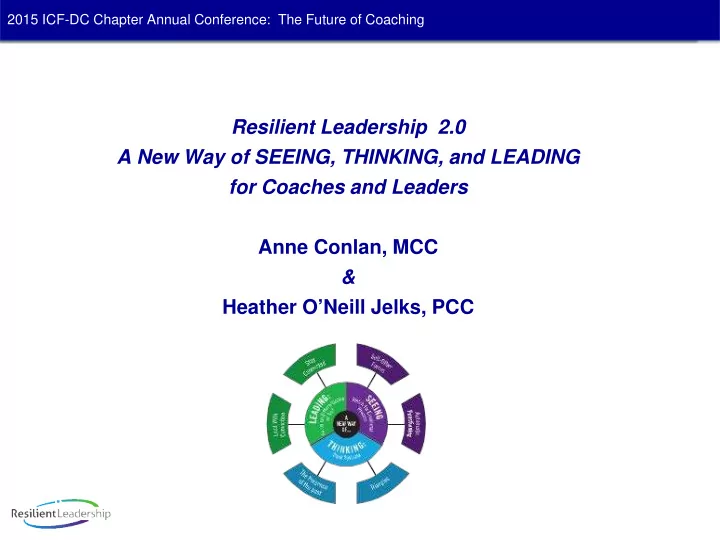
Resilient Leadership 2.0 A New Way of SEEING, THINKING, and LEADING for Coaches and Leaders Anne Conlan, MCC & Heather O’Neill Jelks, PCC
Anne Conlan, MCC & Heather Jelks, PCC 2015 ICF-DC Chapter Annual Conference: The Future of Coaching
Resilient Leadership 2.0 A New Way of SEEING, THINKING, and LEADING - - PowerPoint PPT Presentation
Anne Conlan, MCC & Heather Jelks, PCC 2015 ICF-DC Chapter Annual Conference: The Future of Coaching Resilient Leadership 2.0 A New Way of SEEING, THINKING, and LEADING for Coaches and Leaders Anne Conlan, MCC & Heather ONeill
Resilient Leadership 2.0 A New Way of SEEING, THINKING, and LEADING for Coaches and Leaders Anne Conlan, MCC & Heather O’Neill Jelks, PCC
Anne Conlan, MCC & Heather Jelks, PCC 2015 ICF-DC Chapter Annual Conference: The Future of Coaching
Introductions & Conversation:
RESILIENCE mean to you?
cultivating RESILIENCE matter to your clients?
“The world is becoming more turbulent faster than most organizations are becoming more resilient.”
Gary Hamel, What Matters Now, 2012
Borrowed with permission from the Search Inside Yourself Leadership InstituteSession Objectives
cultivating resilience in yourself and in the leaders you coach
Presence/Reactivity & Triangles
cultivating greater resilience
coaching
Resilient Leadership
Resilient Leaders are able to:
anxiety provoked by increasing complexity and accelerating change.
for themselves emotionally, spiritually and physically, and can sustain their leadership efforts over time.
Resilient Leadership is a new way of SEEING, THINKING and LEADING that helps leaders navigate the hidden dynamics of organizations more effectively.
New Way of Seeing
Reactivity
Chronic Anxiety
Rational System Emotional System
Acute Anxiety
“Automatic Functioning”/Reactivity
Reactivity is the public face of anxiety. Anxiety gives rise to reactivity – the response of the whole person to a perceived threat
Automatic Functioning/Reactivity
Our brain is wired for survival
(Do I eat it, or does it eat me?)but how often are we hijacked by our amygdala?
Reactivity Reflection
Directions: Think back to a time when you were triggered or provoked by someone or something – a time when you reacted in a way that was automatic, knee-jerk or emotion-driven rather than thoughtful. Using the following questions as a guide, reflect on this triggering moment and jot down your responses in the spaces
rapid and shallow?
those around you?
Behavioral Signs of Anxiety*
Seek a lot of feedback resist hearing feedback Seek a lot of contact withdraw Try to make everyone happy impose your own will Make a snap decision postpone deciding Change course abruptly resist changing at all Try to appease people blow up at them Ignore a problem exaggerate it Micromanage disappear Stir up conflict stifle it
*from The Anxious Organization by Jeffrey A. Miller (Facts on Demand Press, 2008)What Triggers Your Clients’ Reactivity?
Threats to…
*David Rock’s 5 Domains that trigger the threat circuitry in our brains
Common workplace triggers
colleague
come through
Reactivity in the Workplace….
A New Way of SEEING
When Resilient Leaders can see reactive functioning in themselves and others, they are able to manage themselves and others more effectively.
Film Clip: The King’s Speech
interaction between Lionel and the King?
anxious presence and reduce the level of anxiety in their interaction?
Coaching a Leader to Be a Step-Down Transformer
Strategies/Practices:
quickly.
understanding.
than feeling responsible to solve everything yourself.
A New Way of THINKING: Think Systems -- Triangles
The image part with relationship ID rId3 was not found in the file. The image part with relationship ID rId3 was not found in the file.A New Way of THINKING: Triangles
unconsciously formed to lower stress that’s experienced between two of the people.
unresolved issue or conflict.
Co-Worker Boss Co-Worker Boss’ S hortcomings Co-Worker Co-Worker
Common Workplace Triangles*
Anxious Person Is Challenged By Turns to
Manager Employee Employee Employee Boss Spouse Sales Group Engineers COO Team Member Another Team Member Manager Manager Underperformer Coach Executive Board Member Peer
*Adapted from: Executive Coaching with Backbone and Heart, by Mary Beth O’Neill“Getting Triangled”
Efforts to change the other side of the triangle generally produce the opposite effect and leave you with the stress.
A (Boss) B (Direct Report) C (Direct Report)
A Better Strategy
Application Conversation Identify a client who’s engaged in a Triangle. Find a partner and discuss:
Triangle?
Triangles to enrich your coaching?
Work to improve an existing triangle in which you are involved by opening up direct lines of communication with the others in the triangle and by withdrawing from any effort to influence the relationship between the other two people involved. Watch for the emergence of negative triangles around you in the work place, and coach
to influence the other side of the triangle in which they are involved. Think about how triangles might be functioning between whole departments or
improve one of the triangles your department
Coaching a Leader to Work with Triangles
1 2 3
Eager to learn more? Here are some helpful resources:
by Bob Duggan & James Moyer
by Jeffery Miller
by Leslie Fox & Katharine Baker
by Edwin Friedman