Retargetable Compilers System on Chip Many different types of - - PowerPoint PPT Presentation

▶
retargetable compilers
SMART_READER_LITE
LIVE PREVIEW

Retargetable Compilers System on Chip Many different types of - - PowerPoint PPT Presentation

Introduction Retargetable Compilers System on Chip Many different types of DSPs and embedded processors Daniel Karlsson ASIPs (replace by latest general purpose processor?) danka@ida.liu.se no compromise, high speed, low cost,


slide-1
SLIDE 1

Retargetable Processors Daniel Karlsson 1 of 36 November 7, 2001

Retargetable Compilers

Daniel Karlsson

danka@ida.liu.se ESLAB, IDA, Linköpings universitet

Retargetable Processors Daniel Karlsson 2 of 36 November 7, 2001

Introduction

■

System on Chip

■

Many different types of DSPs and embedded processors

❚

ASIPs (replace by latest general purpose processor?)

❚

no compromise, high speed, low cost, low power

■

Compilation plays important role

Retargetable Processors Daniel Karlsson 3 of 36 November 7, 2001

Outline

■

Introduction

■

Basic compilation techniques

■

Retargetable compilation issues

■

Processor modelling and the CHESS compiler

■

Summary

Retargetable Processors Daniel Karlsson 4 of 36 November 7, 2001

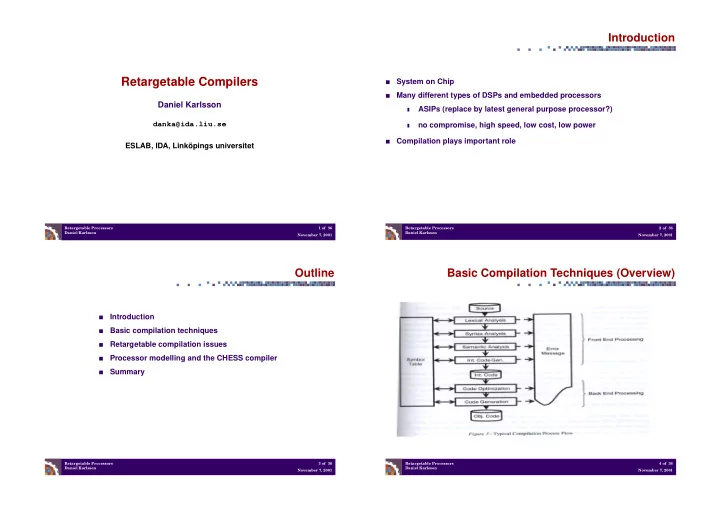
Basic Compilation Techniques (Overview)

slide-2
SLIDE 2

Retargetable Processors Daniel Karlsson 5 of 36 November 7, 2001

Front-End Processing

■

Lexical analysis

❚

Generating tokens

■

Syntax analysis

❚

Generating parse tree

❚

Creating symbol table

■

Semantic analysis

❚

Generating syntax tree

■

Intermediate code generation

❚

Generating quadruples (virtual machine)

Retargetable Processors Daniel Karlsson 6 of 36 November 7, 2001

Back-End Processing (1/3)

■

Machine independent code optimisation

❚

Common sub-expression elimination

❚

Loop unrolling

❚

Loop-invariant expression movement

❚

Induction variable elimination

❚

Unreachable code elimination

❚

Control flow optimisation

❚

Arithmetic optimisation

❚

Operation combining

Retargetable Processors Daniel Karlsson 7 of 36 November 7, 2001

Back-End Processing (2/3)

■

Machine dependent code optimisation

❚

Machine specific instruction mapping

  • Auto incr/decr indexed memory access instructions
  • Stack instructions
  • MAC (Multiply and ACcumulate) instruction

❚

Spill code reduction

  • Too many pseudo registers -> memory space access

❚

Instruction scheduling

  • Pipeline hazards

Retargetable Processors Daniel Karlsson 8 of 36 November 7, 2001

Back-End Processing (3/3)

■

Object code generation

❚

Code reordering

❚

Instruction pattern matching

❚

Register allocation

❚

Register assignment

slide-3
SLIDE 3

Retargetable Processors Daniel Karlsson 9 of 36 November 7, 2001

Questions

■

What stages/transformations does the code go through in a compiler?

■

Name a few optimisation strategies, both machine independent and machine dependent.

■

What are the tasks of code generation? Discussion:

■

Is there one optimisation strategy which generally generates better results than others?

Retargetable Processors Daniel Karlsson 10 of 36 November 7, 2001

What’s the Difference?

■

Retargetability

■

Register constraints

❚

Special-purpose registers

❚

Unusual wordlength

■

Arithmetic specialisation

■

Instruction-level parallelism

❚

DCU and ACU

■

Optimisations

❚

Poor compilation unaffordable

Retargetable Processors Daniel Karlsson 11 of 36 November 7, 2001

About Retargetability

Rapid set-up of a compiler will boost for algorithm developers wishing to evaluate the efficiency of application code on different existing architectures. Retargetability permits architecutre exploration. The processor designer is able to tune the architecture to run efficiently for a set of source applications in a particular domain.

Source Code Instruction-Set Specification Retargetable Compiler FirmWare Development Architecture Exploration Machine Code HardWare Design Cycle SoftWare Design Cycle

Retargetable Processors Daniel Karlsson 12 of 36 November 7, 2001

Levels of Retargetability

■

Automatically retargetable

■

Compiler user retargetable

■

Compiler developer retargetable

slide-4
SLIDE 4

Retargetable Processors Daniel Karlsson 13 of 36 November 7, 2001

Processor Modelling Languages

■

Mimola (HDL)

❚

Netlists display an explicit activation of functional components by bits in the instruction word.

■

nML

❚

Describes behavioural mechanics rather than structural detail.

❚

Description of operations, storage elements, binary and assembly syn- tax, and an execution model.

❚

Based on synchronous register-transfer model

■

Instruction Set Graph (ISG)

❚

Associates behavioural information with structural information.

Retargetable Processors Daniel Karlsson 14 of 36 November 7, 2001

Principal Compiler Tasks

■

Instruction-set matching and selection

■

Register allocation and assignment

■

Instruction scheduling and compaction

Retargetable Processors Daniel Karlsson 15 of 36 November 7, 2001

Instruction-Set Matching and Selection

Instruction set matching: Determine wide set of target instructions which can implement the source code. Instruction set selection: Choose the best subset of instructions from the matched set. A pattern based approach: 1: Produce a template base of patterns, each member represents an instruction. 2: Translate the source program to a forest of syntax trees. 3: Match the trees to the pattern set. 4: A subset of all the matched patterns are selected to form the implementation in microcode.

Retargetable Processors Daniel Karlsson 16 of 36 November 7, 2001

Register Allocation and Assignment

Register allocation: Determine a set of registers which may hold the value of a variable. Register assignment: Determine a physical register which is specified to hold the value of a variable. Solution based on graph colouring: 1: Build interference graph. (nodes=variables, edges=overlap) 2: Assign colours to each node. Adjacent nodes may not have the same colour. Drawback: Can not handle control-flow constructs (if, case, function calls, ...) Special purpose registers complicate the matter.
slide-5
SLIDE 5

Retargetable Processors Daniel Karlsson 17 of 36 November 7, 2001

Instruction Scheduling

Scheduling: Determine an order of execution of instructions. Huge interdependence with instruction selection and register allocation. Mutation scheduling: 1: Implementations of instructions can be regenerated by means

  • f a mutation set.

2: After generation of quadruples, calculate critical path. 3: Improve speed by identifying the instructions which lie on critical paths and mutating them to other implementations which allow a rescheduling of the instructions. Integer Linear Programming (ILP): 1: Consider the following aspects: pattern-matching, scheduling, register assignment and spilling to memory. 2: Dynamically make trade-offs between these based on an objec- tive function and a set of constraints. Common obj. func.: minimise time. Common constraints: architecture characteristics.

Retargetable Processors Daniel Karlsson 18 of 36 November 7, 2001

Instruction Compaction

Compaction: Fine-grained scheduling to support instruction-level parallelism. 1: Define pseudo microinstructions and sequences of micro-oper- ations with source and destinations properties. 2: Pack and upward past pseudo microinstructions to form real microinstructions.

Retargetable Processors Daniel Karlsson 19 of 36 November 7, 2001

Optimisation for Embedded Processors

”Optimisations” which could reduce efficiency: Common subexpression elimination -> increase register pressure. Constant propagation -> too narrow instruction word Loop optimisations (unrolling, pipelining, ...) are important. Take processor characteristics into account! Memory optimisations may lead to cost reduction.

■

Narrowing of instruction words

■

Paged memory

❚

Reduce number of page changes

❚

Long subroutines broken into several pieces

■

Multi-memory allocation

Retargetable Processors Daniel Karlsson 20 of 36 November 7, 2001

Questions

■

What are the main differences between compilationfor general purpose proc- essors and embedded processors?

■

What are the principal compiler tasks?

■

Can we just adopt optimisation techniques for general purpose compilers?

slide-6
SLIDE 6

Retargetable Processors Daniel Karlsson 21 of 36 November 7, 2001

Instruction Set Graph (ISG) (1/2)

■

Bipartite graph with where contains all vertices representing storage elements in the processor and contains all vertices representing its operation types. Edges rep- resent the connectivity of the processor.

■

An operation type is a primitive processor activity.

GISG VISG EISG , 〈 〉 = VISG VS VI ∪ = VS VI EISG VS VI × ( ) VI VS × ( ) ∪ ⊆

Retargetable Processors Daniel Karlsson 22 of 36 November 7, 2001

Instruction Set Graph (ISG) (2/2)

Retargetable Processors Daniel Karlsson 23 of 36 November 7, 2001

Enabling and Encoding

■

The set of instructions that enables operation type is called its enabling condition. .

■

Given a subset of operation types , is the enabling condition for the set .

■

The set has an encoding conflict if .

Ei i enabling:VI 2B → VIo VI ⊆ enabling VIo     enabling i ( ) i VIo ∈

∩

= VIo VIo enabling VIo     ∅ =

Retargetable Processors Daniel Karlsson 24 of 36 November 7, 2001

Storage Elements

■

Static storage

■

Transitory storage Memory: Registers: Transitories: Structural skeleton:

VM VR VT VS VM VR VT ∪ ∪ =

slide-7
SLIDE 7

Retargetable Processors Daniel Karlsson 25 of 36 November 7, 2001

Hardware Conflicts

■

Hardware conflict = access conflict on transitory

■

The function returns the set of transitories that are written by operation type .

■

Operation types are free from structural hazards if .

resources:VI 2 VT → i VIo VI ⊆ ii i j , VIo ∈ ∀ ii i j ≠ ( ) resources ii ( ) resources i j ( ) ∩ ⇒ ∅ =

Retargetable Processors Daniel Karlsson 26 of 36 November 7, 2001

Operation Type Hierarchy

Retargetable Processors Daniel Karlsson 27 of 36 November 7, 2001

Code Generation

The source code is given as a dataflow graph (DFG):

■

A dataflow graph is a bipartite graph , where with representing CDFG operations and representing the values they can produce and consume. The edges represent the dataflow.

■

Code generation is mapping

  • nto

with values in mapped on and mapped on .

GDFG VDFG EDFG , 〈 〉 = VDFG VO VV ∪ = VO VV GDFG GISG VV VS VO VI

Retargetable Processors Daniel Karlsson 28 of 36 November 7, 2001

Refinement

slide-8
SLIDE 8

Retargetable Processors Daniel Karlsson 29 of 36 November 7, 2001

Data Dependencies

r1 v1 r2 r2 r1 m v1 v2 r1 m1 m2 r1 v1 v2 v3 Direct data dep.

  • Dir. data dep. w. move

Allocated data dep.

Retargetable Processors Daniel Karlsson 30 of 36 November 7, 2001

Questions

■

What is an ISG?

■

How are hardware conflicts detected?

■

How does code generation work?

Retargetable Processors Daniel Karlsson 31 of 36 November 7, 2001

Bundles

■

CDFG operations are grouped into bundles. Operations in a bundle have di- rect data dependency.

■

All operations in a bundle are executed in the same clock cycle.

Retargetable Processors Daniel Karlsson 32 of 36 November 7, 2001

Code Selection

■

Partition the CDFG into DAG patterns that can be implemented by a single in- struction.

■

Two subtasks:

❚

Matching template patterns (NP-complete). Patterns may overlap.

❚

Covering (NP-complete)

slide-9
SLIDE 9

Retargetable Processors Daniel Karlsson 33 of 36 November 7, 2001

Matching

Retargetable Processors Daniel Karlsson 34 of 36 November 7, 2001

Covering

Cost function: Minimise cost = number of clock cycles. E.g. minimise number of extra moves. {B4, B5} yields an illegal covering.

Retargetable Processors Daniel Karlsson 35 of 36 November 7, 2001

Questions

■

What are the subtasks of code selection?

Retargetable Processors Daniel Karlsson 36 of 36 November 7, 2001

Summary

■

SoC puts a challenge on retargetable compielers.

■

Truths for general purpose no longer true.

■

Examples of retargetable compilers, modelling processor with ISG.

■

A lot more details, not brought up here..