Review of previous proposals and activities Actionable items from - - PowerPoint PPT Presentation

review of previous proposals and activities
SMART_READER_LITE
LIVE PREVIEW

Review of previous proposals and activities Actionable items from - - PowerPoint PPT Presentation

Review of previous proposals and activities Actionable items from 2014 CRG meeting (numbers refer to items in final report 3. Promote the GRA; Showcase achievements; Develop web content for each country and for the CRG 4. As agreed by the GRA


slide-1
SLIDE 1

Review of previous proposals and activities

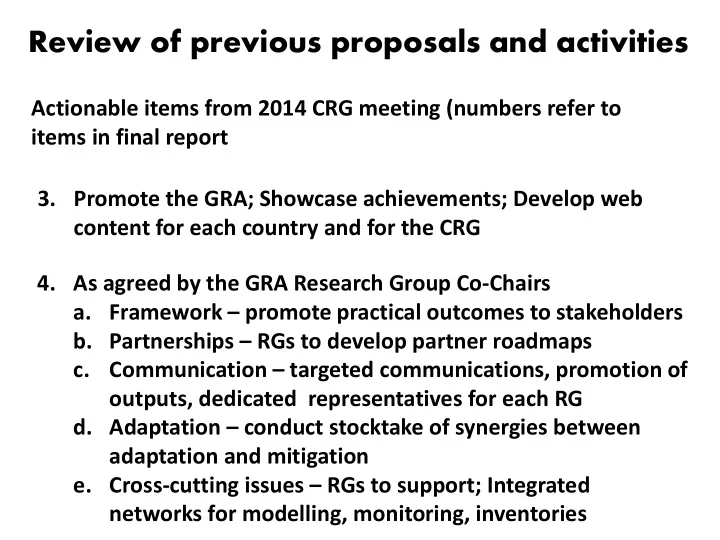
Actionable items from 2014 CRG meeting (numbers refer to items in final report

  • 3. Promote the GRA; Showcase achievements; Develop web

content for each country and for the CRG

  • 4. As agreed by the GRA Research Group Co-Chairs
  • a. Framework – promote practical outcomes to stakeholders
  • b. Partnerships – RGs to develop partner roadmaps

c. Communication – targeted communications, promotion of

  • utputs, dedicated representatives for each RG
  • d. Adaptation – conduct stocktake of synergies between

adaptation and mitigation

  • e. Cross-cutting issues – RGs to support; Integrated

networks for modelling, monitoring, inventories

slide-2
SLIDE 2
  • 8. Members to provide input for MAGGnet
  • 11. N2O modeling workshop (Paris 2014) papers and next steps

with the Soil CN CC Group – see CRG website for materials

  • 14. GRAMP member registration and participation in monthly

webinars

  • 19. Develop research site network of peatlands
  • 22. CRG GHG mitigation options summary / report
  • 27. GRA side event at CABI triennial meeting in 2016
  • 28. Information dissemination and databases with CABI
  • 30. Monthly webinars – initial contributions from CCAFS, Soil CN

CC Group

slide-3
SLIDE 3
  • 32. Fact sheets / decision support tools to farmers and options

for communication strategies

  • 34. Soil CN modeling (see Item 11); MAGGnet (see Item 8);

synthesis of GHG mitigation options (see Item 22)

  • 36. Evaluation of chamber vs eddy covariance techniques
  • 37. Tree crops (olives, vineyards) network
  • 38. Spanish ‘Remedia’ network expansion
  • 39. Characterizing hotspots of GHG emissions around the world;

Yield gap analysis

  • 42. Identify key mitigation options for testing by Soil CN CC

Group

slide-4
SLIDE 4
  • 43. Solicit expert opinion and examples of modeling for tree

crops and crop rotations

  • 45. Filling gaps in measurement and monitoring of soil carbon in

grasslands and diversified landscapes

  • 47. Further develop relationship with CCAFS
  • 48. Explore GRA-wide proposals to World Bank
  • 49. Develop ideas for additional World Bank proposals on

insurance / risk, GHG emissions with crop failure, relationships to food security

  • 51. Characterizing synergies between mitigation and adaptation
slide-5
SLIDE 5

CRG Action Plan developed in 2011 – Anticipated Products

Component 1: Quantifying net GHG emissions in cropland management systems

  • Standardized / acceptable protocols and improved methods for

determining soil C sequestration and GHG emissions

  • International database of existing and new research on GHG

emissions and soil C sequestration rates as affected by particular agricultural management systems

  • Synthesis of available experimental results around the world
  • Guidelines / BMPs for minimizing GHG emissions and

maximizing soil C sequestration under various climatic conditions, ecoregional delineations, and/or soil types

  • Summary documents for use by international negotiating

bodies concerned with GHG emissions, soil stewardship, and natural resource management

slide-6
SLIDE 6

CRG Action Plan developed in 2011 – Anticipated Products

Component 2: Assessing GHG emissions in agricultural peatlands and wetlands

  • Overview reports of ongoing research / status of peatlands

related to GHG emissions

  • Publications / reports on recommended BMPs and their

impacts on reducing GHG emissions

  • Compilation of GHG emission datasets that will contribute to

database development (Comp 1) and modeling of C/N (Comp 3)

  • Recommendations for improved technologies / BMPs to restore

peatlands to more naturally occurring ecosystem functioning

  • Data made available to cross-cutting group on inventories and

measurement methods, through knowledge transfer, datasets, discussion notes for methods, overview of existing methods, and contributions at seminars or other discussions forums

slide-7
SLIDE 7

Component 3: Modeling C and N emissions

  • Review articles and list of publications using (a) N2O emission

and (b) soil organic C models

  • Bibliometric analysis of the global literature on N2O and SOC

and a map of the main research groups active on these topics

  • Evaluation of models of direct N2O emissions according to:
  • spatial scale (e.g. laboratory, field, landscape, regional, etc.)
  • time scale
  • input data requirement
  • main simulated processes
  • context and range of situations tested
  • purposes for which they are suitable (e.g. hypothesis

testing, decision support system, regional inventories, etc.)

  • main related publications

CRG Action Plan developed in 2011 – Anticipated Products

slide-8
SLIDE 8

Component 3: Modeling C and N emissions

  • Evaluation of models of soil C dynamic (with information

similar to that described for modeling of N2O emissions above)

  • Short list of recommended models that have been widely used

and tested in a wide range of situations for a particular set of conditions and purposes

  • List of models that use a mass balance approach in considering

the cycling of both C and N within the same model framework

CRG Action Plan developed in 2011 – Anticipated Products