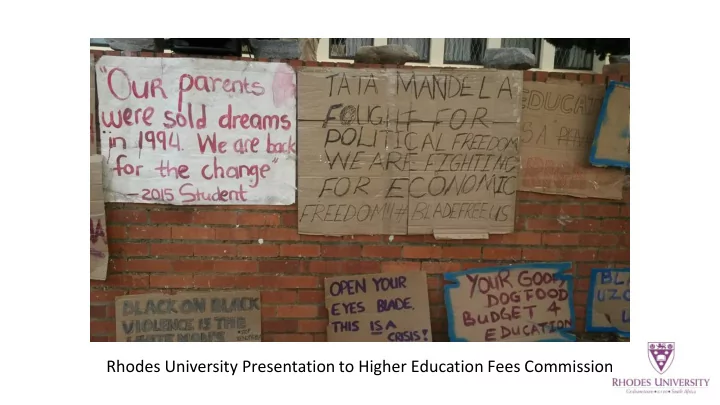
Rhodes University Presentation to Higher Education Fees Commission - - PowerPoint PPT Presentation

rhodes university presentation to higher education fees
SMART_READER_LITE
LIVE PREVIEW

Rhodes University Presentation to Higher Education Fees Commission - - PowerPoint PPT Presentation

Rhodes University Presentation to Higher Education Fees Commission HE access is an issue of social justice Provides graduate returns in form of employment and social mobility massive private goods accessed through higher education But


slide-1
SLIDE 1

Rhodes University Presentation to Higher Education Fees Commission

slide-2
SLIDE 2

HE access is an issue of social justice

  • Provides graduate returns in form of employment and social mobility

– massive private goods accessed through higher education

  • But benefits of HE are not only to those who study within it. HE

provides a public good for the country as a whole

  • We live in a knowledge economy where advanced skills and complex

problem solving capacity is crucial for the stability of the country

slide-3
SLIDE 3

Universities are key to knowledge production

  • Research focused on social problems
  • Blue sky research that drives progress
  • Research production is a major public good contribution of our
  • universities. A country without a vital and advanced research engine

is one reliant on others for its stability and progress

slide-4
SLIDE 4

Social cohesion

  • Universities cannot alone attend to schisms in post-apartheid society

but they do provide a space of transformative potential

  • Access to the private and public goods of a university cannot be

constrained to the financial elite

  • Broad access to higher education is a moral obligation
  • Access to HE is already skewed by our uneven school system
slide-5
SLIDE 5

Uneven access to HE

  • 57% of white South Africans access post-school education
  • 14% of black South Africans access post-school education (CHE 2016)
  • Multiple explanations for this uneven participation but finances are

the key to increasing participation

slide-6
SLIDE 6

Rhodes University

  • Small – no economies of scale
  • Quality teaching – best throughput rates cost money
  • Quality research – continued increases in output cost money
  • Rural – students therefore not only have to pay fees, they have to find
  • accommodation. Highly residential system – expensive
  • Undergraduate fees – R27 000 to R46930 per year
  • Accommodation and meals – R48100 to R50500
  • Total cost of between R80000 and R100000 per year, excluding transport,

toiletries and clothing.

  • This is out of reach for the majority of South Africans
slide-7
SLIDE 7

Missing middle

  • The wealthy few can afford fees, the upper middle class have the

collateral to access a bank loan, the poorest can access NSFAS

  • The majority of South Africans sit between these categories and are

denied access to higher education by the crushing fees

slide-8
SLIDE 8

“It is my personal mission to strive to ensure that no academically talented, but financially needy student is turned away from Rhodes University” Dr Sizwe Mabizela, Vice-Chancellor of Rhodes University: Inaugural address, February 2015.

slide-9
SLIDE 9

Costs of quality transformation

  • Need for re-curriculation for more inclusive programmes
  • Need for transformation of staff demographics
  • Need for better support of students to ensure they are not just

provided physical access to the universities but also epistemological access to the knowledge within it

  • This all costs money.
slide-10
SLIDE 10

Funding of HE in South Africa

  • Percentage of universities’ budgets from the state has consistently

decreased.

  • SA government spends 0.7% of GDP on Higher Education
  • OECD average is 1.5% (OECD report 2015)
  • Chile, Korea, Chine, USA spend between 2.3% and 2.8%
  • We need to double state funding to just to reach average
slide-11
SLIDE 11

Funding of HE in South Africa

2000

Student Fees State Funding Third Stream Income

2013

Student Fees State Funding Third Stream Income

CHE 2016

slide-12
SLIDE 12

Decreases in state funding have been made up by increases in student fees. The burden of underfunding of higher education has been borne by students.

slide-13
SLIDE 13

Third Stream Income is not the solution

  • Universities have succeeded in maintaining their third stream incomes during

difficult economic times.

  • Expecting the shortfall to come from this kind of funding has enormous

consequences for quality.

  • The focus on public good initiatives will be relinquished in favour of income

generating activities.

  • Teaching quality will be impacted by academics undertaking more consultancy

work.

  • Direct industry funding of research constrains it to profitable projects.
  • Furthermore not all universities have equal access to third stream income

possibilities because of historical, geographical and capacity restrictions.

slide-14
SLIDE 14

Implications of zero% increase already felt

  • 66% of SA academics are on short-term or part-time contracts (CHE

2016) with enormous quality implications

  • Other projects, such as NGAP and University Development Grants,

should not be plundered to make up the shortfall. Rhodes University supports students’ protests that higher education is financially inaccessible and that this is an issue of social injustice

slide-15
SLIDE 15

Cutting corners is not the solution

  • Cutting costs has major quality implications for our universities
  • We have parallel health care systems – private for the wealthy and public for the poor
  • We have parallel schooling systems – private for the wealthy and public for the poor
  • We have parallel policing systems – private for the wealthy and public for the poor
  • We have parallel transport systems – private for the wealthy and public for the poor
  • OUR HIGHER EDUCATION SYSTEM IS THE LAST PUBLIC SPACE USED BY ALL CITIZENS
  • This is essential for social cohesion and for the universities to serve as both private

and public good

  • This is is coming to an end as those who can afford private higher education are

moving to this rapidly growing sector in a search for quality and stability.

slide-16
SLIDE 16

Fee free versus free for those who cannot afford HE

  • HE cannot ever be ‘free’. It is a national project and it is expensive.
  • The money has to come from somewhere.
  • Current state funding of universities is nowhere close to sufficient
  • Current state funding of students through NSFAS is nowhere close to

sufficient.

  • Both need major and radical revisions in funding as a matter of

urgency.

slide-17
SLIDE 17

Should poverty stricken taxpayers pay for rich South Africans to study?

  • If the entire HE budget is paid for by the taxpayers, this will entail a

regressive subsidy of the wealthy by the poor.

  • While the idea of ‘free’ higher education is popular, it privileges the

elite in a mockery of a ‘pro-poor’ policy.

  • Why must the VAT paid by someone in a squatter camp pay for the

millionaire’s son to attend university?

slide-18
SLIDE 18

Additional sources of funding

  • First and foremost is the need to double state funding of HE in block grants and in

NSFAS allowances.

  • This should increase access with quality
  • Employer donations to bursaries – but not sufficiently streamlined and employers

do not get to select recipients

  • Section 10(1)(q) only allows provision of R40 000 per annum to relatives of

employees earning less than R400 000. This needs to be urgently trebled and widely marketed.

  • UIF reserves of R90 billion – given the employment benefits of university

education, HE is a suitable recipient of some of these funds.

  • SETA and Skills Development Levies.
  • The funding of higher education is a national issue and not a DHET one