
SLIDE 1
METHOD, ACCIDENTOLOGY & STATEMENTS USE CASE ON CROSSING LEVEL
Risk analysis methodology prioritization of safety investments
FREDERIC HENON – IRSC 2019
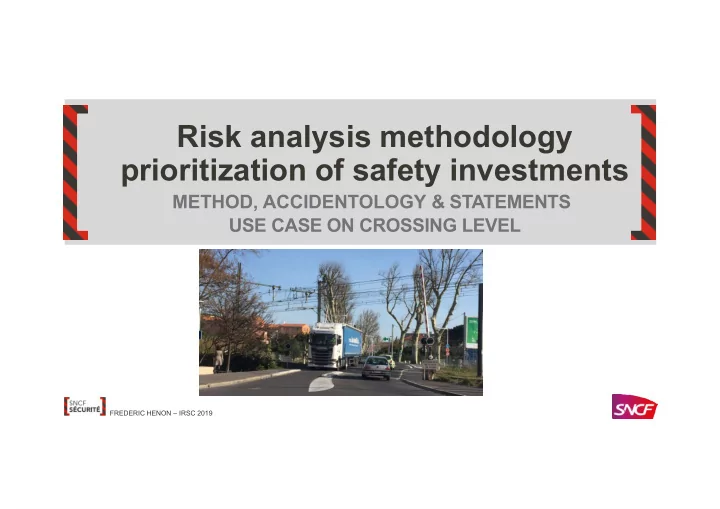
Risk analysis methodology prioritization of safety investments - - PowerPoint PPT Presentation
Risk analysis methodology prioritization of safety investments METHOD, ACCIDENTOLOGY & STATEMENTS USE CASE ON CROSSING LEVEL FREDERIC HENON IRSC 2019 FIRST STEP : METHOD 5 CR1 CR2 1 0,2 CR1 CR2 CR3 CR4 CR3 CR4 CR1: risks
FREDERIC HENON – IRSC 2019
CR1 CR2 CR3 CR4 CR1: risks with a low level of liability from the railway undertaking are weighted by a factor of Y = 0,2 CR2: safety at work (and road drivers safety) are equally weighted: Y = 1 (SNCF choice) CR3: risks of rail transport passenger is also weighted Y = 1 CR4: risks of "uninvolved" third parties are weighted by a factor of Y = 5
CR1 CR3 CR4 CR2 FREDERIC HENON – IRSC 2019
Accidents with very large damage are perceived more strongly than several small accidents, although resulting the same number of victims : 1 accident x 10 victims ≠ 10 accidents x 1 victim It is therefore justified to give more “weight” to these accidents. Risk aversion is characterized by a stronger weighting of serious consequences as these accidents are less well accepted. Operational application use an aversion factor Z : Z = c , c being the number of victims. Example: c = 5 Victims, Aversion factor ϕ =2.23, Risk-averse weighted consequences = 11.2 weighted victims Characterization of accidents (according to "EBP" method):
Nbr killed + 0.1 serious injured + 0.01 lightly injured
factor Y (0.2 for suicides, 1 for others victims)
Weighted Victims : WV = VE * Y* Z
FREDERIC HENON – IRSC 2019
SNCF Réseau ISCHIA base (accidents) 2007-2018, SNCF Réseau descriptive base of infrastructure ARMEN (LC Park)
THE STUDY WAS LED ON 2060 ACCIDENTS WITHIN 11 YEARS, CONCERNING 12500 PUBLIC LC (PASSIVE AND ACTIVE) OF THE FRENCH NETWORK THREE STEPS
3.Propose a cost-effective method and argumentation for the implementation of risk control measures on level crossings (LC)
2 FREDERIC HENON – IRSC 2019
PASSIVE LC
4 BARRIERS LC
2 BARRIERS LC WITH TRAFFIC ISLAND SEPARATOR 2 BARRIERS LC
FREDERIC HENON – IRSC 2019
LC type 1 acc. every WV aver./acc. WV/LC/y Passive LC 188 ys 0,28 1,5.E-03 2 barriers LC 109 ys 0,33 3,0. E-03 2 barriers LC with traffic island separator 43 ys 0,32 7,6. E-03 4 barriers LC 40 ys 0,32 8,0. E-03
3 types of accidents on LC: Clashes against people, 9% of accidents, 0,75 killed/accident Collisions against vehicles, 52% of accidents, 0,2 killed/accident Suicides, 39% of accidents, 0,9 killed/accident Collision accidents are spread as : 40% inattention of the car driver, lack of visibility, surprise … 40% non compliance of the road traffic signage: forcing, zig zaging passage … 20% vehicule blocked on the LC: vehicule that stalls, which blocks behind a raw … Statistical repartition of accidents (without suicides)
FREDERIC HENON – IRSC 2019
Accidentology increases with the “momentum” of the LC
(momentum = rail traffic X road traffic / day) 23% of highest momentum LC are causing 68% of victims. Global accidentology (Aver. Nbr WV/LC/year) is spread as :
WITHOUT SUICIDES MOMENTUM RANGES 1-100 101-1 000 1 001- 5 000 5 001- 25 000 25 001- 125 000 > 125 000
2 BARRIERS LC
4,32E-05 4,77E-04 1,08E-03 2,15E-03 8,19E-03 1,32E-02
2 BARRIERS LC WHIT ISLAND SEPARATOR
3,67E-03 1,39E-02
4 BARRIERS LC
6,25E-04 5,75E-03 1,11E-02
PASSIVE LC
1,43E-03 2,21E-03 4,09E-03
9,60E-04 7,48E-04 1,11E-03 2,09E-03 7,71E-03 1,25E-02
For the highest momentum, for one LC, they may be one Weighted Victim every 70years
FREDERIC HENON – IRSC 2019
HOW SHOULD WE INVEST IN LEVEL CROSSINGS? ALAIN AUTRUFFE – SNCF RESEAU – ILCAD2019
IDENTIFIED MEASURES Passive LC : Simple deletion of LC (ie without bridge) Transformation to active LC ACTIVE LC : Deletion of 2-barrier LC Transformation 2 to 4-barrier LC Equipment with OD (obstacle detection) Equipment with crossing radar 4-barrier stickers ( “BRAKABLE BARRIER”) Flashing red lamps with LED’s + on-ground signaling LED lighting barriers Video-protection with prosecution or not Traffic separator Island (2-barrier)
FREDERIC HENON – IRSC 2019
OBSTACLE DETECTOR VIDEO PROTECTION
CROSSING RADAR
FLASHING LED LIGHT
FREDERIC HENON – IRSC 2019
Coasts : equivalent annual costs (per LC)
Efficiency (per LC)
Coast-efficiency ratio :
Nota: "Interesting" investment if ratio < 10 M€/WV/year, "rationnable" investment if ratio < 20M€/WV/year
FREDERIC HENON – IRSC 2019
PASSIVE LC (momentums) Cost- Efficiency (M€/WV/LC/Y) 1-100 101-1 000 1 001- 5 000
NUMBER OF LC
1341 363 26
SIMPLE DELETION
5,1 3,1 1,6
TRANSFORMATION INTO 2 BARRIERS LC
18 14,4 8,3
FREDERIC HENON – IRSC 2019
TWO BARRIERS LC (ranked with momentum) 101-1000 1001-5000 5001-25000 25001-125000 >125000
NUMBER of LC
1915 2047 2108 1516 489
NUMBER LC WITH ISLAND TRAFFIC SEPARATOR
7 7 34 77 108
DELETION (BRIDGE)
495 314 183 62,8 40,6
TRANSFORMATION INTO 4-B
47,3 31,5 19,7 22,9
OBSTACLE DETECTION
481 230 119 34,1 20,5
CROSSING RADAR
596 263 108,4 3,4 2,1
OBSTACLE DETECTION + RADAR
606 285 138 28,5 17,3
LED BARRIERS
98,6 43,6 21,9 5,7 3,6
LED SIGN LIGHTS + ON- GROUNDSIGNALING
123 54,1 27,2 7,1 4,4
LED SIGN LIGHTS + GROUND SIGNALING + LED BARRIERS
117 51,7 26,0 6,8 4,2
VIDEOPROTECTION WITHOUT PROSECUTION
210 92,9 46,7 12,3 7,6
VIDEOPROTECTION WITH PROSECUTION
335 148 63,3 2,1 1,3
TRAFFIC SEPARATOR ISLANDS
7,0
FREDERIC HENON – IRSC 2019
TWO BARRIERS LC COST / EFFICIENCY (M€/WV/LC/Y) 1001-5000 5001-25000 25001-125000 >125000 NUMBER of LC
14 32 214 340
STICKERS on exit barriers
49,7 5,2 0,6 0,3
OBSTACLE DETECTION
4 579 426 51,0 26,2
CROSSING RADAR
5 844 497 6,5 3,4
LED BARRIERS
725 75,3 8,2 4,2
LED SIGN LIGHTS WITH GROUNDSIGNALING
901 93,5 10,2 5,3
LED LIGHTS SIGNS + GROUND SIGNALING +LED BARRIERS
860 89,3 9,7 5,1
VIDÉOPROTECTION WITHOUT PROSECUTION
1 894 197 21,4 11,1
VIDÉOPROTECTION WITH PROSECUTION
3 043 269 3,7 1,9
FREDERIC HENON – IRSC 2019
Cost/efficiency is high even excessive for low-momentum’s level crossings. Some low-cost investments improve road drivers visibility and are cost-efficient. Deletion of LC eliminates the risk, but low cost-efficiency. Obstacle detectors has a low cost-efficiency (expensive and prevents 40% of collisionsonly). Crossing radars are expensive and have limited efficiency. Videoprotection is
accidents and help enquiries upon an accident.
FREDERIC HENON – IRSC 2019
Evaluate cost/efficiency of road traffic equipment, to provide a global decision-making guide for risks managers Exemple: lighting warning road sign (approximatively located 300 m ahead of thecrossing)
FREDERIC HENON – IRSC 2019
Evaluate cost/efficiency for all « means of actions for more safety »
FREDERIC HENON – IRSC 2019
Individual reliability measures + management
monitoring and supervision activities, including non-technical skills (HF)
“ processes seldom used” e.g.: “calm” program, auto-check, etc.
Help for operators to perform their actions with more reliability
e.g. : check lists, simplification of documents + digitised (& interlocked processes in cat.5) e.g.: double-checks between 2 operators, independent test procedures , validation procedures, etc.
Technical appliances for alerting operators irregularities
e.g.: ATP, dead-man device Automation , etc.
Technical appliances as safety loops
e.g.: flashing light, audible warnings, etc.
Reduction
exposure
e.g.: decrease
Independent backloops
1 2 3 4
5
Example for SNCF NETWORK PROGRAM « SAFETY TO SYSTEM INVESTMENTS »
FREDERIC HENON – IRSC 2019
FREDERIC HENON – IRSC 2019