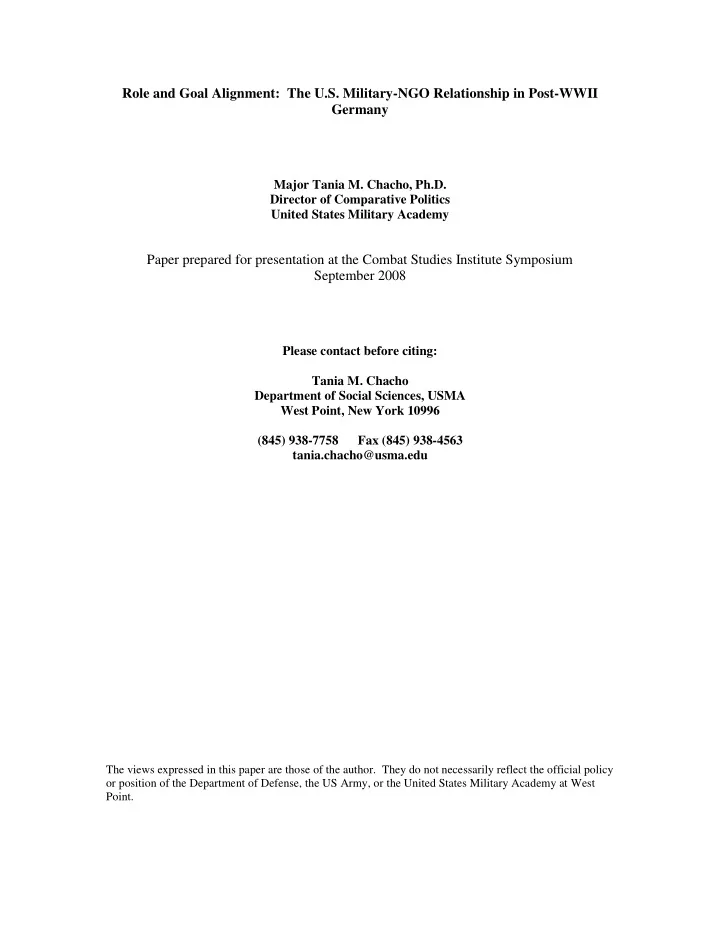
Role and Goal Alignment: The U.S. Military-NGO Relationship in - - PDF document

role and goal alignment the u s military ngo relationship
SMART_READER_LITE
LIVE PREVIEW

Role and Goal Alignment: The U.S. Military-NGO Relationship in - - PDF document

Role and Goal Alignment: The U.S. Military-NGO Relationship in Post-WWII Germany Major Tania M. Chacho, Ph.D. Director of Comparative Politics United States Military Academy Paper prepared for presentation at the Combat Studies Institute


slide-1
SLIDE 1

Role and Goal Alignment: The U.S. Military-NGO Relationship in Post-WWII Germany

Major Tania M. Chacho, Ph.D. Director of Comparative Politics United States Military Academy

Paper prepared for presentation at the Combat Studies Institute Symposium September 2008

Please contact before citing: Tania M. Chacho Department of Social Sciences, USMA West Point, New York 10996 (845) 938-7758 Fax (845) 938-4563 tania.chacho@usma.edu

The views expressed in this paper are those of the author. They do not necessarily reflect the official policy

  • r position of the Department of Defense, the US Army, or the United States Military Academy at West

Point.

slide-2
SLIDE 2

Tania M. Chacho 15 August 2008

1 Role and Goal Alignment: The U.S. Military-NGO Relationship in Post-WWII Germany History has hailed the U.S. experience in the reconstruction of Germany in the aftermath of World War II as a “success story” that epitomized the capabilities and vision

  • f a democracy in a post-conflict environment. The economic recovery of Europe

(enabled to a large degree by the Marshall Plan), along with the development of West Germany as a liberal democracy, provided convincing evidence that the reconstruction and stabilization efforts of the United States and her allies achieved success. During the course of this reconstruction effort, the U.S. military found itself working closely with many non-governmental organizations (NGOs) to restore the basic necessities of daily life to the German (and other former Nazi-occupied) people. This paper examines the intricacies of this military-NGO relationship, and presents several salient characteristics that defined the nature of the interaction. Of these, the leadership and direction provided by the U.S. government emerges as particularly critical in achieving an integrated effort. This guidance served to mitigate many of the organizational and logistical challenges faced by those working to alleviate the humanitarian crisis and set the stage for the eventual reconstruction of Germany. Overall, the humanitarian relief and reconstruction work carried out by the U.S. Army and non-governmental organizations in post-war Germany provides testament to the value of the relationship developed between these two entities, and the circumstances under which they developed these ties offers interesting insights regarding the ability of two different organizational entities to work in the same geographic space to achieve their goals. This study will begin with a brief overview of the general state of thinking regarding crisis-response and developmental environments, followed by an examination

slide-3
SLIDE 3

Tania M. Chacho 15 August 2008

2

  • f the situation in post-war Germany, and in Europe in general, to set the context for the
  • relationship. Next, a discussion of the goals and objectives of both the U.S. military and

the various NGO actors establishes the conditions for “success” in the humanitarian mission that both undertook. The third section will explore the interaction itself, identifying the characteristics that marked the relationship. The penultimate portion of the paper investigates the challenges that organizations on both sides faced, and the conclusion explores the role of U.S. governmental leadership in setting goals and forging the structure around which the military-NGO relationship could develop. Ultimately, this paper seeks to investigate the salient characteristics of the relationship between U.S. military forces and NGOs that resulted in the successful handling of the humanitarian crisis and set the stage for reconstruction efforts in post-WWII Germany. Immediate and Long-Term Efforts: From Crisis-Response to Development Much of the existing literature focusing on post-war environments emphasizes the need for capacity building and places the challenge in a developmental context.1 Yet

  • ften, it is the effectiveness of the preceding immediate humanitarian efforts to save lives

and alleviate human suffering that sets the stage for these societal building activities. Such humanitarian relief takes place as soon as hostilities cease (or in some cases, while the security situation is still tenuous), and scholars view these efforts as largely short- term and usually unsustainable in scope.2 Post-World War II developments, such as the

1 See Sultan Barakat and Margaret Chard, “Theories, Rhetoric, and Practice: Recovering the Capacities of

War-Torn Societies,” Third World Quarterly, Vol. 23, No. 5 (October 2002): 817-818.

2 See Deborah Maresko, “Development, Relief Aid, and Creating Peace: Humanitarian Aid in Liberia’s

War of the 1990s” OJPCR: The Online Journal of Peace and Conflict Resolution, 6.1 Fall: 94-120 (2004),

  • 102. Maresko offers a definition of “relief aid” as “any provision of aid during an emergency that is meant

to attend to a person’s immediate requirements for survival or recovery, which include food, clothing,

slide-4
SLIDE 4

Tania M. Chacho 15 August 2008

3 Geneva Conventions of 1949 and the additional protocols of 1977, have articulated the rights of victims of armed conflicts to receive assistance and protection with the purpose

  • f satisfying their immediate needs,3 thus lending further credence to the short-term

nature of the involvement. However, often the initial response is just a stop-gap measure, intended to mitigate the suffering in order to allow a more sustainable, long-term effort to get underway. The concept of separate military and civilian domains within the humanitarian and reconstruction environments is also a prevalent theme of the literature, both during the World War II era and today. Recent writings have emphasized the concept that the military has “taken on new and significant political roles”4 that place it within the realm

  • f what NGOs regard as civil space. Missions in the 1990s and early 21st century have

seen the military engaging in tasks such as providing shelter for displaced persons, supervising the return of refugees, organizing and monitoring elections, and supporting civilian reconstruction – many of the same functions performed by their non- governmental counterparts.5 This overlap has created tensions and misunderstandings about the propriety of military involvement in these types of situations. Yet these debates are not new. Recent years have seen larger numbers of civilian relief workers and organizations engaged in post-conflict operations, and a better articulated concept of humanitarian space has emerged. Yet many of the issues and

housing, medical care, necessary social services, and security when a person is faced with circumstances beyond her or his control.”

3See Joana Abrisketa, “The Right to Humanitarian Aid: Basis and Limitations”, in Reflections on

Humanitarian Action: Principles, Ethics and Contradictions. Edited by Humanitarian Studies Unit, Transnational Institute (London, Sterling, VA: Pluto Press, 2001), 55.

4 Michael Williams, Civil Military Relations and Peacekeeping, Adelphi Paper 321, (London: International

Institute for Strategic Studies, 1998):14.

5 See Donna Winslow, “Strange Bedfellows: NGOs and the Military in Humanitarian Crises”, The

International Journal of Peace Studies Vol. 7 Issue 2 (Autumn/Winter 2002).

slide-5
SLIDE 5

Tania M. Chacho 15 August 2008

4 challenges that exist today between soldiers and civilian aide workers were also present in the post-World War II period. Each perceived their roles to be distinctly different and separate, and this self-identification of roles persists in each organization today. The U.S. military in 1945 had just waged four years of high intensity combat, and was not eager to pick up additional missions as an occupying force – missions that the Department of War believed would be best honchoed by the Department of State. But we must take care not to overstate any parallels present between postwar Germany and more recent humanitarian and reconstruction efforts. Certain specific elements of the postwar situation in Germany may mirror more modern situations, yet their very context is different due to the vast changes in the international environment

  • ver the past 60 years. As many recent commentators have observed, parallels between

current U.S. operations in Iraq and those in post-war WWII Germany are difficult to make, because the contrasts tend to outweigh the similarities.6 The danger in attempting analogies is that the investigation often creates links out of context, potential ignoring critical shaping aspects in a desire to capitalize on similarities that make sense of the situation and potentially illuminate the way forward. But if, as the saying goes, history “rhymes, but never repeats,” perhaps a micro approach – in this case, examining the specific dynamics of a carefully defined aspect of the military-NGO relationship – may offer some insights into the elements necessary for a fruitful partnership. It is in this vein that this study moves forward.

6 See Fred Kaplan, “Iraq's Not Germany: What a 60-year-old Allen Dulles speech can teach us about

postwar reconstruction,” Slate, posted Oct. 17, 2003: Available from: http://www.slate.com/id/2089987/; Internet; accessed 22 January 2008.

slide-6
SLIDE 6

Tania M. Chacho 15 August 2008

5 Context: The Crisis Situation in Post-War Germany Almost six years of war left Germany utterly and completely devastated. By the time of her unconditional surrender to Allied forces in May 1945, experts estimated that more than 20 million Germans were homeless or without adequate shelter, a food shortage and coal crisis was looming, and a further 5.2 million displaced persons (mostly liberated civilians and prisoners of war) were moving throughout SHAEF-held territory.7 Of these issues, the lack of food was perhaps the most acute. And the situation was indeed grim: American officials estimated that the caloric intake of German civilians living in the British and U.S.-occupied zones in the fall of 1945 was only 1250 a day (on average), compared to 3000 calories a day in Great Britain and between 3000 and 4000 calories a day in the United States military.8 Some deemed even this figure too high: a report by COL Joe Starnes the week that the war ended indicated that the “average basic ration is less than 1,000 calories.”9 A typical week’s ration for a German citizen in May 1945 consisted of the following: “bread, 3 pounds; meat, 4 ounces; butter and fat, 2

  • unces; sugar, 7 ounces; macaroni and spaghetti, 5 ounces; potatoes, 6 pounds.”10 This

added up to just under 1,000 calories a day. By the fall of 1945, the infant mortality rate approached 65% in many places, according to the U.S. Deputy Military Governor General Lucius Clay.11 He further noted that “by the spring of 1946, German observers

7 Earl F. Ziemke, The U.S. Army in the Occupation of Germany, 1944-1946 (Washington, D.C.: U.S. Army

Historical Series, Center of Military History, 1975), 275, 283-284.

8 Heney Clark Schor and Harmon L. Swan, “Simultaneous Surveys of Food Consumption in Various

Camps of the United States Army,” (Chicago, Illinois: Department of the Army Medical Nutrition Laboratory, 1949), 56. See also Military Government of Germany, "Monthly Report of the Military Governor, U.S. Zone," No. 4, "Monthly Report of the Military Governor," 20 November 1945, Record Group (RG) 94, OpBr/B1174. National Archives at College Park, College Park, MD (NACP)

9 Ziemke, 283. 10 Ibid, 274. 11 Lieutenant General Lucius D. Clay, Office of the Deputy Military Governor to John J. McCloy, Assistant

Secretary of War, War Department, 5 October 1945, RG107, E180/B26, NACP; Hans W. Schoenberg,

slide-7
SLIDE 7

Tania M. Chacho 15 August 2008

6 expect that epidemics and malnutrition will claim 2.5 to 3 million victims between the Oder and Elbe."12 Yet losses in the rest of Europe were also severe, and the hardships suffered there (many at the hands of the Nazis) created a situation in which many of the Allies had little desire, inclination, or capacity to assist the German population. In the U.S., the Morgenthau Plan – a punitive “pastoralization” of Germany to ensure that she never again took hostile action – initially gained favor among governmental leaders as the preferred method of administering the occupation, and reparations were a key component

  • f this strategy.13 But even if the desire to help was present, the French, Brits, and other

Europeans had very little to offer the German people, as they themselves struggled to feed and shelter their own citizens. The displacement of millions of Europeans, caused both by the war and by the migrations of those that wished to positions themselves on different territory as the lines between the Soviet east and the democratic west became clear, added to the humanitarian crisis. The people of Europe faced a daunting tasks just meeting one of their most basic needs: food. Due to the devastation of the war, sufficient food was simply not available in theater, save for that brought in by Allied Armies for use by their troops.14 Worries about the ability of European farmers to harvest adequate crops in the fall of 1945 became compounded by a worldwide food shortage that shrunk the available supply and added to

Germans from the East: A Study of their Migration, Resettlement, and Subsequent Group History Since 1945 (The Hague: Martinus Nijhoff, 1970), 32, 38.

12 Ibid. 13 The simplification of the harsh treatment argument into “Morgenthau” has come under valid critique by

at least some current historians. For a nuanced study of the perils of the reductive statement the “Morgenthau Plan”, see Jeffrey K. Olick, In the House of the Hangman: The Agonies of German Defeat, 1943-1949 (Chicago and London: The University of Chicago Press, 2005).

14 See “Prospectus for Cooperation for American Remittances to Europe, Inc.”, CARE Collection, Box #1,

Folder: Prospectus for CARE. Manuscripts and Archives Division. The New York Public Library. Astor, Lenox and Tilden Foundations.

slide-8
SLIDE 8

Tania M. Chacho 15 August 2008

7 the crisis.15 In the United States, President Truman’s Cabinet Food Committee worked with the multi-national Combined Food Board allocated resources in an attempt to mitigate hunger in Europe.16 Yet the intent of this aid was primarily for the newly-liberated areas of Europe, not for the German people. Furthermore, the Allied government-supported agencies supplying aid to refugees, displaced persons, and those in the newly liberated territories did not view assistance to German citizens, seen as the perpetrators of the war, as part of their mandate. Eventually, in February 1946, President Truman did approve the creation

  • f a Council of Relief Agencies Licensed for Operation in Germany (CRALOG), and

allowed this umbrella organization to operate under the direction of the U.S. Military Government.17 Yet CRALOG’s creation came 9 months – and one winter – after the cessation of hostilities in May 1945. And the worldwide food situation did not improve over the next few years. By 1947, a report by the Cabinet Food Committee spelled out the story in convincing detail: because of poor crops abroad, because of a sharp drop in U.S. corn production, Europe now faced a food shortage of 4.5 million tons in grain alone.18 By 1947, the Office of Military Government, United States (OMGUS) had the responsibility for supplying food

15 Paul W. Gulgowski, The American Military Government of United States Occupied Zones of Post World

War II Germany in Relation to Policies Expressed by its Civilian Authorities at Home, During the Course

  • f 1944/45 Through 1949 (Frankfurt am Main: Haag und Herchen Verlag, 1983), 283.

16 John Gimbel, The American Occupation of Germany: Politics and the Military, 1945-1949 (Stanford,

California: Stanford University Press, 1968), 54-55 and Harry S Truman, Memories, Volume I: Years of Decisions (Garden City, New York: Doubleday, 1955), 468-469.

17 Richard Dominic Wiggers, “The United States and the Refusal to Feed German Civilians after World War

II” in Ethnic Cleansing in Twentieth-Century Europe eds. Steven Bela Vardy and T. Hunt Tooley (Boulder, Colorado: Social Science Monographs, 2003), 282.

18 “Waste Less,” Time Magazine, 6 October 1947.

slide-9
SLIDE 9

Tania M. Chacho 15 August 2008

8 to the displaced persons in Germany, a population of roughly 552,000,19 which further strained the availability of food for ordinary German civilians. The humanitarian crisis that Germans faced from 1945-1948 was one of unprecedented magnitude.20 And on top of the physical hardships endured by the German people, they also faced worldwide censure and condemnation for their role in the war. This left many people in allied nations unable to identify with their plight, or even to demand that they be forced to continue to live at bare sustenance levels.21 Goodwill towards Germans was not readily apparent in many quarters, and this reluctance to aid a former enemy further complicated the humanitarian situation. Yet some segments of American society did view the German people with compassion, and they worked to provide a means by which humanitarian aid could flow to ordinary German citizens. American voluntary agencies wanted to provide help to the war-stricken population for a variety of different reasons, ranging from pure humanitarianism, to a desire to help ethnic brethren and relatives, evidenced by German-

  • Americans. Religious organizations, particularly those with members of their faith in

Germany (Lutherans, Catholics, and Mennonites, for example) were also interested in rendering assistance, as were organizations such as the American Friends Service Committee (AFSC) that had a record of operating in Germany, having helped German children in the aftermath of World War I.22 Nongovernmental agencies were critical in shaping public perception of Germany, helping it to overcome the negative image of

19 Oliver J. Frederiksen, The American Military Occupation of Germany: 1945-1953 (United States Army

Europe: Historical Division, 1953), 74 and 78.

20 Michael R. Marrus, The Unwanted: European Refugees in the Twentieth Century (New York: Oxford

University Press, 1985), 296–299.

21 See Ziemke, 104. 22 Haim Genizi, America’s Fair Share: The Admission and Resettlement of Displaced Persons, 1945-1952

(Detroit: Wayne State University Press, 1993), 55.

slide-10
SLIDE 10

Tania M. Chacho 15 August 2008

9 being the country of Nazism.23 Once this stigma was no longer at the forefront of American minds, the need to provide aid for a starving people became more readily

  • apparent. Such was the environment in which the U.S. Army and NGOs performed their

work. “Success” in the Reconstruction Effort Setting the criteria for “success” in any endeavor that involves multiple actors is always difficult, which is perhaps why in the realm of post-conflict reconstruction, a clear definition is often absent. Most early researchers who examined the U.S. occupation of Germany have evaluated it as successful, noting that America achieved her objective of an independent, liberally democratic, economically viable, and non-aggressive West German state.24 Later scholars challenged this overall positive assertion, arguing that certain occupation policies contained notable shortcomings.25 Still, the overall impression of American reconstruction activities in Germany during the post-war period remains favorable, at least in retrospect. At the time, there was much more angst about the course taken, and much more uncertainty about the eventual outcome.26 The U.S. government initially set its criteria for post-war success through a series

  • f directives and agreements, beginning in the spring of 1945 while the war was still

23 See Hermann J. Rupieper, Review in the American Historical Review, Vol.. 106, No. 5, p1828. 24 See Harold Zink, The United States in Germany, 1944-1945 (Princeton, NJ: D. Van Nostrand Co.,

1957); Gimbel, The American Occupation of Germany; Edward N. Peterson, The American Occupation of Germany: Retreat to Victory (Detroit: Wayne State University Press, 1978); John H. Backer, The Decision to Divide Germany American Foreign Policy in Transition. (Durham, N.C.: Duke University Press, 1978); John H. Backer, Winds of History: The German Years of Lucius DuBignon Clay (New York: Van Nostrand Reinhold, 1983); Dewey A. Browder, Americans in Post-World War II Germany Lewiston: Edwin Mellen Press, 1998).

25 Petra Goedde. GIs and Germans: Culture, Gender, and Foreign Relations, 1945–1949 (New Haven:

Yale University Press, 2003), xv.

26 In August 2003, members of the Bush Administration drew similarities between the uncertainty of the

  • utcome of Germany in 1945 and that of Iraq in 2003. See Daniel Benjamin, “Condi's Phony History:

Sorry, Dr. Rice, postwar Germany was nothing like Iraq” Posted Aug. 29, 2003. Available from: http://www.slate.com/id/2087768/. Internet; accessed 22 January 2008.

slide-11
SLIDE 11

Tania M. Chacho 15 August 2008

10

  • ngoing. First, in April 1945, Joint Chiefs of Staff (JCS) 1067 set the policy for the
  • ccupation, although scholars generally believe that a discrepancy existed between
  • fficial policy and the views of those who carried it out.27 JCS 1067 was, in fact, a harsh

document, intent on producing the “hard” peace favored by Henry Morgenthau and devoid of any mention of humanitarian assistance for the German people. In fact, the paper provided General Eisenhower with the “Basic Objectives of Military Government in Germany” as follows:

  • a. It should be brought home to the Germans that Germany's ruthless warfare and

the fanatical Nazi resistance have destroyed the German economy and made chaos and suffering inevitable and that the Germans cannot escape responsibility for what they have brought upon themselves.

  • b. Germany will not be occupied for the purpose of liberation but as a defeated

enemy nation. Your aim is not oppression but to occupy Germany for the purpose

  • f realizing certain important Allied objectives. In the conduct of your occupation

and administration you should be just but firm and aloof. You will strongly discourage fraternization with the German officials and population.

  • c. The principal Allied objective is to prevent Germany from ever again becoming

a threat to the peace of the world. Essential steps in the accomplishment of this

  • bjective are the elimination of Nazism and militarism in all their forms, the

immediate apprehension of war criminals for punishment, the industrial disarmament and demilitarization of Germany, with continuing control over Germany's capacity to make war, and the preparation for an eventual reconstruction of German political life on a democratic basis.

  • d. Other Allied objectives are to enforce the program of reparations and

restitution, to provide relief for the benefit of countries devastated by Nazi aggression, and to ensure that prisoners of war and displaced persons of the United Nations are cared for and repatriated. Furthermore, paragraph 5 of JCS 1067 clearly stated that Military Government

  • fficials were to restrict themselves to promoting the production and maintenance of only

those indigenous goods and services “required to prevent starvation or such disease and

27 Gimbel, 5. See also Department of State: Foreign Relations of the United States, 1945, vol. 3, European

Advisory Commission; Austria; Germany, p. 484.

slide-12
SLIDE 12

Tania M. Chacho 15 August 2008

11 unrest as would endanger the occupying forces."28 Planners envisioned no mass scale relief efforts to assist the German population; instead, they directed their attention to the care of displaced persons and the imposition of order within the U.S. zone of occupation. Thus, JCS 1067 did not supply any stated humanitarian relief and reconstruction

  • bjectives of the U.S. as an occupying force.

Yet those responsible for running the military occupation received additional guidance from the Potsdam Agreement, issued in August 1945. In the few months that passed between the end of the war in Europe in May and Potsdam in late July-early August, doubts had emerged about the ability of the communist USSR and the democratic West to sustain their wartime partnership into the post-war era, and the document reflected some of the strategic maneuverings between the Allies. Ultimately, under the rubric of economic unity, the West used the Potsdam communiqué to consolidate their three zones and create a capitalistic and democratic West Germany.29 But more importantly from a developmental standpoint, the spreading East-West divide and developing Cold War that became clear at Potsdam eventually allowed the U.S. to shift its policy regarding the long-term viability of the German state. This marked the starting point of American leadership’s strategic turn away from the Morgenthau plan and their move to an acceptance of a “softer” attitude toward defeated Germany. Secretary of State James Byrnes officially announced this change in American attitude in a speech at Stuttgart on September 6, 1946 when he emphasized (among other things) the need for an

28 SHAEF Food and Agriculture Section, Economic Control Agency, G-5 Division, "The Food Position in

Western Germany as of 1 June 1945", 3 July 1945, RG332, ETO,SGS/B57, NACP; see also John H. Backer, "From Morgenthau Plan to Marshall Plan," in Americans as Proconsuls: United States Military Government in Germany and Japan, 1944-1952, Robert Wolfe, ed. (Carbondale, Ill.: Southern Illinois University Press, 1984), 157.

29 See Robert Cecil, “Potsdam and Its Legends,” International Affairs, Vol. 46, No.3 (June 1970): 462.

slide-13
SLIDE 13

Tania M. Chacho 15 August 2008

12 improved level of industry for Germany.30 As Franklin Davis notes, from an American policy standpoint, the Stuttgart statement “oriented the Occupation Army away from a repression of German militarism and dispelled once and for all any concept of the Army in Germany as a force to exploit the purely military values of the victory in Europe.”31 So approximately 16 months after the formal cessation of hostilities, the role of the

  • ccupying U.S. forces finally formally transitioned into one that could engage in relief
  • perations for the benefit of the German people.

In addition, from a legal perspective, there existed support for use of the military in a limited humanitarian role. In fact, and some law experts argued that international law dictates that an occupying force provide adequate feeding of civilian populations under their control, and thus the care of the German civilian population should ultimately become a mission of the U.S. military.32 Military doctrine of the time tends to support this view, and by 1946, Defense Department officials argued before Congress that international law obligated them to import and distribute food to prevent “disease and unrest” among the German population.33 The pacifying effects that an adequate caloric intake provided the occupied citizenry was something that the military recognized and appreciated, as ultimately it facilitated the job of preserving the security environment. Initially, then, the relief mission was thus an implied task required to complete the stated goal of maintaining order. But while military involvement in providing food aid to the German population may have originated with these practical operational considerations, evidence suggests that military leaders in theater were among the first to

30 Franklin M. Davis, Come As Conqueror: The United States Army’s Occupation of Germany, 1945-1949

(New York: The MacMillian Company, 1967), 186.

31 Ibid. 32 See Wiggers, 275. 33 Ibid.

slide-14
SLIDE 14

Tania M. Chacho 15 August 2008

13 recognize and call for the need for an expanded effort to avert a humanitarian disaster. For example, the Military Governor of the U.S. Zone (Germany), General Clay, writes in his memoirs that, “From the first I begged and argued for food because I did not believe that the American people wanted starvation and misery to accompany occupation ...”34 Clay further notes that in November 1945 he “made a hurried trip home” to discuss the food shortages with government officials and “ask personally for their assistance in increasing the food supply.”35 While Clay’s efforts were largely unsuccessful (due to the world grain shortage and the desire to ensure that Allies received preferential treatment

  • ver former enemies), they do indicate a military awareness of the critical humanitarian

need. So as the mission of the U.S. military morphed by default and necessity into one that included a formalized humanitarian role beyond that required to maintain the peace, the definition of “success” changed along with it. By taking on this role, the U.S.

  • ccupying forces now had to measure their efforts against a new standard. Given this, a

contemporary definition of relief “success” may prove useful here: Francis Fukuyama describes the first phase of successful nation-building as the United States solving immediate problems of physical infrastructure through the infusion of security forces, humanitarian relief, and technical assistance.36 This contemporary definition also provides a useful bridge to a discussion of the goals of humanitarian relief organizations involved in post-war Germany. In December 1945, a group of American voluntary relief agencies formed a united body – CRALOG –

34 Lucius D. Clay, Decision in Germany (Garden City, New York: Doubleday and Company, Inc., 1950),

263.

35 Ibid. 36 Francis Fukuyama, State-Building: Governance and World Order in the 21st Century (Ithaca, NY:

Cornell University Press, 2004), 100.

slide-15
SLIDE 15

Tania M. Chacho 15 August 2008

14 that received formal recognition from President Truman in February 1946. While each voluntary aid organization maintained its own individual mission and mandate, through participation in CRALOG, those operating in Germany agreed to a standardized set of four goals: “to provide a channel through which interested Americans could send relief to Germany; to avoid duplication among the agencies; to provide liaison with government and military authorities as well as German welfare agencies; and to provide facilities for

  • ther agencies and individuals, not members of the Council, to participate in this

humanitarian undertaking.”37 These generalized goals created the framework under which voluntary aid

  • rganizations operated. Yet some also opted for a more specialized, “niche” approach.

For example, the Cooperation for American Remittances to Europe (CARE) had a stated mission of selling food remittances to interested individuals, groups, and organizations, for designated beneficiaries. This person-to-person aid (with its striking similarities to micro-finance ventures promoted today) appealed to many Americans who wanted reassurance that their donation made a tangible difference to an individual recipient’s life. As General Clay explains: The physical and psychological effects of this aid were immense. Much larger quantities of bulk food, largely grain, brought in with appropriated funds, lost their identity through processing before they reached the consumer. He knew something of the huge extent of this aid, but it remained impersonal. On the other hand, when a CARE package arrived, the consumer knew it was aid from America and that even the bitterness of war had not destroyed our compassion for suffering.38 Voluntary aid organizations often reported on the amount of food and supplies provided from the monies raised from donors, and this became a measure of their

37 Genizi, 56. 38 Clay, 277.

slide-16
SLIDE 16

Tania M. Chacho 15 August 2008

15 “success”. Although many recognize now that this is a crude guide, at best, since it focuses on quantifiable rather than qualitative measures, it was nonetheless an accepted standard of the time. Using these criteria, CARE’s Executive Director reported in February 1948 that “since the actual operation commenced, we have supplied between fifty-two and fifty-three million dollars worth of food and other packages.”39 This relief represented a vast impact on the lives of many Germans, and kept many from starving during the initial rough post-war years. As such, it warrants mention in a discussion of the criteria of voluntary relief agency “success.” Characteristics of the Military-NGO Relationship Post-war interactions between civil relief workers and military authorities

  • ccurred in an environment marked by clear (if often debated) policies and regulation,

coordinated by a Presidential-appointed central authority. The government mobilized philanthropy, like other aspects of national life, in the interests of “efficiency and speedy victory.”40 The President’s War Relief Control Board, established by Executive Order of President Roosevelt on 25 July 1942, oversaw the overall coordination of the efforts of public charities with regard to the provision of relief, reconstruction, or welfare arising from the war or its immediate aftermath (the order was valid until six months after the termination of hostilities, “unless revoked by Presidential order.”)41 Not only was the

39 Memorandum from Paul Comly French, Executive Director, CARE, dated February 20, 1948. CARE

Collection, Box #1, Folder “CARE – Organization” CARE records. Manuscripts and Archives Division. The New York Public Library. Astor, Lenox and Tilden Foundations.

40 Merle Eugene Curti, American Philanthropy Abroad (New Brunswick, N.J.: Rutgers University Press,

1963), 452.

41 Executive Order 9205 Establishing the President's War Relief Control Board. July 25th, 1942. John T.

Woolley and Gerhard Peters, The American Presidency Project [online]. Santa Barbara, CA:

slide-17
SLIDE 17

Tania M. Chacho 15 August 2008

16 Board active throughout the war, but President Truman saw fit to have the functions of the Board continue into peacetime, and on 16 May 1946 he renamed it the Advisory Committee on Voluntary Foreign Aid.42 The development of the War Relief Control Board created some controversy. It essentially forced the mergers of many independent agencies, citing efficiency concerns, and made licensing decisions amongst ethnic-orientated agencies with different viewpoints that also caused contention.43 The Board sought to clearly identify aid agencies with the United States government and its citizens, and so required charitable

  • rganizations to change their names to include “American” in their title to identify the

source of the aid.44 So, the French Relief Fund became American Relief for France; the Queen Wilhelmina Fund changed it’s moniker to American Relief for Holland, and so forth.45 Such partisan identification clearly linked the aid organization to the foreign policy objectives of the U.S. government, but this identification was one that most made willingly46, in an atmosphere of national mobilization. This wholehearted identification with the aims of the national government is a unique feature of the time, and a response to the call for a national wartime effort. The ideological appeal was clear-cut and well- defined, which aided the government in its appeal for support and its establishment of a centralized framework for aid work. The United States government was also instrumental in founding an international coordination effort for humanitarian relief. On 9 November 1943, sixteen months after

University of California (hosted), Gerhard Peters (database). Available from World Wide Web: http://www.presidency.ucsb.edu/ws/?pid=16287.

42 See Anna C. Bramwell, ed. Refugees in the Age of Total War (London: Unwin Hyman Ltd, 1988), 96. 43 Curti, 454. 44 See Bramwell, 96 and Curti, 453-455. 45 Curti, 453. 46 See Rachel M. McCleary and Robert J. Barro, “Private Voluntary Organizations Engaged in International

Assistance, 1939-2004”, Nonprofit and Voluntary Sector Quarterly Journal, December 2007: 20.

slide-18
SLIDE 18

Tania M. Chacho 15 August 2008

17 President Roosevelt established the War Relief Control Board, the United Nations Relief and Rehabilitation Agency (UNRRA) began its operations. A collaborative effort involving 44 Allied nations, the purpose of UNRRA was to "plan, co-ordinate, administer

  • r arrange for the administration of measures for the relief of victims of war in any area

under the control of any of the United Nations through the provision of food, fuel, clothing, shelter and other basic necessities, medical and other essential services"47 Although UNRRA eventually operated in occupied Germany (primarily operating displaced persons camps), the organization did not render assistance to ethnic Germans.48 This distinction was critical, and Richard Wiggers sees it in the overall context of a lack of American desire to care for a population seen not only as the enemy, but also as perpetrators of horrible crimes against humanity.49 Slowly, as the dire nature of the situation became clear through independent reports, U.S. relief agencies and others began to advocate greater amounts of assistance for the German people. Yet President Truman remained initially reluctant, noting that it was difficult to feel “great sympathy” for the Germans, “who caused the death of so man human beings by starvation, disease and

  • utright murder.”50

Public pressure, coupled with an increasing understanding of the criticality of the situation in Germany and the emerging geo-political outlines of the Cold War, slowly changed the minds of U.S. leaders. Notably, however, this did not occur until about 12 months (and one harsh winter) into the occupation period. The mindset of U.S.

47 Agreement for United Nations Relief and Rehabilitation Administration, November 9, 1943. Pamphlet

  • No. 4, Pillars of Peace. Documents Pertaining To American Interest In Establishing A Lasting World

Peace: January 1941-February 1946 (Carlisle Barracks, Pa.: Army Information School, May 1946), Articles 1 and 2.

48 Wiggers, 281-282. 49 Wiggers, 287. 50 Cited in Wiggers, 281.

slide-19
SLIDE 19

Tania M. Chacho 15 August 2008

18 leadership toward the Germans at the cessation of hostilities (and thus the beginning of the post-conflict period) was one of retribution and punishment, and as mentioned above, this influenced the guidance given to those in charge of the occupation. But some historians have argued that all along, the American Occupation Forces did “frequently perform their duties at variance with the policies expressed by the civil authorities at home.”51 This dissonance between stated government policy and actions of the military government on the ground in Germany is a critical aspect of the post-conflict relief

  • peration. Acknowledgement that the military performed tasks designed to alleviate

human suffering suggests recognition that those soldiers on the ground were perhaps best poised to assess and address the operational situation. In 1946, Congress authorized emergency aid for Germany, Japan, and Austria under the Government Aid and Relief in Occupied Areas (GARIOA) program. This money came with Congress’ stipulation that OMGUS use the funds only to import “food, petroleum, and fertilizers” to prevent “disease and unrest” in Germany.52 In 1946, GARIOA provided almost $9 million in aid and supplies.53 Military authorities worked with aid organizations (both foreign and local national) to distribute this assistance, and in this way, developed their relationship. Prior Planning: Immediate Humanitarian Needs As indicated above, discussions regarding the role of charitable organizations in post-war Europe began long before the surrender of the Third Reich. Indeed, a long war

51 Gulgowski, 10. 52 Nicholas Balabkins, Germany Under Direct Controls: Economic Aspects of Industrial Disarmament

1945 - 1948 (New Brunswick, N.J.: Rutgers University Press, 1964), 101.

53 John Killick, The United States and European Reconstruction: 1945–1960, (Edinburgh, UK: Keele

University Press, 1997), 76.

slide-20
SLIDE 20

Tania M. Chacho 15 August 2008

19 (and a mobilized public) provided ample time and opportunity to engage in planning regarding the post-war challenges that the European continent as a whole would face. Americans agencies paid time and attention to both the immediate humanitarian needs faced by the European people (many in newly-liberated territory in the wake of the advancing Allied Armies) and to the longer-term reconstruction challenges that these war-torn societies would encounter. The President’s War Relief Control Board set the priority of effort. Although it came under “continued and increasing pressure from persons and organizations who desire to assist in the reconstruction of damaged towns, institutions, monuments, etc. in Europe,” the Control Board took the position that “in view of the present conditions in Europe, private relief resources should be utilized for the direct relief of human suffering rather than for reconstruction.” 54 While some might argue for a simultaneous rather than a sequenced effort, the Control Board’s determination was unambiguous. Letters from private citizens and organizations reached the White House and State Department and

  • ther government agencies, requesting guidance as to how to proceed in reconstruction

efforts for Europe. Citing the Control Board’s policy, government officials replied that this was premature, and that the sole focus of current relief efforts should be on the alleviation of human suffering.55 The human aspect of the post-war situation was indeed critical, and many offered ideas for providing and facilitating this relief as well. For example, a national committee

54 Department of State, War Problems – Special Division Letter dated 12 September 1945, signed by Edwin

  • A. Plitt. General Records of the Department of State (RG 59), National Archives Microfilm Publication

840.48, Records of the Department of State Relating to the Problems of Relief and Refugees in Europe Arising From World War II and Its Aftermath, 1938-1949, Roll 15, NACP.

55 See, for example, Department of State Airgram to US Ambassador in Brussels, dated 22 February 1945,

General Records of the Department of State (RG 59), National Archives Microfilm Publication 840.48, Records of the Department of State Relating to the Problems of Relief and Refugees in Europe Arising From World War II and Its Aftermath, 1938-1949, Roll 14, NACP.

slide-21
SLIDE 21

Tania M. Chacho 15 August 2008

20 headed by Henry J. Kaiser organized a United National Clothing Collection in the spring

  • f 1945 – a unified effort on the part of United Nations Relief and Rehabilitation

Administration (UNRRA) and all the voluntary war relief agencies of the United States.56 The campaign’s publicity department (it was a very well organized effort) issued a release to inform Americans that the nationwide drive would occur between April 1-30, 1945 to “secure the maximum quantity possible of good used clothing for free distribution to needy and destitute men, women, and children in war-devastated countries.”57 This drive was strictly to benefit the newly liberated areas of Europe, so it did not encompass Germany. Yet after the war, other organizations did take the needs of the German people into account. For example, concern over the immediate humanitarian needs spawned the creation of the Cooperation for American Remittances to Europe (CARE) by “some twenty leading American charitable organizations.”58 Created “largely at the insistence

  • f the President’s War Relief Control Board,” CARE had a stated mission of selling food

remittances to interested individuals, groups, and organizations, for designated beneficiaries throughout Europe.59 By June 1946, CARE had concluded a formal agreement with OMGUS that specifically delineated the obligations expected of both

  • sides. On paper, the relationship appeared to be an unequal one: CARE listed four

56 Department of State, Plitt letter, RG 59, 840.48, Roll 15, NACP. 57 General Information from the Publicity Department, United National Clothing Collection, 100 Maiden

Lane, New York 5, New York. General Records of the Department of State (RG 59), National Archives Microfilm Publication 840.48, Records of the Department of State Relating to the Problems of Relief and Refugees in Europe Arising From World War II and Its Aftermath, 1938-1949, Roll 14, NACP.

58 Cooperative for American Remittances to Europe, memorandum dated January 8, 1946. CARE

Collection, Box #1, Folder: Development – Committee on Cooperatives. Manuscripts and Archives

  • Division. The New York Public Library. Astor, Lenox and Tilden Foundations

59 Ibid, 3; Agreement Between the Deputy Military Governor of the United States Zone of Occupation in

Germany and Cooperative for American Remittances to Europe, Inc., Records of U.S. Occupation Headquarters, World War II (RG 260), Office of Military Government, U.S. Zone (Germany)-CARE file, Entry 81, NACP.

slide-22
SLIDE 22

Tania M. Chacho 15 August 2008

21 points under their obligations, and in return articulated 12 items (some with subcomponents) under the paragraph titled, “Exemptions and Facilities Accorded to CARE.”60 This was a reflection of the environment: OMGUS administered the U.S. Occupied Zone, and thus were the entity responsible for executing the occupation plan’s rules, including those dealing with humanitarian assistance. Yet aid and economic assistance was not a business that the military desired to remain involved in beyond what was necessary for as an emergency, stop-gap, measure. During the war, in February and March 1945, President Roosevelt sent Judge Samuel Rosenman to investigate Europe’s reconstruction needs. The Rosenman Report identified the need to remove the military from responsibility for civilian supply as soon as operationally feasible, citing concerns that the continuation of such involvement would “mitigate against ultimate economic recovery.”61 The report noted that General Eisenhower, SHAEF Commander, had made the same recommendation regarding the termination of military responsibility for civilian supply in the newly liberated territories – namely, that it occur at the earliest practicable date.62 The Army’s eagerness to get out

  • f the humanitarian business did come with the recognition that initially, they were the
  • nly organization who could perform some essential tasks. For example, the Rosenman

report readily acknowledged that war created conditions in which the “only effective medium for the initial provision of civilian supplies” is the Army.63

60 Agreement Between Deputy Military Governor of U.S. Zone and CARE, RG 260, Entry 81, NACP. 61 Report prepared by Rosenman Mission London, England, April 15, 1945. General Records of the

Department of State (RG 59), National Archives Microfilm Publication 840.48, Records of the Department

  • f State Relating to the Problems of Relief and Refugees in Europe Arising From World War II and Its

Aftermath, 1938-1949, Roll 14, NACP.

62 Ibid. General Eisenhower identified this date as 1 May 1945 for France. 63 Ibid.

slide-23
SLIDE 23

Tania M. Chacho 15 August 2008

22 Soon after the Rosenman report, President Truman instructed the Secretary of War to plan for the termination of military responsibilities for shipping and distributing relief supplies for liberated areas of Europe as soon as the military situation permits.64 He also clearly indicated that he expected a relationship between military and civil authorities to develop: In addition, I think that the general policy of the Army, upon such termination, should be to continue to assist the national governments involved and the appropriate civilian agencies of our own Government and UNRRA to the extent the military situation permits. This should include, where possible, and to the extent legally permissible, the transfer of supplies which are in excess of essential military requirements.65 Thus, initial relief planning efforts from both the U.S. governmental and voluntary agencies had expectations of close interaction and working relationships developing between the military and NGOs. Prior Planning: Reconstruction Efforts While the focus of this study is immediate humanitarian efforts, it is worth mentioning that longer-term reconstruction planning also occurred – and not just in the governmental realm. Private organizations and agencies engaged in strategic planning regarding reconstruction on the European continent. For example, the Director of the International Relations Board of the American Library Association penned a letter to the Secretary of State in May 1945 expressing that the Association was “anxious to renew and extend their relationships with European libraries”, including the restoration of the

64 President Harry S Truman letter to the Secretary of War, dated 21 May 1945. General Records of the

Department of State (RG 59), National Archives Microfilm Publication 840.48, Records of the Department

  • f State Relating to the Problems of Relief and Refugees in Europe Arising From World War II and Its

Aftermath, 1938-1949, Roll 14, NACP.

65 Ibid.

slide-24
SLIDE 24

Tania M. Chacho 15 August 2008

23 “flow of books, pamphlets and serial publications from the United States to Europe, and from Europe to the United States.”66 He further notes that the American Library Association “has now in stock piles in the United States nearly half a million dollars’ worth of carefully selected books and periodicals (purchased with Rockefeller Foundation money)” with which to bring European libraries up-to-date in “American publications and American scholarship and thought.”67 The identification of the need to provide the necessary materials to resume educational opportunities speaks to the recognition of a long-term effort to re-build war-torn societies, and is thus firmly in the realm of reconstruction activities. For Germany, as well as for the rest of Europe, the ultimate reconstruction effort

  • ccurred with the announcement of the Marshall Plan (or the Economic Recovery

Program, as it was formally known) in 1947. This also signaled the end of the emergency relief effort and the transition to foreign aid for development. Goal Alignment During the humanitarian assistance phase, several characteristics of the relationship between the U.S. military and voluntary aid agencies quickly became

  • evident. First, thanks to the establishment of the President’s War Relief Control Board,

there existed an alignment of goals between aid agencies and governmental policies. The recognition of this commonality was important in that it established the framework for

66 Keyes D. Metcalf letter to the Honorable Edward R. Stettinius, Secretary of State, dated 14 May 1945.

General Records of the Department of State (RG 59), National Archives Microfilm Publication 840.48, Records of the Department of State Relating to the Problems of Relief and Refugees in Europe Arising From World War II and Its Aftermath, 1938-1949, Roll 14, NACP.

67 Ibid.

slide-25
SLIDE 25

Tania M. Chacho 15 August 2008

24

  • perations within the theater of operations. Of course, the path was not smooth, and

disagreements arose regarding the best means to achieve the end. For example, the Control Board regulated “appeals to the public for funds and

  • ther contributions for foreign relief”68 and thus arguably stifled the free speech of

agencies that would have otherwise asked the public for donations. And by setting the conditions under which private relief agencies could operate, the Control Board ensured that it controlled the means by which each goal was tackled. For example, it “…has refrained from giving its approval for campaigns to raise funds for the restoration of cities

  • abroad. It has taken the position that the solicitation of funds for war relief at this time

should be confined to emergent projects, that is, for the direct relief of human suffering through provision of food, clothing, medicaments, et cetera.”69 NGOs reaction to this control was overall rather muted. For example, CARE documents from the time show that the organization developed within the system emplaced by the Control Board, and sought to align their goals with those of the Board in

  • rder to achieve success by emphasizing the areas of overlap. CARE emphasized that by

design, they filled a “need for an individual to individual and group to group package service” that the American voluntary relief agencies “were not equipped to handle”.70 Like any good business plan, the CARE concept sought to find a niche to fill. Once it identified this, its supporters then lobbied an initially reluctant government to grant it recognition and allow it to operate in pursuit of this goal.71 In doing so, it did not change

68 Department of State Airgram to US Ambassador in Brussels, dated 22 February 1945, NACP. 69 Ibid. 70 Memorandum from Paul Comly French, dated February 20, 1948. CARE Collection, Manuscripts and

Archives Division. The New York Public Library. Astor, Lenox and Tilden Foundations.

71 See for example, letter from Wallace J. Campbell, Chairman, Committee on Cooperatives, to Secretary

  • f State James F. Byrnes, dated October 18, 1945. General Records of the Department of State (RG 59),

National Archives Microfilm Publication 840.48, Records of the Department of State Relating to the

slide-26
SLIDE 26

Tania M. Chacho 15 August 2008

25 its stated mission, nor did it alter its’ vision regarding the essential functions of this

  • mission. The organization’s concept of providing a method for interested Americans to

purchase remittances to send food overseas to designated or undesignated individuals and groups remained intact. The organizers of CARE marketed their plan effectively, and in doing so, helped the U.S. government to see that their goals aligned. Another compelling force for goal alignment was CRALOG. The requirement to register with CRALOG prior to operating in theater ensured that the ends pursued by voluntary agencies coincided, with the intent of reducing inefficiencies and duplication of

  • effort. Of course, the means by which each agency decided to pursue the goal was still

matter of discussion. Coordination and deconfliction of effort. Once the actors established agreement on goals, or ends, a discussion over means (procedures and processes) naturally ensued. The State Department handled many inquires from citizens and groups regarding providing assistance to the civilians liberated in Europe. The standard response was that the provision of supplies was a military responsibility and that the interested party should contact the President’s War Relief Control Board to determine how best to render assistance.72 Although the provision of supplies was indeed a military responsibility at the end of the war, it was one that the Department of War wanted divested as soon as possible.

Problems of Relief and Refugees in Europe Arising From World War II and Its Aftermath, 1938-1949, Roll 15, NACP.

72 See, for example, telegram from the Reverend Steven H. Fritchman, to Matthew J. Connelly, Secretary to

the President, dated 24 April 1945. General Records of the Department of State (RG 59), National Archives Microfilm Publication 840.48, Records of the Department of State Relating to the Problems of Relief and Refugees in Europe Arising From World War II and Its Aftermath, 1938-1949, Roll 14, NACP.

slide-27
SLIDE 27

Tania M. Chacho 15 August 2008

26 In fact, inter-agency disagreements permeated the discussion of the means of execution for the post-war relief aid plan. A central issue was who held ultimate responsibility for the provision of civilian supplies, and this was a matter of intense debate between the Secretary of War and the Secretary of State. President Roosevelt directed the Secretary of War to provide initial relief supplies in newly liberated areas necessary to “avoid disease and unrest.”73 In a letter dated 21 May 1945, President Truman directed that the War Department cease taking responsibility for these relief efforts “as soon as the military situation permits” and after consultation with the State Department.74 What ensued was a series of letters back and forth between the Secretary

  • f State and the Secretary of War, discussing the terms of the handoff arrangement. State

expressed reluctance to take on the mission immediately, as they had very few resources in theater that would allow them to effectively oversee the effort. For its part, the military wanted to relinquish this mission – and its ensuing financial obligations – as rapidly as practicable.75 Ultimately, the military wound up retaining responsibility for these aid functions longer than they felt necessary given the President’s directive, and they did so under protest. Initial military plans for the occupation of Europe overlooked the need for coordination with voluntary aid organizations. For example, the Basic Preliminary Plan for Allied Control and Occupation of Germany 1944-45 does not include any non- governmental organizations in an extensive matrix of those organizations with which

73 See Rosenman Mission Report, dated 15 April 1945, RG 59, 840.48, Roll 14, NACP. 74 President Harry S Truman letter to Secretary of War, dated May 21, 1945, RG59, 840.48, Roll 14,

NACP.

75 See letters between the Department of War and the Department of State, General Records of the

Department of State (RG 59), National Archives Microfilm Publication 840.48, Records of the Department

  • f State Relating to the Problems of Relief and Refugees in Europe Arising From World War II and Its

Aftermath, 1938-1949, Roll 14, NACP.

75 See Rosenman Mission Report, dated 15 April 1945, RG 59, 840.48, Roll 14, NACP.

slide-28
SLIDE 28

Tania M. Chacho 15 August 2008

27 military divisions or headquarters sections should coordinate.76 This oversight persisted into the administration of the military government and occupying force in Germany. Indeed, as late as the fall of 1946, many in the U.S. government opposed allowing voluntary aid organizations to even enter into Germany. A case in point is the reaction of the Office of Political Affairs as they expressed non-concurrence with a proposal from the American Friends Service Committee (AFSC) to allow ten Americans into a town in Bavaria to provide relief to displaced persons and to facilitate relations between them and the German population.77 The Director of Political Affairs indicated his concern with this plan, noting: The door, admitting the entrance of relief personnel, cannot be readily closed once it is opened. The British opened the door at an early stage and now find themselves with more than 600 non-German volunteer workers in the British Zone working in the interests of the German population.78 The worry about “opening the floodgates” of relief workers is clear, and the Director goes on to note that “every non-German individual who comes into the Zone occupies space and utilizes facilities which are at a great premium and definitely needed by the German people themselves.”79 The discussion about the best means to use to execute the relief plan produced many challenges for both the relief organizations and the military. For example, CARE initially struggled to obtain authority to purchase surplus “ten-in-one” rations from the

76 This matrix did include a caveat, noting that it does not list “all agencies with which coordination may be

required.” See HQ US Group CC – Sub-Plans (Annexes) to preliminary basic plan allied control and

  • ccupation of Germany – Tab D, Records of U.S. Occupation Headquarters, World War II, RG 260

390/40-5/17, Entry 2, Records of the US Group Control Council (Germany) – Records Relating to the Basic Preliminary Plan for Allied Control and Occupation of Germany 1944-45, NACP.

77 American Friends Service Committee Proposal for Aid to German Expellees (undated), OMGUS Entry

25, Records of U.S. Occupation Headquarters, World War II, RG 260 390/40/19/7, NACP.

78 Memorandum from Sumner Sewall, Director, Internal Affairs and Communications Division, “Aid to

German Expellees by AFSC” dated 12 Nov 1946. OMGUS Entry 25, Records of U.S. Occupation Headquarters, World War II, RG 260 390/40/19/7, NACP.

79 Ibid.

slide-29
SLIDE 29

Tania M. Chacho 15 August 2008

28 Army, which the organization needed in order to establish their individual food package

  • plan. These rations could feed ten combat soldiers for one day or one combat soldier for

ten days – a total of 30 meals or 45,000 calories.80 The military initially wanted to sell these surplus rations to UNRRA, apparently to dispose of them in the “simplest way and in one transaction.”81 CARE ultimately achieved success here, and managed to purchase 2.8 million to successfully launch their remittance program and also inaugurate their

  • perations as a private non-profit agency.82

Scholars of humanitarian assistance often cite a clear recognition of areas of responsibility as a key element necessary for the successful execution of the aid mission.83 Yet this was not immediately achieved in U.S. governmental operations in post-war Germany, and still the organizers found ways to overcome this difficulty. As noted above, disagreements most certainly existed, and inter-agency and inter-

  • rganizational debates challenged smooth transitions and timelines. Yet as this occurred,

the force on the ground, in theater, with resources – the U.S. military government – stepped in to address the gaps created (and often self-inflicted). As a recent RAND study

  • n U.S. nation-building experience in Germany notes, “The U.S. Army’s focus on

80 CARE’s Financial Requirements Memorandum, dated January 8, 1946. CARE Collection, Box #1,

Folder “Development-Committee on Cooperatives ” CARE records. Manuscripts and Archives Division. The New York Public Library. Astor, Lenox and Tilden Foundations.

81 E.D. Kuppinger, Department of State, Memorandum dated October 17, 1945. General Records of the

Department of State (RG 59), National Archives Microfilm Publication 840.48, Records of the Department

  • f State Relating to the Problems of Relief and Refugees in Europe Arising From World War II and Its

Aftermath, 1938-1949, Roll 14, NACP.

82 Agreement on 10-in-1 Rations dated 2-11-46, CARE Collection, Box #1, Folder “Development-

Committee on Cooperatives ” CARE records. Manuscripts and Archives Division. The New York Public

  • Library. Astor, Lenox and Tilden Foundations.

83 Ray Salvatore Jennings, “The Road Ahead: Lessons in National Building from Japan, Germany, and

Afghanistan for Postwar Iraq” Peaceworks No. 49 (Washington, D.C.: United States Institute of Peace, April 2003).

slide-30
SLIDE 30

Tania M. Chacho 15 August 2008

29 “getting things moving” was key to minimizing humanitarian suffering and accelerating economic recovery in its zone in the immediate aftermath of World War II.”84 Reliance on local national groups (aid organizations) Another key characteristic of the relationship between the U.S. military and American-based voluntary aid organizations was their reliance on another actor: namely, German relief agencies. In fact, the lessons learned by the War-torn Societies Project from its experience of working in war-torn societies85 have a familiar ring: “Local solutions and responses to rebuilding challenges are often more effective, cheaper and more sustainable” than any of those imported by foreign counterparts.86 The Military Governor, General Lucias Clay, fully recognized and appreciated this distinction: While German welfare agencies deserved high praise for their work in the winter

  • f 1945-46 with meager resources, there was a growing consciousness of their

need for help from the United States. I was convinced that German organizations were competent to distribute supplies and that United States aid sent directly to these agencies would prove most effective.87 In retrospect, General Clay felt even more strongly about the role played by German

  • rganizations, “While it is true that without American food, bought with American

money, loss of life in Germany would have been appalling, the major relief burden was carried by the German state governments and private welfare organizations.”88 Fortunately, in post-war Germany, there was a network of private welfare

  • rganizations that the Allies could work with to provide this emergency relief. The

84 James Dobbins, John G. McGinn, Keith Crane, Seth G. Jones, Rollie Lal, Andrew Rathmell, Rachel M.

Swanger, Anga R. Timilsina, “America’s Role in Nation-Building, From Germany to Iraq,” (Santa Monica, CA: RAND, 2003), 22.

85 Matthias Stiefel, Rebuilding After War: Lessons Learned from the War-Torn Societies Project (Geneva:

UNRISD/PSIS, 1999), 16-19.

86 Barakat and Chard, 827. 87 Clay, 276. 88 Clay 279.

slide-31
SLIDE 31

Tania M. Chacho 15 August 2008

30

  • rganizations did have to undergo a vetting process, to ascertain that they did not have

ties to the Nazi Party, but then could operate under the direct supervision of local German

  • authorities. Many were religious organizations, and they worked with the administrators
  • f the Lander (State-level authorities) to distribute aid, particularly when it began arriving

from abroad.89 Understanding and Appreciation of Roles Mutual recognition and understanding go a long way to reduce friction, and this was evident in the relationship between U.S. soldiers and American civilian aid workers in Germany. The gap was not a wide one to breech, since conscription in the U.S. ensured that most aid workers had a relative, neighbor, or friend serving in uniform. Furthermore, many voluntary aid organizations were led by former members of the U.S.

  • military. For example, CARE’s Executive Director during the immediate post-war

period was former Army Major General William Haskell.90 The benefits derived from this rather widespread understanding of military had the effect of minimizing any potential institutional culture divides between civilians and soldiers working in Germany. Clearly outlined expectations also assisted the smooth progression of the military- NGO relationship. On behalf of OMGUS, General Clay signed a concise two-page agreement with the American Council of Voluntary Agencies that captured the

89 Hermann J. Rupieper, review of Humanitare Auslandshilfe als Bruke zu atlantischer Partnerschaft:

CARE, CRALOG und die Entwicklung der deutsch-aamerikanischen Beziehungen nach ende des Zweiten Weltkrieges by Karl-Ludwig Sommer, American Historical Review, Vol 106, No.5 (December 2001):

  • 1828. See also Godehard Weyerer, “CARE Packages: Gifts from Overseas to A Defeated and Debilitated

Nation” in Detlef Junker, editor, The United States and Germany in the Era of the Cold War, 1945-1990: A Handbook, Volume 1: 1945-1968, (Washington, D.C. and Cambridge University Press: German Historical Institute, 2004), 524.

90 William Haskell, Executive Director of CARE, letter to Robert Patterson, Secretary of War, dated

September 9, 1946. CARE Collection, Box #1, Folder “Contracts” CARE records. Manuscripts and Archives Division. The New York Public Library. Astor, Lenox and Tilden Foundations.

slide-32
SLIDE 32

Tania M. Chacho 15 August 2008

31 understanding of the necessary procedures that both sides would follow.91 Notable in this agreement was the liaison functions that the voluntary relief agencies performed, which provided evidence of the close nature of the cooperation between the military and these

  • rganizations.

The CARE program operated in a similar close fashion with the military government, who provided “general supervision of the CARE program” and received the attachment of three CARE representatives “to observe and assist in the operation of the CARE program.”92 Such close collaboration, so problematic today, was a feature of the post-war landscape in 1946 Germany. Challenges The mutual understanding of roles also allowed the both organizations to

  • vercome challenges. For example, perhaps one of the greatest concerns for the aid
  • rganizations operating in Germany was the living and working conditions for the

volunteers themselves. Many did without rations, living on bread and a meager ration of “one or two sardines on a small triangle of cheese”93 and contracted illnesses. According to a Quaker relief worker, the “lack of food and the consequences of not getting enough” created a “constant worry.”94 These conditions made arrangements for military provisions all the more necessary. The military agreed to provide “billets, mess, and

91 Memorandum: Agreement from German Delegation, American Council of Voluntary Agencies to Office

  • f Military Government (U.S.) Re: Relief Operations by American Voluntary Agencies. OMGUS Entry

112, Records of U.S. Occupation Headquarters, World War II, RG 260 390/40/19/7, NACP.

92 Alden E. Bevier, Chief, Public Welfare Section, Information Memorandum: “CARE Food Package

Program” dated 2 July 1946. CARE Collection, Box #13, Folder “Germany – U.S. Zone” CARE records. Manuscripts and Archives Division. The New York Public Library. Astor, Lenox and Tilden Foundations.

93 W. Howard Wriggins, Picking up the Pieces from Portugal to Palestine: Quakers Refugee Relief in

World War II: A Memoir, (Lanham, Md.: University Press of America, 2004), 151.

94 Ibid.

slide-33
SLIDE 33

Tania M. Chacho 15 August 2008

32 transportation”95, but in return, could set limits on the number of aid workers allowed in country and receiving this type of support. This unequal relationship was not accepted by all agencies: for example, aid workers with the American Friends Service Committee (AFSC - Quakers) “lived in the German economy and shared to considerable degree the hardships of the German”96, as noted above. This conscious choice created a unique role for the AFSC, and it differentiated their efforts from those of other aid organizations. A final thought in relation to roles deals with budgets and donor accountability. As Barakat and Chard point out, in the non-profit arena, a donor culture of “financial accountability tied to the management of short, fixed-term budgets by means of measurable indicators of expenditures” often exists and presents challenges to those agencies operating in a post-conflict environment. And although the agencies operating in post-WWII Germany did so long before this analysis, there is substantial evidence to indicate that donor concerns were very similar in the late 1940s. For example, the precise CARE method of insuring that donor remittances went to the named individual involved the “proper presentation of credentials” and then CARE transmitted a receipt of delivery to the donor.97 The need to formally notify the donor that his or her aid money was converted to a food package that reached the intended friend or relative was clear. In fact, if CARE could not find the designated beneficiary, they promised to notify the donor and refund his or her money.

95 Memorandum: Agreement from German Delegation, American Council of Voluntary Agencies to Office

  • f Military Government (U.S.) Re: Relief Operations by American Voluntary Agencies. OMGUS Entry

112, Records of U.S. Occupation Headquarters, World War II, RG 260 390/40/19/7, NACP.

96 Clay, 277. 97 See “Prospectus for Cooperation for American Remittances to Europe, Inc.”, CARE Collection, Box #1,

Folder: Prospectus for CARE. Manuscripts and Archives Division. The New York Public Library. Astor, Lenox and Tilden Foundations.

slide-34
SLIDE 34

Tania M. Chacho 15 August 2008

33 Conclusion Times have undeniably changed since the post-World War II era. In the humanitarian and reconstruction arena, non-governmental organizations have expanded their work, and their definition of the international environment in which they conduct

  • business. Concepts of impartiality, neutrality, and independence have become critical to

the operations of most aid organizations, and in some cases, this has created clear lines between military and non-governmental actors. Can the characteristics of the relationship be duplicated, or are they a product of a specific time period and set of circumstances? A powerful argument exists for the uniqueness of the experience, with its specific configuration of social, political, and economic factors creating an environment conducive to such communication, cooperation, and coordination of efforts. But to what degree do leaders affect the political (and arguably the economic and social) sphere, thus shaping and ultimately creating this environment? If we accept the notion that individual actors (leaders) can influence and affect the political environment, then perhaps lessons learned from a particular type of environment can provide useful insights into the conditions that breed successful operations, from both a governmental and a non-governmental perspective. The skill sets that both soldiers and aid workers possess are critical to the humanitarian relief endeavor. The understanding of each other’s mission, and a willingness to search for aligned goals and common ground, also assists the relief work

  • n the ground. An ability to communicate with each other further facilities the

relationship, although it cannot (and will not) overcome different points of view regarding the means of mission accomplishment. Context matters, and drawing analogies

slide-35
SLIDE 35

Tania M. Chacho 15 August 2008

34 imprecisely can create imperfect solutions. But when viewed on a microscale, certain elements of a “successful” relationship in a humanitarian relief environment can perhaps provide guidance to those looking to improve such interactions in the future. Whether or not there should be a normative basis for the relationship is a question that deserves

  • discussion. It is in this spirit that this study offers these thoughts regarding the interaction
  • f the U.S. military and NGOs in Germany during the post-conflict phase of World War

II.

slide-36
SLIDE 36

Tania M. Chacho 15 August 2008

Works Cited Abrisketa, Joana. “The Right to Humanitarian Aid: Basis and Limitations”, in Reflections

  • n Humanitarian Action: Principles, Ethics and Contradictions. Edited by

Humanitarian Studies Unit, Transnational Institute. London, Sterling, VA: Pluto Press, 2001. Agreement for United Nations Relief and Rehabilitation Administration, November 9,

  • 1943. Pamphlet No. 4, Pillars of Peace. Documents Pertaining To American

Interest In Establishing A Lasting World Peace: January 1941-February 1946. Carlisle Barracks, Pa.: Army Information School, May 1946. Articles 1 and 2. Backer, John H. The Decision to Divide Germany American Foreign Policy in

  • Transition. Durham, N.C.: Duke University Press, 1978.
  • -------. Winds of History: The German Years of Lucius DuBignon Clay. New

York: Van Nostrand Reinhold, 1983. Backer, John H. "From Morgenthau Plan to Marshall Plan," in Americans as Proconsuls: United States Military Government in Germany and Japan, 1944-1952, Robert Wolfe, ed. Carbondale, Ill.: Southern Illinois University Press, 1984. Balabkins, Nicholas. Germany Under Direct Controls: Economic Aspects of Industrial Disarmament 1945 – 1948. New Brunswick, N.J.: Rutgers University Press, 1964. Barakat, Sultan and Margaret Chard. “Theories, Rhetoric, and Practice: Recovering the Capacities of War-Torn Societies,” Third World Quarterly, Vol. 23, No. 5 (October 2002). Benjamin, Daniel. “Condi's Phony History: Sorry, Dr. Rice, postwar Germany was nothing like Iraq” Posted Aug. 29, 2003. Available from: http://www.slate.com/id/2087768/. Internet; accessed 22 January 2008. Bramwell, Anna C., ed. Refugees in the Age of Total War. London: Unwin Hyman Ltd, 1988. Browder, Dewey A. Americans in Post-World War II Germany. Lewiston: Edwin Mellen Press, 1998. Cecil, Robert. “Potsdam and Its Legends,” International Affairs, Vol. 46, No.3 (June 1970). Clay, Lucius D. Decision in Germany. Garden City, New York: Doubleday and Company, Inc., 1950.

slide-37
SLIDE 37

Tania M. Chacho 15 August 2008

Curti, Merle Eugene. American Philanthropy Abroad. New Brunswick, N.J.: Rutgers University Press, 1963. Davis, Franklin M. Come As Conqueror: The United States Army’s Occupation of Germany, 1945-1949. New York: The MacMillian Company, 1967. Department of State: Foreign Relations of the United States, 1945, vol. 3, European Advisory Commission; Austria; Germany. Dobbins, James, John G. McGinn, Keith Crane, Seth G. Jones, Rollie Lal, Andrew Rathmell, Rachel M. Swanger, Anga R. Timilsina, “America’s Role in Nation- Building, From Germany to Iraq,” Santa Monica, CA: RAND, 2003. Frederiksen, Oliver J. The American Military Occupation of Germany: 1945-1953 United States Army Europe: Historical Division, 1953. Fukuyama, Francis. State-Building: Governance and World Order in the 21st Century. Ithaca, NY: Cornell University Press, 2004. Genizi, Haim. America’s Fair Share: The Admission and Resettlement of Displaced Persons, 1945-1952. Detroit: Wayne State University Press, 1993. Gimbel, John. The American Occupation of Germany: Politics and the Military, 1945-

  • 1949. Stanford, California: Stanford University Press, 1968.

Goedde, Petra. GIs and Germans: Culture, Gender, and Foreign Relations, 1945–1949. New Haven: Yale University Press, 2003. Gulgowski, Paul W. The American Military Government of United States Occupied Zones of Post World War II Germany in Relation to Policies Expressed by its Civilian Authorities at Home, During the Course of 1944/45 Through 1949 Frankfurt am Main: Haag und Herchen Verlag, 1983. Jennings, Ray Salvatore. “The Road Ahead: Lessons in National Building from Japan, Germany, and Afghanistan for Postwar Iraq” Peaceworks No. 49. Washington, D.C.: United States Institute of Peace, April 2003. Kaplan, Fred. “Iraq's Not Germany: What a 60-year-old Allen Dulles speech can teach us about postwar reconstruction,” Slate, posted Oct. 17, 2003: Available from: http://www.slate.com/id/2089987/; Internet; accessed 22 January 2008. Killick, John. The United States and European Reconstruction: 1945–1960. Edinburgh, UK: Keele University Press, 1997. McCleary, Rachel M. and Robert J. Barro, “Private Voluntary Organizations Engaged in International Assistance, 1939-2004”, Nonprofit and Voluntary Sector Quarterly

slide-38
SLIDE 38

Tania M. Chacho 15 August 2008

Journal, December 2007. Maresko, Deborah. “Development, Relief Aid, and Creating Peace: Humanitarian Aid in Liberia’s War of the 1990s” OJPCR: The Online Journal of Peace and Conflict Resolution, 6.1 Fall: 94-120 (2004). Marrus, Michael R. The Unwanted: European Refugees in the Twentieth Century. New York: Oxford University Press, 1985. Olick, Jeffrey K. In the House of the Hangman: The Agonies of German Defeat, 1943-

  • 1949. Chicago and London: The University of Chicago Press, 2005.

Peterson, Edward N. The American Occupation of Germany: Retreat to Victory. Detroit: Wayne State University Press, 1978. Rupieper, Hermann J. review of Humanitare Auslandshilfe als Bruke zu atlantischer Partnerschaft: CARE, CRALOG und die Entwicklung der deutsch- aamerikanischen Beziehungen nach ende des Zweiten Weltkrieges by Karl- Ludwig Sommer, American Historical Review, Vol 106, No.5 (December 2001): 1828. Schoenberg, Hans W. Germans from the East: A Study of their Migration, Resettlement, and Subsequent Group History Since 1945. The Hague: Martinus Nijhoff, 1970. Schor, Heney Clark and Harmon L. Swan, “Simultaneous Surveys of Food Consumption in Various Camps of the United States Army,” Chicago, Illinois: Department of the Army Medical Nutrition Laboratory, 1949. Stiefel, Matthias. Rebuilding After War: Lessons Learned from the War-Torn Societies

  • Project. Geneva: UNRISD/PSIS, 1999.

Truman, Harry S. Memories, Volume I: Years of Decisions. Garden City, New York: Doubleday, 1955. “Waste Less,” Time Magazine, 6 October 1947. Weyerer, Godehard, “CARE Packages: Gifts from Overseas to A Defeated and Debilitated Nation” in Detlef Junker, editor, The United States and Germany in the Era of the Cold War, 1945-1990: A Handbook, Volume 1: 1945-1968. Washington, D.C. and Cambridge University Press: German Historical Institute, 2004. Wiggers, Richard Dominic. “The United States and the Refusal to Feed German Civilians after World War II” in Ethnic Cleansing in Twentieth-Century Europe eds. Steven Bela Vardy and T. Hunt Tooley. Boulder, Colorado: Social Science Monographs, 2003.

slide-39
SLIDE 39

Tania M. Chacho 15 August 2008

Williams, Michael. Civil Military Relations and Peacekeeping, Adelphi Paper 321. London: International Institute for Strategic Studies, 1998. Winslow, Donna. “Strange Bedfellows: NGOs and the Military in Humanitarian Crises”, The International Journal of Peace Studies Vol. 7 Issue 2 (Autumn/Winter 2002). Woolley, John T. and Gerhard Peters, The American Presidency Project [online]. Santa Barbara, CA: University of California (hosted), Gerhard Peters (database). Available from World Wide Web: http://www.presidency.ucsb.edu/ws/?pid=16287. Wriggins, W. Howard. Picking up the Pieces from Portugal to Palestine: Quakers Refugee Relief in World War II: A Memoir. Lanham, Md.: University Press of America, 2004. Ziemke, Earl F. The U.S. Army in the Occupation of Germany, 1944-1946. Washington, D.C.: U.S. Army Historical Series, Center of Military History, 1975. Zink, Harold. The United States in Germany, 1944-1945. Princeton, NJ: D. Van Nostrand Co., 1957. Primary Sources CARE Collection. Manuscripts and Archives Division. The New York Public Library. Astor, Lenox and Tilden Foundations. General Records of the Department of State (RG 59), National Archives Microfilm Publication 840.48, Records of the Department of State Relating to the Problems

  • f Relief and Refugees in Europe Arising From World War II and Its Aftermath,

1938-1949, Rolls 14-15, National Archives at College Park, College Park, MD (NACP). OMGUS Entry 25, Records of U.S. Occupation Headquarters, World War II, RG 260 390/40/19/7, NACP. Records of U.S. Occupation Headquarters, World War II, RG 260 390/40-5/17, Entry 2, Records of the US Group Control Council (Germany) – Records Relating to the Basic Preliminary Plan for Allied Control and Occupation of Germany 1944-45, NACP.