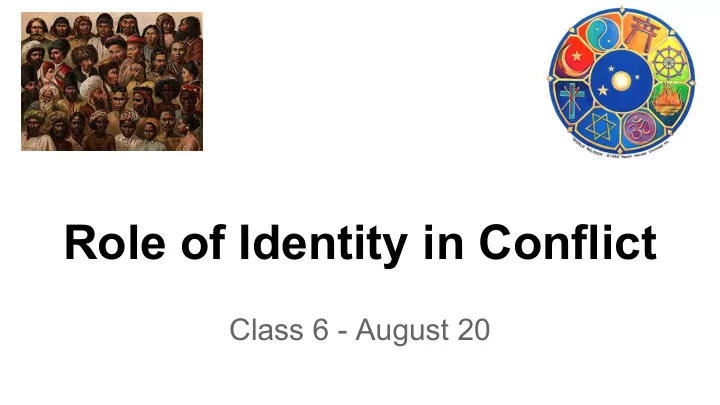
SLIDE 1
Role of Identity in Conflict
Class 6 - August 20
SLIDE 2 Definition of identity
- Aspects or attributes of a person.
○ Categorizable in society.
○ Ethnicity. ○ Religion. ○ Class ○ Organization membership. ○ City of birth.
SLIDE 3
Types of identity (Fearon)
Role vs. Type Personal vs. Social. Both categories overlap and categorizations influence one another.
SLIDE 4 Janus Face Model (Laitin)
- Some aspects of identity are fixed:
○ Skin color, language, place of birth, culture.
○ Race, religion, class, etc.
- People can choose to highlight one
characteristic over others.
SLIDE 5 Identity helps people overcome collective action and coordination problems.
- Social ties reveal preferences.
- Denser social networks apply pressure to
group members.
SLIDE 6 In-group closeness = out-group threat
- Social proximity leads to distrust
- f outsiders.
- Similarly, outsiders can start to
distrust in-group because of social proximity.
SLIDE 7 Three ways to view identity and conflict:
- Essentialist (Horowitz, Geertz)
- Instrumentalist/Institutionalist (Brass, Bates,
King)
- Constructivist (Wilkinson, Posner, Kalyvas)
SLIDE 8 Essentialist Perspective
- Identity characteristics, particularly ethnicity,
are ingrained into collective consciousness.
- Ethnicity ingrains three characteristics:
○ Affectivity ○ A priori ○ Ineffability
- Fixed in the short term, difficult to change in
long term.
SLIDE 9 Ethnicity shapes interactions
- Ethnic distinctions shape
economic, political and social competition.
- Co-ethnics are more likely
to interact with one another, less likely with non-co-ethnics.
SLIDE 10
Horizontal Inequality drives conflict
Advanced groups: empowered by colonial authorities, wealthy, educated, hold political power and civil service jobs “Backward” groups: disempowered by colonial authorities, poor, uneducated, no political power or civil service jobs.
SLIDE 11 Horizontal Inequality leads to conflict
- Both disempowered advanced and
backward groups can seek secession.
- Neighboring states can try to annex
disempowered co-ethnics across borders.
○ Think Russia and Ukraine.
SLIDE 12 Instrumentalist/Institutionalist View
- Shared history of identity is irrelevant.
- Conflict occurs when politicians or
entrepreneurs exploit identity divisions to empower themselves. Institutionalists: Same, through political institutions.
SLIDE 13 Bates: Traditional leaders enhance bonds for profit
profit as societies urbanize.
- The identity they highlight
is purely opportunistic.
SLIDE 14 King: Institutions exploited for conflict
- What conflicts does King talk about?
SLIDE 15 King: Institutions exploited for conflict
- What conflicts does King talk about?
○ Former Soviet secessionist conflicts ○ What do they have in common?
SLIDE 16 Growth of National Sentiment:
- Dependent on pre-existing political institutions
established by USSR.
- Myths built by politicians after de facto
independence solidify separatism.
- How would Horowitz explain the movements?
SLIDE 17 Constructivist View
Wilkinson, to an extent + Dan Posner.
- Identities are fixed, but overlap (cross-cut).
These overlaps can be exploited for political gain or change based on political factors.
SLIDE 18 Posner: Cleavage salience in Africa
- Chewas and Tumbukas are allies in Malawian
politics, adversaries in Zambia.
○ Depends on relative group size.
- Tribal affinity more relevant when Zambia was a
- ne-party state, ethnic identity when a
democracy.
○ Depends on whether local or national elections matter more.
SLIDE 19
Discussion: What school is more plausible to you?
Does conflict start because of unchanged historical rivalries or is it used as a fluid tool by opportunists?
SLIDE 20
Serbs in Croatia Identity Case
SLIDE 21 Background: Yugoslavia
Slavs created after WWI.
dictatorship under Josip Broz Tito.
○ Tito dies in 1980.
SLIDE 22 Central Government challenged in 1980s.
governments of each component of Yugoslavia.
attempts to govern Yugoslavia as a Serbian dominated country.
SLIDE 23
How does crisis begin?
SLIDE 24 How does crisis begin?
- Serb paramilitaries formed to put down
protests in Kosovo.
○ Recruit soccer hooligans, criminals and thugs to participate in militias.
- Milosevic gains power in 1989.
- Four constituent states of Yugoslavia seek
independence.
SLIDE 25 Lead-up to war
- Croatian nationalists win
local elections.
WWII-era genocide.
- Paramilitaries enter Serb
areas and inflame tensions.
SLIDE 26
Why were paramilitaries used?
SLIDE 27 Why were paramilitaries used?
- Take pressure off of regular army
○ Do what army wouldn’t do.
- Compel Serbs to rise up against Croatia.
- Lack of USSR support encouraged Greater
Serbia plan.
- Gains were institutionalized in 1992 Vance
Plan...until Croatians overran Serbian Krajina in 1995.
SLIDE 28
Given Croatia, which school seems more valid?
Does the essentialist explanation have any value? Which conflict does it apply to, if any? Think back to South Sudan, Syria, Northern Ireland, Chechnya or Nigeria.