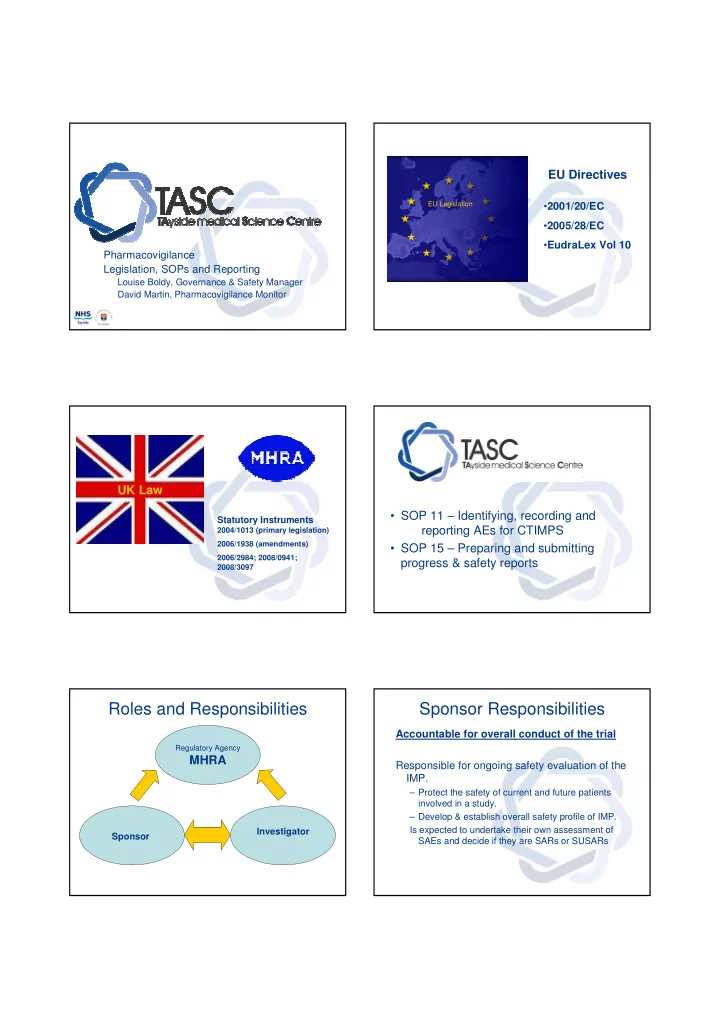
Roles and Responsibilities Sponsor Responsibilities Accountable for - - PDF document

roles and responsibilities sponsor responsibilities
SMART_READER_LITE
LIVE PREVIEW

Roles and Responsibilities Sponsor Responsibilities Accountable for - - PDF document

EU Directives EU Legislation 2001/20/EC 2005/28/EC EudraLex Vol 10 Pharmacovigilance Legislation, SOPs and Reporting Louise Boldy, Governance & Safety Manager David Martin, Pharmacovigilance Monitor UK Law SOP 11


slide-1
SLIDE 1

Pharmacovigilance Legislation, SOPs and Reporting

Louise Boldy, Governance & Safety Manager David Martin, Pharmacovigilance Monitor

EU Legislation

EU Directives

  • 2001/20/EC
  • 2005/28/EC
  • EudraLex Vol 10

UK Law

Statutory Instruments

2004/1013 (primary legislation) 2006/1938 (amendments) 2006/2984; 2008/0941; 2008/3097

  • SOP 11 – Identifying, recording and

reporting AEs for CTIMPS

  • SOP 15 – Preparing and submitting

progress & safety reports

Roles and Responsibilities

Regulatory Agency

MHRA

Sponsor Investigator

Sponsor Responsibilities

Accountable for overall conduct of the trial Responsible for ongoing safety evaluation of the IMP.

– Protect the safety of current and future patients involved in a study. – Develop & establish overall safety profile of IMP. Is expected to undertake their own assessment of SAEs and decide if they are SARs or SUSARs

slide-2
SLIDE 2

Sponsor Requirements

  • Report UK SUSARs to MHRA and

main REC within defined timelines

–Fatal/life-threatening within 7 days –Non-fatal/life-threatening within 15 days

  • SUSARs now reported electronically
  • Annual Safety Reporting

Investigator Responsibilities

  • Must record all AEs during a study

– records can be inspected by the Sponsor

  • decide if an event is serious
  • decide if an event is a reaction
  • decide if a reaction caused by IMP
  • Must immediately notify the Sponsor of

SAE/Rs (usually within 24 hrs).

Investigator Responsibilities

  • Trial design
  • Patient recruitment and safety
  • IMP accountability
  • Accuracy of results
  • Analysis and interpretation
  • End of Trial Declaration (MHRA, Ethics)
  • End of Trial Report

SOP 11

IDENTIFYING, RECORDING AND REPORTING ADVERSE EVENTS FOR CTIMPS

What is an Adverse Event?

“any untoward medical occurrence in a

patient or clinical trial subject administered a medicinal product and which does not necessarily have a causal relationship with this treatment”

Directive 2001/20 EC

What information is needed to report an event?

Sufficient information to identify:

– The clinical trial – The trial subject – The event – The IMP – The reporter

slide-3
SLIDE 3

Is it serious?

  • results in death
  • is life-threatening
  • required inpatient hospitalization or

prolongation of existing hospitalisation

  • results in persistent or significant disability
  • r incapacity
  • is a congenital anomaly or birth defect
  • is otherwise considered serious

(ICH Guidelines for GCP)

If the Adverse Event is Serious…

“The investigator shall report all serious adverse

events immediately to the sponsor except for those that the protocol or Investigator’s Brochure identifies as not requiring immediate reporting. The immediate report shall be followed by detailed written reports”.

Directive 2001/20 EC

  • Article 16

Recording and Reporting

  • All Adverse Events must be recorded

– Case Report Form (CRF) – Adverse Event Log

  • Serious Adverse Events must be reported

to the sponsor

Is it a Reaction?

Marketed medicinal products:

– A response to a drug which is noxious and unintended and which occurs at doses normally used in man for prophylaxis, diagnosis, or therapy of diseases or for modification of physiological function. (ICH Guidelines for GCP)

Is it expected?

  • Clarify what section(s) of the IB/SPC are

being used to assess expectedness.

  • Any person making expectedness

assessments must understand the regulatory definition

– An adverse reaction the nature or severity of which is not consistent with the applicable product information.

  • If multiple people are performing these

assessments there must be consistency.

What happens to your SAE?

  • Check for completeness and signature
  • Assess for expedited reporting
  • Enter into Pv database
  • Assign WHO-ICD code
  • Confirm receipt and code to investigator, check

that code is appropriate

  • Arrange for independent clinical review

– complete subsequent actions

  • Follow up SAE to resolution if required
  • Expedited reporting to MHRA if required
slide-4
SLIDE 4
  • Adverse Reaction
  • Serious
  • Unexpected
  • Suspected

= SUSAR

Expedited Reporting Requirements

If the IMP is suspected of being the cause of a serious adverse reaction it must be reported to the MHRA within…

– Seven days if fatal or life-threatening – Fifteen days for other suspected reactions

Other Reporting Requirements

  • It is the sponsor’s responsibility to keep all

investigators undertaking clinical trials for which they are also acting as sponsor informed of SUSARs, where such trials also involve the same IMP.

  • Reports sent to the Investigator regarding SUSARs

from other trials of the same medicinal product must be reviewed by the Investigator and acted upon if

  • appropriate. Copies of such SUSAR reports must be

kept in the ISF and the TMF.

Question 1

If a subject is treated in A&E but not admitted to hospital, is this an SAE?

Answer 1

  • Probably not, but…
  • Is it covered in the protocol?
  • What did the subject attend A&E for?
  • Could it be otherwise considered serious?
  • If the decision is not to report the event as

serious, it must be entered in to the AE log

Question 2

If a subject is admitted to hospital for a pre-planned

  • peration, is this a SAE?
slide-5
SLIDE 5

Answer 2

  • Probably not but…
  • This should be covered in the protocol.
  • If elective surgery is excluded in the

protocol an event may still be reportable if:

– Complications arise which cause prolongation

  • f hospital stay

– The IMP is possibly linked to any drug interactions during the hospital stay

Question 3

A well known side-effect of product X is

  • hypotension. A trial subject is hospitalised

due to hypotension after receiving the product. Does this still need to be reported to the Sponsor as a SAE?

Answer 3

  • Yes – unless excluded by the protocol

Even if excluded – did the reaction occur with greater than expected severity, or rapidity of onset?

SOP 15

PREPARING AND SUBMITTING PROGRESS AND SAFETY REPORTS

Reporting

  • Annual Safety Reports — becoming…

– Development Safety Update Reports

  • Annual Progress Reports
  • Pregnancy Reporting
  • Expedited Reporting
  • Urgent Safety Measures
  • Other Reporting Requirements

Annual Safety Reports (CTIMPs)

  • Annually from date of CTA approval
  • Prepared by TASC on behalf of the Chief

Investigator

  • Prepare ASR
  • Line listing of SARs
  • Send to CI for checking and IMP safety

assessment.

– Submit to MHRA – Submit to REC

slide-6
SLIDE 6

Development Safety Update Reports DSURs

  • Annually, on the International Birth Date of

the IMP

  • Includes all trials which use same IMP

Annual Progress Reports

  • Annually from date of REC approval
  • NRES annual progress report form

(CTIMPs or non CTIMPs form)

  • First annual progress report should state

the commencement date for the study or an explanation for the delay

.

Pregnancy Reporting

  • Not considered an AE or SAE
  • Unless a congenital abnormality or birth defect
  • Should be notified on pregnancy reporting forms (TASC

website)

  • Pregnancies of a trial participant or the female partner of

a trial participant should be followed up to outcome

  • For female partners of male trial participants, consent is

required

Expedited Reporting

  • The following safety issues should also be reported by

the Investigator to the Sponsor in an expedited fashion:

– An increase in the rate of occurrence or a qualitative change of expected SAR, which is judged to be clinically important. – Post-study SUSARs that occur after the trial participant has completed a clinical trial and are notified to the Investigator. – New events related to the trial or the development of the investigational medicinal products and are likely to affect the safety of the participants. – Recommendations of the Data Monitoring Committee where relevant for the safety of trial participants.

  • The Sponsor is responsible for informing the MHRA

and the REC of these safety issues.

Urgent Safety Measures

  • CI or PI at participating site may take

appropriate safety measures to protect the participants of a CTIMP against any immediate hazard to their health or safety

  • Urgent safety measures can be implemented

immediately

  • Investigator should contact Clinical Trial Unit at

MHRA and discuss with a medical assessor.

  • Sponsor and REC should also be contacted at

this time

  • Investigator must notify MHRA, REC and

sponsor in writing within 3 days

Where to find the forms

  • TASC Website

http://www.tasc-research.org.uk/_page.php?id=269

  • Please use live forms as they may change
  • Adverse Event Log
  • SAE form, and guidance
  • Pregnancy Notification Form
  • Pregnancy Follow Up Form
slide-7
SLIDE 7

Contact details

Pharmacovigilance Department TASC R&D Office Ninewells Hospital and Medical School Residency Block, Level 3 Dundee DD1 9SY Email: pharmacovigilance.tayside@nhs.net Fax: 01382-740122 Telephone

Direct: 01382 740296 (40296 internal) Admin: 01382 632236 (32236 internal)