
SLIDE 1
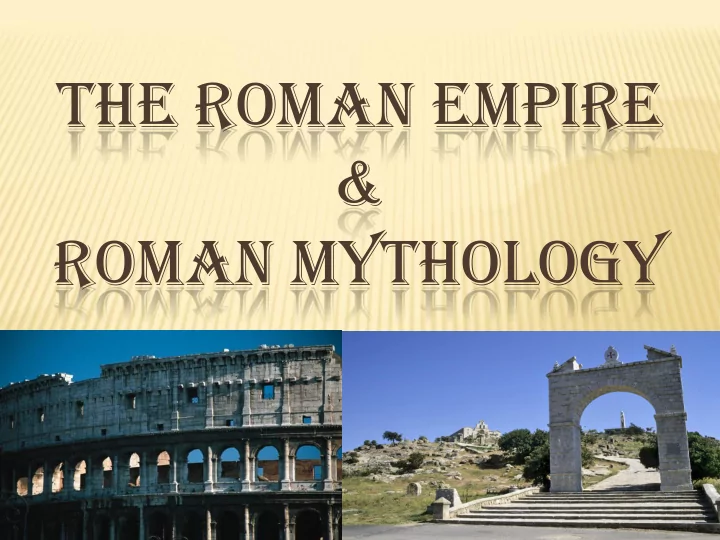
& ROMAN MYTHOLOGY A BRIEF HISTORY OF ROME Rome, known as 'the - - PowerPoint PPT Presentation
THE ROMAN EMPIRE & ROMAN MYTHOLOGY A BRIEF HISTORY OF ROME Rome, known as 'the eternal city, is believed to be founded in the year 625 BC. Early Rome was governed by kings, but after only seven of them had ruled, the Romans took
Rome, known as 'the eternal city„, is believed to be founded in the
year 625 BC.
Early Rome was governed by kings, but after only seven of them
had ruled, the Romans took power and ruled themselves.
They established a council known as the „Se
Senate' which ruled over the roman people who are as the 'Roman an Republ blic ic'.
The Roman Republic was a very successful government. It lasted
from 510 BC until 23 BC - almost 5000 years. In comparison the United States of America only exist since 1776 - less than 300 years.
Rome's most famous citizen was no doubt Julius
the year 49 BC, Caesar conquered Rome and then ruled as a dictator.
Julius Caesar, having claimed to be a direct
descendent of Aeneas, the son of Venus, was among the first to deify himself in such a manner.
His life was ended as he was infamously murdered
in the senate in Rome and is the subject of a play by
Shakespeare.
Roman mythology is the
Most of the Roman gods and goddesses were a
blend of several religious influences.
Many of these were introduced via the Greek
colonies
In some cases the Etruscan or Latin names
survived throughout the cultural existence of Rome, but many were adopted so completely that they maintained their names from other cultures.
the Greek names remained the choice of the
people and the major gods of the system therefore, were known by both.
Uranus was God of the Sky Gaia was Goddess of the Earth They had many children together
including giants.
They had a violent argument and
split up. Ever since the earth and sky have been apart.
Uranus was a shadowy figure right at the start of time.
Uranus was not worshipped by the Romans, and as such there are no pictures of him.
Saturn ruled the Gods before Jupiter. The Roman version of
Saturn‟s myth is similar to that of Cronus with his children.
Jupiter, Neptune and Pluto were his children. They
represent Air, Water and Death, the three things that Time cannot kill.
Son of Gaia and Uranus He is called Old Father Time. Held a sickle or scythe in his left
hand and a bundle of wheat in his right
The Roman version of Saturn‟s
myth is similar to that of Cronus with his children
Son of Saturn, Brother of Neptune & Pluto Jupiter was King of the Gods The eagle was his messenger Jupiter means Father Jove Thunderbolt, thunder & lightening Other gods were terrified of him, although
he was a little scared of his wife Juno!
Patron God of Rome – his temple was the official
place of state business and sacrifices
There was a big temple on the Capitol in Rome dedicated to Jupiter
Optimus Maximus (which means Jupiter Best and Greatest).
God of the Sea God of Earthquakes Son of Saturn He rode a dolphin or a horse Carried a trident, which had three prongs. When the sea is rough enough to show white
tops to the waves called sea horses. The back half of the seahorse is a fish. (see picture above)
He was also the God of Horses and horse-racing.
Son of Saturn Brother of Jupiter & Neptune Husband of Proserpine God of Death Ruler of the Underworld Romans were afraid to say Pluto's name
because they were afraid he might notice them and they would die.
When someone died, they travelled
down to the Underworld.
First, they had to cross the River of
the Dead, called the Styx.
Everyone was buried with a coin, to
pay the ferryman,
Then they had to get past Cerberus,
a fierce dog with three heads, which would only let the Dead through.
Finally they had to come before the
Judges of the Dead.
Mother of Mars & Vulcan Wife of Jupiter
Queen of the gods
En
Englis glish h wor
means a large beautiful woman
Goddess of women and
marriage.
Her bird was the peacock.
Goddess of Earth & Corn
Mother of Proserpine, Queen of the Underworld
Sister of Jupiter She carried the cornucopia, a horn full of
vegetables and fruit.
ROMAN
N MYTH: Pluto fell in love with Proserpine, and carried her off to the Underworld. Ceres searched everywhere, but couldn't find her. Eventually Ceres refused to let the plants grow any more, and everyone begun to die of hunger. Pluto then admitted he had
had to return to her husband for six months every year. When this happens, Ceres stops everything growing, and winter comes.
Sister of Jupiter Vesta was the center of the Roman home In Roman homes, every day, during a meal, a small cake was
thrown on the fire for Vesta. It was good luck if it burnt with a crackle.
She was a quiet well-behaved goddess, who didn't join in the
arguments and fights of the other gods.
She was protector of the sacred flame. The flame was relit
every March 1st and had to be kept alight all year. If this flame ever went out, disaster would fall on Rome. The flame was kept alive by the Vestal Virgins, priestesses were chosen to serve for thirty years, and were not allowed to marry.
Son of Jupiter and Juno En
English lish word: d: Martial means warlike.
Father of Romulus and Remus, the founders of Rome.
Because of this mythological lineage, the Roman people felt as though they were also the children of Mars and he was regarded as their protector.
The month March (Martius) is named after him.
March was called after Mars because that was when the soldiers started fighting again after winter.
He was a god of spring, growth in nature, and
fertility, and the protector of cattle.
Mars held a special place in Roman life because
Roman Empire who conquered Northern Africa and much of Europe and the Middle East.
Mars is portrayed as a warrior in full
battle armor, wearing a crested helmet and bearing a shield.
His sacred animals are the wolf and
the woodpecker, and he is accompanied by Fuga and Timor, the personifications of flight and fear
Daughter of Jupiter Her symbol was the owl.
The Roman goddess of wisdom, medicine, the arts,
dyeing, science, trade, and war.
As Minerva or “Medica” she is the patroness of
physicians.
Minerva is believed to be the inventor of numbers and
musical instruments.
ROMAN
AN MYTH TH: : She had a strange birth. One day, Jupiter had a bad
ROMAN
AN MYTH TH: : Minerva was the goddess of arts and crafts. She was particularly good at weaving. Once a woman called Arachne wove a beautiful picture. Minerva tried to find something wrong with it. When she couldn't, she tore it up and turned Arachne into a spider. The spider still weaves beautiful webs.
ROMAN
AN MYTH: H: Minerva helped the hero Perseus to kill the gorgon Medusa. Minerva told Perseus to look at Medusa's reflection in a polished shield. That way he could cut the head off without looking directly at the gorgon. He gave the head to Minerva, who put it on her shield, so it would turn her enemies to stone.
Daughter of Jupiter Mother of Cupid Venus was born in the sea and first came to shore at Cyprus,
floating on a scallop shell with “For the Fairest" written on a Golden Apple.
ROM
OMAN AN MYTH: Venus, Juno & Minerva all wanted to be named the most beautiful. They decided to let a mortal man, Paris, judge. They were all so beautiful that he couldn't make his mind up. The Goddess tried to bribe him: Juno said she would make him powerful, Minerva said she would make him wise and Venus
chose Venus and her gift. Unfortunately, Helen was married to someone else, and when Paris carried her off to his home at Troy, her husband came with his allies to get her back. Paris and all his family were killed and Troy was destroyed. Many famous stories were written about Helen of Troy.
Son of Venus Englis
ish h word: d: “Cupidity” means greediness.
mischievous His weapon was a bow, and anyone hit by
ROMAN
N MYTH: Cupid once scratched himself with one of his own arrows by mistake. He was looking at a woman called Psyche, and fell in love with her. He knew that his mother Venus would be angry, so he hid Psyche away and told her that she must never try to look at him. Psyche thought that she had been captured by a hideous monster, and, of course, couldn't resist taking a peep. She was enchanted by the first sight of her handsome husband, and while playing with his arrows, scratched herself as well. So now they were both desperately in love with each other. Venus drove Psyche away, and she had many adventures before she was allowed to stay with Cupid, and Venus became reconciled to being a mother-in-law!
Son of Jupiter, Twin Brother of Diana Each day he drove his chariot of fiery
horses across the sky to give light to the world.
God of music and played the lyre His most famous temple was at Delphi
in Greece. Know as God of Prophesy, his priestess would prophesize the future.
Apollo had a son called Phaethon, who was human. Phaethon nagged at Apollo to let him borrow the sun chariot and fly across the sky. Finally, Apollo agreed.
Phaethon proudly drove the sun chariot up into the sky, but then he lost control of the
earth, burning everything. Finally, Jupiter had to stop him with a thunder bolt.
Daughter of Jupiter Twin Sister of Apollo Carried a bow and arrows Goddess of the Moon & Hunting Helped women in child-birth, because her mother,
Leto, gave birth to her and her twin brother so easily.
Roman
man Myt yth: h: Once she was bathing in a forest pool and a hunter, Actaeon, spied on her. As punishment, Diana turned him into a stag and he was chased by his own hunting dogs.
Son of Jupiter and Goddess Maia God of thieves and travelers. God of science and business Wore a winged hat and sandals so he could fly. He carried a staff which also has wings and
two snakes winding round it.
ROMAN MYTH:
H: When he was only a few days old, he stole the cows of Apollo. Mercury made special shoes for the cows and made them walk backwards, so no one could follow their
instrument, a lyre, strung with cow-gut. He realized Mercury had stolen his cows. Apollo was furious with Mercury, but agreed that Mercury could keep the cows if Apollo kept the the lyre.
“Mercurial” means light-hearted and active.
Son of Jupiter Vulcan was the smith of the gods He made Jupiter‟s thunderbolts. God of the Volcano, his smithy was
in the volcano Etna, in Sicily, where you can see fire from his forge.
ROM
OMAN N MYTH: TH: Once, he made Jupiter angry, and Jupiter threw him out of Heaven. Vulcan fell to Earth and broke both legs, which made him lame.
He made women of gold to help him in his smithy
Son of Jupiter God of the Theatre He was accompanied by
Maenads, or wild dancing
a staff of giant fennel, covered with ivy leaves, with a pine cone
Janus kept the gate of Heaven,
so he became the god of doors and gates.
He was very important, because a house is only as strong as
its doors.
His temple in Rome had its doors thrown open in times of War,
and closed in times of Peace. They were usually open! The Emperor Augustus closed the doors of the temple, since he brought peace to the Roman Empire.
Janus had two faces, one looking forwards and one looking
back, since a door can let you in, or let you out.
The first month of the year is named after him. In January, we
look back at the last year, and forward to the next.
Relations:
lations: Maia is Mother of Mercury
En
Engl glish ish wor
flower.
Goddess of Growth Goddess for which the month of May is
named.
In the Middle Ages, people went out
Maying on the first of May. They would go to the fields and woods, collecting flowers and enjoying the sunshine.
Goddess of flowers Origin of words related to flowers
Zeus Jupiter Hera Juno Apollo Apollo Demeter Ceres Artemis Diana Ares Mars Hermes Mercury
Dionysus Bacchus Hades Pluto Eros Cupid Athena Minerva Poseidon Neptune Aphrodite Venus Hestia Vesta Hephaestus Vulcan
The Roman Empire was one of the largest and most enduring in world
history.
The saying "All Roads Lead to Rome" alludes to this central hub of
technology, literature, culture and architecture in the ancient world. The engineers of the Roman age created an unparalleled network of roads in ancient history.
They built strong arched bridges, and mastered the concept of "running
water" using aqueducts that, among other things, supplied public baths rivaling today's modern water facilities.
At the height of its power in the 1st and 2nd centuries AD, the Roman
Empire consisted of some 2.2 million square miles (5.7 million sq. km). 60 million people (or as much as 1/5 of the world's population) claimed citizenship of Rome
Name Why??? God Sun
The Sun is the brightest object in the sky. Apollo - God of Enlightenment
Moon
The Moon is the next brightest object. Diana - Goddess
Mercury Fastest planet
Mercury - Messenger of the Gods
Name WHY??? God
brightest planet Venus - Goddess
the red (blood) planet Mars - God of War
largest planet Jupiter - King of the Gods
slowest planet Saturn - God of Time
The days of the week are Saxon. They are
named after the Sun, Moon and planets.
Lundi – Monday (Moon-day) Mardi – Tuesday Mercredi – Wednesday Jeudi - Thursday Vendredi - Friday Saturday Sunday
When you look at September, October, November
and December, it seems as if the Romans couldn't count! But their year used to start in
reorganized the calendar and made it start in January, he kept the old names, apart from one month, which he called after himself.
The next ruler of Rome, Augustus that came
after Julius Caesar and changed the name of another month. Of course, he named a month after himself. Can you guess?
Ma March ch Mars, , God d of War
Star art t of year for soldier iers (no
ting ng during ing winter er month ths) s)
April Aperire meaning open This is the month when trees & flowers “open” their leaves May Maia,
Goddess of Growth
The month when trees and flowers start to grow June Juno,
Queen of the Gods
Julius lius Cae aesa sar, , Ruler ler of Rome me He reorgan ganiz ized ed th the e ca cale lenda ndar.
Augustus, Ruler of Rome after Caesar He thought he was at least as important as Julius Caesar!
Ja Janu nuar ary
Ja Janu nus, , God d of Doors This is mo month th opens ens th the year ar.
Feb ebrua uary
Februo meaning purify This was a Roman month of sacrifices and purification.
Planet Saturn Jupiter Mars Moon Venus Mercury Sun Metal Lead Tin Iron Silver Copper Cinnabar Gold Gemstone Turquoise Cornelian Emerald Rock crystal Amethyst Lodestone Diamond
http://www.unrv.com/culture/minor-roman-god-list.php http://gwydir.demon.co.uk/jo/roman/index.htm http://library.thinkquest.org/5679/