Rules: Process Control Event 2019 PLEASE NOTE THAT SECTIONS WITH - - PDF document

rules process control event 2019
SMART_READER_LITE
LIVE PREVIEW

Rules: Process Control Event 2019 PLEASE NOTE THAT SECTIONS WITH - - PDF document

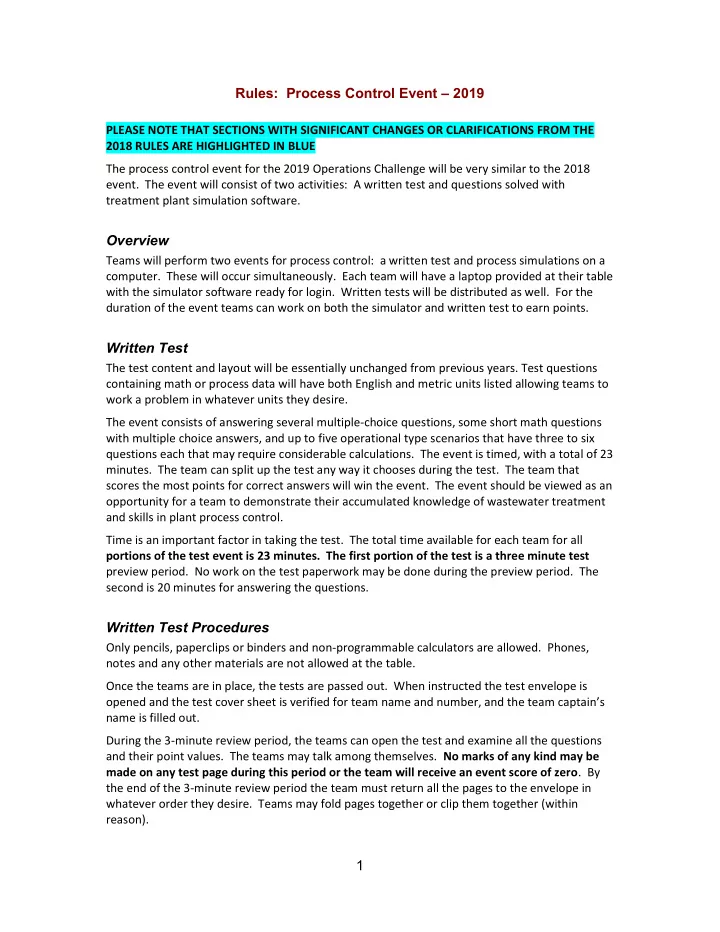
Rules: Process Control Event 2019 PLEASE NOTE THAT SECTIONS WITH SIGNIFICANT CHANGES OR CLARIFICATIONS FROM THE 2018 RULES ARE HIGHLIGHTED IN BLUE The process control event for the 2019 Operations Challenge will be very similar to the 2018


slide-1
SLIDE 1

1 Rules: Process Control Event – 2019

PLEASE NOTE THAT SECTIONS WITH SIGNIFICANT CHANGES OR CLARIFICATIONS FROM THE 2018 RULES ARE HIGHLIGHTED IN BLUE The process control event for the 2019 Operations Challenge will be very similar to the 2018

  • event. The event will consist of two activities: A written test and questions solved with

treatment plant simulation software.

Overview

Teams will perform two events for process control: a written test and process simulations on a

  • computer. These will occur simultaneously. Each team will have a laptop provided at their table

with the simulator software ready for login. Written tests will be distributed as well. For the duration of the event teams can work on both the simulator and written test to earn points.

Written Test

The test content and layout will be essentially unchanged from previous years. Test questions containing math or process data will have both English and metric units listed allowing teams to work a problem in whatever units they desire. The event consists of answering several multiple-choice questions, some short math questions with multiple choice answers, and up to five operational type scenarios that have three to six questions each that may require considerable calculations. The event is timed, with a total of 23

  • minutes. The team can split up the test any way it chooses during the test. The team that

scores the most points for correct answers will win the event. The event should be viewed as an

  • pportunity for a team to demonstrate their accumulated knowledge of wastewater treatment

and skills in plant process control. Time is an important factor in taking the test. The total time available for each team for all portions of the test event is 23 minutes. The first portion of the test is a three minute test preview period. No work on the test paperwork may be done during the preview period. The second is 20 minutes for answering the questions.

Written Test Procedures

Only pencils, paperclips or binders and non-programmable calculators are allowed. Phones, notes and any other materials are not allowed at the table. Once the teams are in place, the tests are passed out. When instructed the test envelope is

  • pened and the test cover sheet is verified for team name and number, and the team captain’s

name is filled out. During the 3-minute review period, the teams can open the test and examine all the questions and their point values. The teams may talk among themselves. No marks of any kind may be made on any test page during this period or the team will receive an event score of zero. By the end of the 3-minute review period the team must return all the pages to the envelope in whatever order they desire. Teams may fold pages together or clip them together (within reason).

slide-2
SLIDE 2

2

The second portion of the event follows quickly. At the signal teams open the envelope and have 20- minutes to complete the test. All pages must be in the envelope at the end of twenty minutes.

Process Simulator

The Process Simulator is a treatment plant software model created by Hydromantis. The user interface is designed so that operators start with an overview of a plant layout and a series of process questions. Starting from the Main Menu, each question will have a description and the performance objectives needed to solve that problem. These performance objectives are typically related to effluent performance but may also include process operating conditions, as well as chemical and energy costs. Competitors can then open windows to change operational controls and view data for various units. They can adjust aeration, pump settings, chemical feed rates and even the number of units in service. Note that in some problems, units may start the simulation as out of service or chemical addition may be on at the start of the problem that will need to be turned off. Essentially the simulator allows operators to see data and adjust plant

  • perations just as they would in real life.

There are 10 steady state questions and 1 dynamic question in the 2019 event. The computer run time for the steady state questions is typically only a few seconds each but the run time for the dynamic question (#11) is typically between 90 and 120 seconds. Each of the steady state questions will have from 2 to 5 objectives to meet and there will be 25 points awarded for each objective correctly answered (question point totals ranging from 50- 125 points). The dynamic question will have a simulated run time of 5 days and points are awarded only if the parameter (i.e., TSS) is met for the entire 5-day simulation run time. Each team will have up to 15 minutes to achieve as many process objectives as they can. The software will display points as objectives are met as well as the time remaining. At the end of the allotted time the simulator will stop and display the points earned. Note that points will be awarded for each problem objective met but only if the question answer has been submitted during the 15-minute time limit.

Process Simulator Procedures

The team will be given paperwork briefly describing each of the questions. The paperwork describes the type of plant and the goals to be achieved. The point value for each problem will be listed. Each team will have three minutes to review the list of simulator questions, then must return them to the envelope with the written test paperwork. The computers may not be touched during the 3-minute preview period. Once the overall 20-minute event time begins, each team will proceed to log in to the simulator computer. The 15-minute timed simulator event will begin once the competitor presses the “START” button but must be completed within the

  • verall 20-minute duration of the event.

After logging in to the simulator, a 15-minute timer starts, and a menu of the questions is

  • presented. Teams can choose any question and begin studying the initial conditions and current
  • utputs. Then they make as many adjustments as desired and update the simulation. An

update to the steady state questions will take a few seconds and present new results. The team

slide-3
SLIDE 3

3

can repeat the adjustments and results as many times as desired. Goals will be highlighted as they are achieved. A team can move to a different question before all goals are achieved if they

  • wish. They will earn points only for the goals achieved and submitted. The software doesn’t

allow returning to the exact point where a scenario was left, so some of the prior changes made will need to be re-entered. In the time provided the team will complete as many question

  • bjectives as possible. The time remaining will show continuously in the middle of the screen.

Event Philosophy

The purpose of the Process Control event is to distinguish the relative process control skills of the teams so that points can be awarded proportionately. In an ideal world this would consist of each team standing before a panel of judges and reciting all their wastewater knowledge and answering questions from the judges. In the context of the Operations Challenge this is not practical, so a timed written test is used. Unlike most test situations, the expectation is not that all teams will complete all the questions. The goal is not to see who can answer all questions with the fewest mistakes. Instead, teams are given the opportunity to provide as many correct answers as they can in the allowed time. The test is designed to be long enough so that teams do not run out of questions to answer. The types and difficulty levels for questions are roughly matched to the points awarded for getting the correct answer. Solving the process scenario questions are usually worth more than the quick multiple choice questions. It is up to each team to develop a strategy to figure out which questions to answer in the time allotted to achieve the highest final score. Showing work is required and emphasized because it allows distinction between knowing the right answer and guessing the right answer. Test graders can only see what is written by the team and cannot infer what was meant. Since the goal of the test is to demonstrate knowledge, graders need to see the steps used to arrive at an answer to a math question.

Process Scenario Categories

The scenario problems will be chosen from the following processes:  Disinfection  Lagoons  Activated Sludge It is always possible that categories could change due to changes in volunteer time available. There are no mandatory questions.

Grading

The tests will be graded as follows:  multiple choice questions as: correct answer, incorrect answer, or no answer  short math multiple choice questions as: correct, incorrect, or no answer as well as whether work is shown on test paper. No points awarded unless adequate work is shown. 

  • perational scenarios as: correct, incorrect, or no answer as well as whether work is shown
  • n test paper. No points awarded unless adequate work is shown.
slide-4
SLIDE 4

4 Scoring

The overall score for the Process Control event is the sum of the points earned in the simulator and the written test. The process simulator software will add all the points earned for objectives achieved in all the

  • problems. This will be the score for the simulator event. There are no penalties in this event.

Scoring for the written test consists of adding all the team’s points for correct answers and any partial credit given in math or process scenario problems. There is no time bonus or penalty for finishing before the 20 minute time limit. There are no penalties for incorrect answers or not answering a question. For the multiple choice and extended multiple choice questions, there are three possible results: no answer, incorrect answer, or correct answer. For no answer or incorrect answer, zero points are awarded. If the question is answered correctly the score is the point value of that question. In general, multiple choice questions range from 10 to 30 points each. Extended multiple choice questions range from 25 to 50 points each. Point values are shown on each test page. Math and Operational Scenario questions are handled in a similar manner with one additional requirement and one exception. The requirement is that a certain amount of work must be shown to receive any credit. If a correct answer is circled on a math or scenario question, but no work is shown, zero points are awarded for the effort. The exception is that even if there is no answer or the answer is incorrect, the team may receive half credit for that question if work is shown as described below. Short math questions range from 25 to 50 points each. Operational scenario questions may range from 25 to 200 points. Grading of Questions (percent of question value awarded)

Test section Correct answer1 No answer Incorrect answer Correct answer AND showing work Multiple choice 100% N/A Extended multiple choice 100% N/A Short math multiple choice 01 50%* 50%* 100%* Operational scenarios (except mandatory) 01 50%* 50%* 100%*

1For any math questions, there are no points for a correct answer if inadequate work is

shown. *Half credit possible for showing work as described below If a Judge determines that a team member is not attempting to help with parts of the test, a 500 point penalty will be assessed for each non-participating team member.

Rounding and Significant Digits

As a general practice, values should not be rounded off or digits dropped until the final answer is

slide-5
SLIDE 5

5

  • achieved. The possible answers for a math question should differ enough that choosing an

incorrect answer due to rounding errors is unlikely, but this is not guaranteed in long, complex

  • questions. When showing the work, it is not necessary to write out all the digits that may be

displayed on the calculator; generally three or four is enough for the grader to determine how you are working the problem. When using conversion factors, such as 8.34 lbs per gallon, you must show the appropriate number of digits as used in wastewater textbooks. For example, 7.48 is the common conversion factor for gallons per cubic feet. Using 7.5 or even 7 is not acceptable. Part of demonstrating process knowledge is knowing appropriate conversion factors. While shortcuts and approximations might be acceptable in the field, test takers must show the grader that they know the proper conversion factor.

Half Credit and Showing Work

For any math question, the team must write out the numbers used and show them in an equation form. Example:

16 mg/l x 8.34 x 2.4 MGD = 320 lbs

Simply writing down numbers does not count. The equation (including the mathematical operation – add, subtract, multiply, etc) used must be shown and be relevant to the question. For example there will not be credit for writing down the lbs formula when the question is about detention time. The work shown must be consistent with the operational theory described in the problem. For the math and operational scenario questions, if the grader feels that the work shown demonstrates conceptually correct and significant, but incomplete, progress towards the answer the work shown may receive the half credit listed in the Points Table. If the work shown uses a conceptually incorrect approach half credit will likely not be awarded. Note that in the Operational Scenarios, sometimes answers that are text rather than numbers may still require work to be shown. For example, if the correct answer for a problem is “the hydraulic loading rate is too high” then the work shown must include a calculation of the hydraulic loading rate. The test grader can only use what the test taker writes down to determine how the test taker is attempting to solve the problem. Therefore it is the responsibility of the test taker to clearly show how the answer has been derived. The grader cannot infer missing steps in solving the problem. While labeling of units is not required, it is highly encouraged so that graders can better determine if partial credit is warranted. Because each math problem is unique, the requirements of “significantly complete and conceptually correct” will be based on the content of the question. "Significantly complete" generally means that all but one step is shown or that only one mistake is made. "Conceptually correct" depends on the question and what it is asking. Most questions are designed to focus on

  • ne or two key elements of wastewater knowledge. For example, an F/M question focuses on food
slide-6
SLIDE 6

6

and mass. So if an answer doesn’t show BOD, or uses MLSS instead of MLVSS, a key element is missing and no half credit would be given.

slide-7
SLIDE 7

7 Scope

The questions will cover the following areas of wastewater treatment as well as general topics such as: collections, pumping, maintenance, laboratory, safety, flow measurement, and metering: Process Areas Example Systems

Collections System Odor Control Inspection and Testing Pipeline Cleaning and Maintenance Underground Repair and Construction Preliminary Treatment Screening Grit Removal Flow Equalization Odor Control Wet Chemical Scrubbing Chemical Addition Biofilters Primary Treatment Primary Sedimentation Flow Equalization Clarification Secondary Treatment Suspended Media Activated Sludge Biological Nutrient Removal Clarification Sequencing Batch Reactors Secondary Treatment Fixed Media Trickling Filtration Biological Nutrient Removal Advanced Treatment Filtration Biological Nutrient Removal Thickening Gravity Belt Thickener Dissolved Air Flotation Gravity Thickening Solids Stabilization Methods Anaerobic Digestion Aerobic Digestion Dewatering Belt Filter Press Drying Beds Centrifuge Dewatering Disinfection Chlorination \ Dechlorination Ultraviolet Disinfection Management and Support Process Instrumentation Treatment Plant Security

Resources

The following references will be used in creating and grading the test questions:  Water Environment Federation: Manual of Practice 11 and Study Guide  Water Environment Federation: Wastewater Collection System Operator Certification Studybook  California State University Sacramento: Operations of WWTPs Volumes 1 & 2 and Advanced Waste Treatment  California State University Sacramento: Operations and Maintenance of Wastewater Collections Systems.  Manual on the Causes and Control of Activated Sludge Bulking and Foaming, Jenkins, Richards & Daigger

slide-8
SLIDE 8

8

 Water Environment Federation: Wastewater Treatment Fundaments I – Liquid Treatment  The monthly Water Environment & Technology Operations Forum WEF Skills Builder quiz: http://www.wef.org/SkillsBuilder/  Additional general study material includes:  EPA design manuals, which can be obtained at: http://nepis.epa.gov/EPA/html/pubindex.html. Select Browse to see the full list of available documents. Only some are applicable to wastewater.  Wastewater Engineering Treatment Disposal, and Reuse, Metcalf and Eddy, McGraw-Hill  Note that these sources will NOT be used in creating or grading tests. They are listed for those interested in additional sources of wastewater knowledge.

Test Details

The same test is used for both Division 1 and Division 2. The multiple-choice test will consist of up to 42 questions with four possible answers each and 20 questions where each answer is chosen from a list of 20 possible answers (extended multiple choice). The short-math portion of the event will consist of up to 15 multiple choice questions that include a small amount of math. Up to four process scenarios with three to six questions each are in the test. Teams may answer as many parts of any scenario that they desire. The Simulator portion of the event will consist of 10 steady state questions and 1 dynamic question that will run for a longer duration. Formula sheets, reference books or any other material are not permitted. Team members may talk among themselves but may not be disruptive. Teamwork in solving problems is encouraged. Also consider that other teams may overhear your discussions.

General Details

What will be supplied at the event: Answer sheet forms. Competitors must supply their own pencils and calculators (calculators cannot have programming

  • r printout capability). We will also try to have a pencil sharpener available prior to the event but

this is not guaranteed. All four team members must be present before the start of the event. If a team is disqualified from the event, they will receive a score based on every question left blank and no work shown.

Notes

The exact number of questions may change slightly between now and the event. The points may also be adjusted to ensure test balance.

slide-9
SLIDE 9

9

Scenario topics will be listed as soon as possible. However since all scenarios are written from scratch and created by volunteers, the final topics in the test may change slightly or a topic may be

  • mitted.

Graders and event judges will not have reference books available at the event; plan on bringing your own copies as needed. (No reference material can be used during the test) Process Control Event committee members will be available to discuss scoring of test questions the morning after the event.