Run-Time Analysis of repeat Pr[ nobody disturbs ] 1 3 2 c := - - PowerPoint PPT Presentation

run time analysis of
SMART_READER_LITE
LIVE PREVIEW

Run-Time Analysis of repeat Pr[ nobody disturbs ] 1 3 2 c := - - PowerPoint PPT Presentation

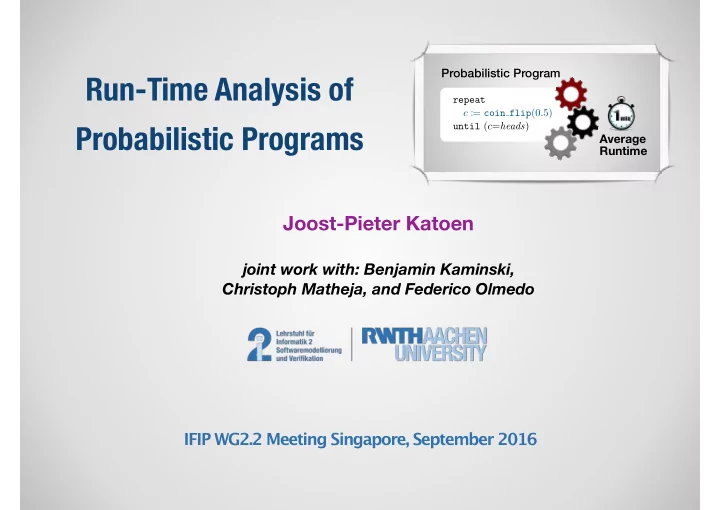
Probabilistic Program Run-Time Analysis of repeat Pr[ nobody disturbs ] 1 3 2 c := coin flip (0 . 5) Probabilistic Programs until ( c = heads ) Average Runtime Joost-Pieter Katoen joint work with: Benjamin Kaminski, Christoph


slide-1
SLIDE 1

Run-Time Analysis of Probabilistic Programs

Joost-Pieter Katoen


joint work with: Benjamin Kaminski, Christoph Matheja, and Federico Olmedo

IFIP WG2.2 Meeting Singapore, September 2016

Pr[nobody disturbs] ≥ 1 2 3

repeat c := coin flip(0.5) until (c=heads)

Probabilistic Program Average Runtime

slide-2
SLIDE 2

Probabilistic Programs — Basics

What is a probabilistic program?

“Ordinary” Program Probabilistic Choice

+

randomly choose a process with which communicate select a random prime in interval [1, n2] flip a (fair/biased) coin; imperative functional logical … In this work

2

Program behaviour (input-output relation + runtime) is determined by the

  • utcome of its probabilistic choices.

Program output is a probability distribution: v1 with probability p1, v2 with probability p2, etc Program runtime is a random variable: t1 with probability p1, t2 with probability p2, etc

slide-3
SLIDE 3

Probabilistic Programs — Example

3

Program Runtime

3 5 7 9 11

1/2 1/4 1/8 1/16 1/32

Run–Time Probability

Average Runtime:

3 · 1

2 + 5 · 1 4 + · · · + (2n+1) · 1 2n + · · · = 5

Program Output Distribution

1 2 3 4 5

1/2 1/4 1/8 1/16 1/32

Output Probability

Probabilistic program that simulates a geometric distribution

Cgeo : n := 0; repeat n := n + 1; c := coin flip(0.5) until (c=heads); return n

slide-4
SLIDE 4

Randomisation Allows Speeding Up Algorithms

4

QS(A) , if (|A|  1) then return (A); i := b|A|/2c; A< := {a0 2 A | a0 < A[i]}; A> := {a0 2 A | a0 > A[i]}; return

  • QS(A<) ++ A[i] ++ QS(A>)
  • Quicksort:

Worst case complexity: O(n2) comparisons

rQS(A) , if (|A| ≤ 1) then return (A); i := rand[1 . . . |A|]; A< := {a0 ∈ A | a0 < A[i]}; A> := {a0 ∈ A | a0 > A[i]}; return

  • QS(A<) ++ A[i] ++ QS(A>)
  • Randomised Quicksort:

Worst case complexity: O(n log(n)) expected comparisons

slide-5
SLIDE 5

Run-Time Analysis of Probabilistic Programs is Intricate

5

Positive almost sure termination is not closed under sequential composition: (Positive) almost-sure termination is “more undecidable” than ordinary termination C1 and C2 both terminate in finite expected time, while C1;C2 does not. Probabilistic programs may admit infinite runs, but finite expected run-time

Cgeo : n := 0; repeat n := n+1; c := coin flip(0.5) until (c=heads) C1 : x := 1; repeat c := coin flip(0.5); x := 2x; until (c=heads) C2 : repeat x := x−1; until (x≤0)

slide-6
SLIDE 6

This talk

Soundness of the calculus w.r.t. an operational program semantics wp-Calculus for bounding the expected runtime of probabilistic programs Consistency w.r.t. Nielson's logic for bounding runtime of ordinary programs

6

Runtime analysis of random walk and the coupon collector’s problem

slide-7
SLIDE 7

Probabilistic Programming Language

7

C ::= empty empty program | skip effectless operation | halt immediate termination | x :≈ µ probabilistic assignment | C; C sequential composition | {C} 2 {C} non–deterministic choice | if (η) {C} else {C} probabilistic conditional | while (η) {C} probabilistic while loop

if 1

2 ·htruei + 1 2 ·hfalsei

  • {succ :⇡ true} else
  • if

1

2 ·htruei + 1 2 ·hfalsei

  • {succ :⇡ true}

else {succ :⇡ false}

Truncated geometric distribution:

h :⇡ 0; t :⇡ 30; while (h  t) t :⇡ t + 1; if 1

2 ·htruei + 1 2 ·hfalsei

  • {h :⇡ h + Unif[0..10]}

else {empty}

Race between tortoise and hare:

slide-8
SLIDE 8

The Expected Runtime Transformer — Basics

8

In particular, runtime

  • f C, when started in state s.

ert [C] (0) (s) 7! Our aim: number of skips, assignments and guard evaluations in the execution of C from state s program C hC :

T

z }| { S → R

∞ ≥0

hC(s) 7! Our approach: We use a continuation passing style through transformer f 7! runtime of the compu- tation following program C ert [C] (f) 7! runtime of C, plus the computation following C

ert[C] : T → T

slide-9
SLIDE 9

The Expected Runtime Transformer — Inductive Definition

9

P

v Pr[µ=v] · f(s[x/v])

Characteristic functional

ert [empty] (f) = f ert [skip] (f) = 1 + f ert [halt] (f) = 0 ert [x :⇡ P

i pi · hvii] (f)

= 1 + λs • P

i pi · f(s[x 7! vi])

ert [C1; C2] (f) = ert [C1] (ert [C2] (f)) ert [{C1} 2 {C2}] (f) = max{ert [C1] (f) , ert [C2] (f)} ert [if (η) {C1} else {C2}] (f) = 1 + Pr [η=true] · ert [C1] (f) + Pr [η=false] · ert [C2] (f) ert [while (η) {C}] (f) = lfp

  • F hη,Ci

f

  • where

F hη,Ci

f

(X) = 1 + Pr [η=false] · f + Pr [η=true] · ert [C] (X)

slide-10
SLIDE 10

The Expected Runtime Transformer — Elementary Properties

10

f g = ) ert [C] (f) ert [C] (g) ert [C] (k + f) = k + ert [C] (f) provided C is halt–free ert [C] (1) = 1 provided C is halt–free ert [C] (f + g) ert [C] (f) + ert [C] (g); C is fully probabilistic ert [C] (r · f) ⌫ min{1, r} · ert [C] (f) ert [C] (r · f) max{1, r} · ert [C] (f) Monotonicity: Propagation

  • f constants:

Preservation of ∞: Sub-additivity: Scaling:

slide-11
SLIDE 11

The Expected Runtime Transformer — Application Example

11

Ctrunc : if 1

2 ·htruei + 1 2 ·hfalsei

  • {succ :⇡ true} else
  • if

1

2 ·htruei + 1 2 ·hfalsei

  • {succ :⇡ true}

else {succ :⇡ false} ert [Ctrunc] (0) = 1 + 1

2 · ert [succ :≈ true] (0)

+ 1

2 · ert [if (. . .) {succ :≈ true} else {succ :≈ false}] (0)

= 1 + 1

2 · 1 + 1 2 ·

⇣ 1+ 1

2 · ert [succ :≈ true] (0) + 1 2 · ert [succ :≈ false] (0)

⌘ = 1 + 1

2 · 1 + 1 2 ·

⇣ 1 + 1

2 · 1 + 1 2 · 1

⌘ =

5 2

The execution of takes, on average, 2.5 units of time Ctrunc

ert [x :⇡ P

i pi · hvii] (f) =

1 + λs • P

ipi · f(s[x 7! vi])

ert [if (η) {C1} else {C2}] (f) = 1 + Pr [η=true] · ert [C1] (f) + Pr [η=false] · ert [C2] (f)

slide-12
SLIDE 12

The Expected Runtime of Loops — Proof Rules

12

F hη,Ci

f

(I) ≤ I ert [while (η) {C}] (f) ≤ I [while]

F hη,Ci

f

(X) = 1 + Pr [η=false] · f + Pr [η=true] · ert [C] (X)

Theorem

The above proof rules are sound and complete.

F hη,Ci

f

(0) ≥ I0 F hη,Ci

f

(In) ≥ In+1 ert [while (η) {C}] (f) ≥ lim

n!1 In

[ω–while

≥]

F hη,Ci

f

(0) ≤ I0 F hη,Ci

f

(In) ≤ In+1 ert [while (η) {C}] (f) ≤ lim

n!1 In

[ω–while

≤]

slide-13
SLIDE 13

The Expected Runtime of Loops — Example

13

1 + [b 6= 1] · 0 + [b = 1] · ert ⇥ b :⇡ 1

2 ·h0i + 1 2 ·h1i

⇤ (I) = 1 + [b = 1] ·

  • 1 + 1

2 · I[b/0] + 1 2 · I[b/1]

  • = 1 + [b = 1] ·
  • 1 + 1

2 · (1 + [0 = 1] · 4

| {z }

=1

) + 1

2 · (1 + [1 = 1] · 4

| {z }

=5

)

  • = 1 + [b = 1] · 4 = I  I

1 + Pr [η=false] · f + Pr [η=true] · ert [C] (I) ≤ I ert [while (η) {C}] (f) ≤ I [while] ert [x :≈ µ] (f) = 1 + λs • Eµ (λv. f(s[x/v]))

Cgeo? : while (b = 1) {b :⇡ 1

2 ·h0i + 1 2 ·h1i}

To upper-bound the runtime of we apply rule [while] with continuation and invariant I = 1 + [b = 1] · 4 f = 0 Cgeo? The expected runtime of is at most 5 from any initial state where b=1 and at most 1 from all other states.

Cgeo?

and conclude that ert [Cgeo?] (0) ≤ 1 + [b=1] · 4

slide-14
SLIDE 14

The Expected Runtime of Loops — Bound Refinement

14

ert [ while (η) {C}] (f) ≤ g F hη,Ci

f

(g) ≤ g ert [while (η) {C}] (f) ≤ F hη,Ci

f

(g) ≤ g ert [ while (η) {C}] (f) ≥ g F hη,Ci

f

(g) ≥ g ert [while (η) {C}] (f) ≥ F hη,Ci

f

(g) ≥ g

slide-15
SLIDE 15

Operational Program Semantics — The Big Picture

15

Reward Markov Decision Process (RMDP)

Correspondence Theorem

Program C Initial state s0 Continuation

f : T

+ +

Transformer

ert[C]: T → T

slide-16
SLIDE 16

Operational Program Semantics

16

Ctrunc : if 1

2 ·htruei + 1 2 ·hfalsei

  • {succ :⇡ true} else
  • if

1

2 ·htruei + 1 2 ·hfalsei

  • {succ :⇡ true} else {succ :⇡ false}

| {z }

C0

RMDP for program , initial state s0 and continuation f Ctrunc

hsucc :⇡ true, s0i h sink i hC0, s0i

hCtrunc, s0i hsucc :⇡ false, s0i

f(s0[succ/true])

f(s0[succ/false])

1

1

1

1

1/2

1

1/2 1/2

1

1

1

Probability Reward

⌅ ⌅

1

1/2

h#, s0[succ 7! false]i h#, s0[succ 7! true]i

slide-17
SLIDE 17

Operational Program Semantics — Reward MDP Construction

17

Sample Construction Rules

intermediate execution point

(C remaining computation from intermediate state s)

normal termination

(s final program state)

0 or 1 Interpretation RMDP Reward RMDP State h sink i hC, si, h#; C, si h#, si termination

(normal or halt)

f(s)

Pr [µ(s)=v] = p > 0 hx :⇡ µ, si

τ

  • ! h#, s[x/v]i ` p

[pr–assgn] Pr [η(s)=true] = p > 0 hif (η) {C1} else {C2}, si

τ

  • ! hC1, si ` p

[if–true] hwhile (η) {C}, si

τ

  • ! hif (η) {C; while (η) {C}} else {empty}, si ` 1

[while]

slide-18
SLIDE 18

Operational Program Semantics — Relation to the Transformer

18

ert[·]

Theorem (Soundness)

Let be the expected reward to reach the sink in the RMDP associated to program C, initial state s0 and continuation f. Then ExpRewMf

s0[C](h sink i)

ert [C] (f) (s0) = ExpRewMf

s0[C](h sink i) .

ExpRewMf

s [C](h sink i)

= Pr[πtrue] · rew(πtrue) + Pr[πfalse true] · rew(πfalse true) + Pr[πfalse false] · rew(πfalse false) = 1

2 · 1 · 1

  • · (1 + 1 + f(s0[succ/true]))

+ 1

2 · 1 2 · 1 · 1

  • · (1 + 1 + 1 + f(s0[succ/true]))

+ 1

2 · 1 2 · 1 · 1

  • · (1 + 1 + 1 + f(s0[succ/false]))

=

5 2 + 3 4 · f(s0[succ/true]) + 1 4 · f(s0[succ/false]).

ExpRewM0

s0[C](h sink i) =

5 2 = ert [C] (0) (s0)

hsucc :⇡ true, s0i h sink i hC0, s0i hCtrunc, s0i hsucc :⇡ false, s0i

f(s0[succ/true]) f(s0[succ/false])

1

1

1

1

1/2

1

1/2 1/2

1

1

1

1

1/2

h#, s0[succ 7! false]i h#, s0[succ 7! true]i

slide-19
SLIDE 19

Nielson’s Logic for Deterministic Programs — Basics

19

  • Eg. {true} while (x≥0) {x := x−1} {x ⇓ x<0}

Sample proof rules

`E {Q[x/e]} x := e {1 + Q} [Assgn] `E {P ^ B} C1 {E + Q} `E {P ^ ¬B} C2 {E + Q} `E {P} if (B) {C1} else {C2} {E + Q} [if]

Judgments

deterministic program numeric expression

  • ver program variables

(Total Correctness) (Runtime Bound)

{P} C {E ⇓ Q} , {P} C {⇓ Q} + C terminates from s in (at most a

  • mult. of) JEK(s) steps if s|

=P

slide-20
SLIDE 20

Consistency w.r.t. Nielson’s Logic

20

Theorem generalises Nielson’s logic to probabilistic programs

For any deterministic program C, ` {P} C {+ Q} = ) `E {P} C {ert [C] (0) + Q} (soundness) (completeness)

ert[·]

`E {P} C {E + Q} = ) 9k • ert [C] (0) (s) = k · JEK(s)

slide-21
SLIDE 21

Runtime Analysis of a Random Walk

21

Crw : x := 10; while (x > 0) {x :⇡ 1/2 · hx1i + 1/2 · hx+1i}

It can be shown that Crw terminates with probability one. Using our expected runtime calculus one can show that it takes an expected infinite time to do so: ert [Crw] (0) = ∞

A particle starts at position x=10 and moves with equal probability to the left or to the right in each turn. The random walk stops when the particle reaches position x=0. What is the expected number of moves to termination?

1

1/2 1/2

10

… …

slide-22
SLIDE 22

Coupon Collector’s Problem

22

slide-23
SLIDE 23

Coupon Collector’s Problem

23

Cccp : cp := [0, . . . , 0]; i := 1; x := N; while (x > 0) { while (cp[i] 6= 0) {i :⇡ Unif[1 . . . N]}; cp[i] := 1; x := x1 } Suppose each box of cereal contains one of N different coupons and once a consumer has collected a coupon of each type, he can trade them for a prize. The aim of the problem is determining the average number of cereal boxes the consumer should buy to collect all coupon types, assuming that each coupon type

  • ccurs with the same probability in the cereal boxes.

ert [Cccp] (0) = 4 + 2N · (2 + HN−1) ∈ O(N log(N)) Using our expected runtime calculus we showed that the expected number of necessary cereal boxes is in . O(N log(N))

slide-24
SLIDE 24

Summary

Soundness of the technique w.r.t. an operational program semantics Reasoning about the expected runtime of probabilistic programs a la Dijkstra

Handles finite and infinite runtimes Establishes both bounds and exact values of the program runtimes Includes several sound and complete proof rules for reasoning about loops Extension with recursion has recently been provided

Extends Hoare logic for bounding the runtime of deterministic programs

24

Cases: random walk, coupon collector’s problem, randomised binary search

Further details: see ESOP’16 paper; for recursion see LICS’16

Certified in Isabelle (courtesy Johannes Hölzl)