S as a State Function Note: adiabatic ( d /Q = 0) constant S if the - - PowerPoint PPT Presentation

s as a state function note adiabatic d q 0 constant s if
SMART_READER_LITE
LIVE PREVIEW

S as a State Function Note: adiabatic ( d /Q = 0) constant S if the - - PowerPoint PPT Presentation

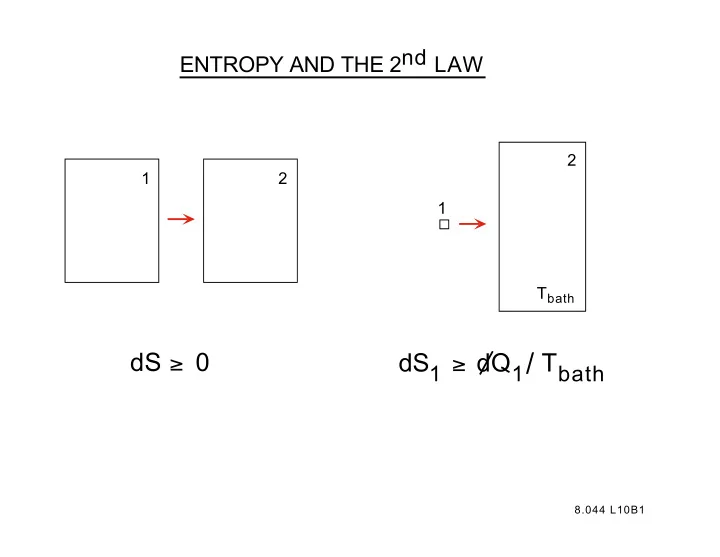
ENTROPY AND THE 2nd LAW 2 1 2 1 T bath dS 1 dQ 1 / T bath dS 0 8.044 L10B1 S as a State Function Note: adiabatic ( d /Q = 0) constant S if the change is quasistatic. This is the origin of the sub- script S on the adiabatic


slide-1
SLIDE 1

ENTROPY AND THE 2nd LAW

2 1 2 1 Tbath

dS ≥ 0 dS1 ≥ dQ1/ Tbath

8.044 L10B1
slide-2
SLIDE 2

S as a State Function Note: adiabatic (≡ d /Q = 0) ⇒ constant S if the change is quasistatic. This is the origin of the sub- script S on the adiabatic compressibility. 1 ∂V 1 ∂V κT ≡ − κS ≡ − V ∂P

T

V ∂P

S

8.044 L10B2

slide-3
SLIDE 3

Example A Hydrostatic System ∂S ∂S dS = dT + dV by expansion ∂T

V

∂V

T

1 P = dU + dV from dU = TdS − PdV T T 1 ∂U 1 ∂U = dT + + P dV T ∂T

V

T ∂V

T

by expansion of U But the cross derivatives of S must be equal.

8.044 L10B3

slide-4
SLIDE 4

∂ 1 ∂U 1 ∂2U = ∂V T ∂T T ∂V ∂T

V T

∂ 1 ∂U 1 ∂U 1 ∂2U 1 ∂P + P = − + P + + ∂T T ∂V

T V

T 2 ∂V

T

T ∂V ∂T T ∂T

V

Equating these two expressions gives ∂U ∂P + P = T ∂V

T

∂T

V

∂U ∂P = T − P ∂V

T

∂T

V

New Information! Does not contain S!

8.044 L10B4

slide-5
SLIDE 5

CONSEQUENCES a) γ ∂U ∂U d /Q = dU + PdV = dT + + P dV ∂T

V

∂V

T

' V. ' V.

CV

∂P

T

∂T V

d /Q ∂P ∂V = ≡ CP CV + T dT ∂T

V

∂T

P P

' V.

αV

1 ∂V 1 ∂V Use α ≡ and κT ≡ − . V ∂T

P

V ∂P

T

8.044 L10B5

slide-6
SLIDE 6

∂V

(−1) ∂P −1

∂T P

α = = = ∂T

V ∂T ∂V ∂V

κT

∂V ∂P ∂P P T T

 

α Tα2V Tα2V

 

CP − CV = T αV = → γ − 1 = κT κT κTCV For an ideal gas PV = NkT ⇒ α = 1/T and κT = 1/P. Thus V/T CP − CV = = Nk 1/P This holds for polyatomic as well as monatomic gases.

8.044 L10B6

slide-7
SLIDE 7
  • CONSEQUENCES b) Ideal Gas: CV

NkT ∂U Nk P = = T − P = P − P = 0 V ∂V

T

V ∂U ∂U dU = dT + dV = CV dT ∂T

V

∂V

T

' V. ' V.

CV T

U = CV (T , V ) dT + constant (∂U/∂V )T = 0 for all T CV is not f(V ); CV = CV (T).

8.044 L10B7

slide-8
SLIDE 8

CONSEQUENCES c) Ideal Gas: S ∂S ∂S dS = dT + dV ∂T

V

∂V

T

d /Q ∂S d /Q = TdS ≡ CV = T dT ∂T V

V

dU P dU = TdS − PdV ⇒ dS = + dV T T ∂S 1 ∂U P = + . ∂V T ∂V T

T

  • 1L

T

  • 1L

Nk/V

8.044 L10B8

slide-9
SLIDE 9

CV (T) Nk dS = dT + dV T V

T CV (T )

V S(T, V ) = dT + Nk ln( ) + S(T0, V0)

T0

T V0 For a monatomic gas CV = (3/2)Nk. T V S(T, V ) − S(T0, V0) = (3/2)Nk ln( ) + Nk ln( ) T0 V0

   3/2

V T

   

= Nk ln 

V0 T0

8.044 L10B9

slide-10
SLIDE 10

isentropic (adiabatic) ⇒

 

V T 3/2 

       

V 2/3T 

       

V 5/3P  are constant

8.044 L10B10

slide-11
SLIDE 11

Maxwell Relations dE(S, V ) =

∂E

∂S

V

dS +

∂E

∂V

S

dV expansion = TdS − PdV 1st and 2nd laws ⇒

∂T

∂V

S

= −

∂P

∂S

V

8.044 L10B11

slide-12
SLIDE 12

∂T ∂F dE(S, L) = TdS + FdL ⇒ = ∂L S ∂S

L

∂T ∂H dE(S, M) = TdS + HdM ⇒ = ∂M

S

∂S

M

Observe: d(TS) = TdS + SdT d(PV ) = PdV + V dP

8.044 L10B12

slide-13
SLIDE 13

Helmholtz Free Energy F ≡ E − TS ∂S ∂P dF = −SdT − PdV ⇒ = ∂V

T

∂T

V

Enthalpy H ≡ E + PV dH = TdS + V dP ⇒

∂T

∂P

S

=

∂V

∂S

P

8.044 L10B13

slide-14
SLIDE 14

Gibbs Free Energy G ≡ E + PV − TS ∂S ∂V dG = −SdT + V dP ⇒ − = ∂P

T

∂T

P

E, F, H and G are called ”thermodynamic potentials”.

8.044 L10B14

slide-15
SLIDE 15

' V.

The Magic Square Mnemonic

x E F G H

  • V
  • T

P S

dE = TdS + Xdx ∂S ∂V (−1) = (−1)(−1) ∂P

T

∂T

P (+1)

X

8.044 L10B15

slide-16
SLIDE 16

MIT OpenCourseWare http://ocw.mit.edu

8.044 Statistical Physics I

Spring 2013 For information about citing these materials or our Terms of Use, visit: http://ocw.mit.edu/terms.