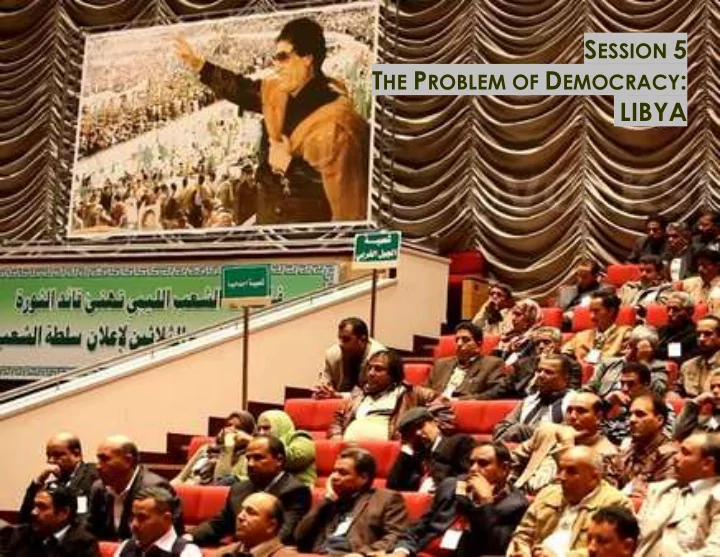
S ESSION 5 T HE P ROBLEM OF D EMOCRACY : LIBYA 1 The Green Book: - - PowerPoint PPT Presentation

s ession 5 t he p roblem of d emocracy libya
SMART_READER_LITE
LIVE PREVIEW

S ESSION 5 T HE P ROBLEM OF D EMOCRACY : LIBYA 1 The Green Book: - - PowerPoint PPT Presentation

S ESSION 5 T HE P ROBLEM OF D EMOCRACY : LIBYA 1 The Green Book: Principles of a Model egalitarianism, participation, management The instrument of government is the prime political problem confronting human communities (p. 7)


slide-1
SLIDE 1

1

SESSION 5 THE PROBLEM OF DEMOCRACY:

LIBYA

slide-2
SLIDE 2

2

The Green Book: Principles of a Model  egalitarianism, participation, management

 The instrument

  • f

government is the prime political problem confronting human communities (p. 7)  Political struggle that results in the victory of a candidate with, for example, 51 per cent of the votes leads to a dictatorial governing body in the guise of a false democracy… (pp. 7-8)  when votes are distributed among several candidates, though one polls more than any other, the sum of the votes received by those who received fewer votes might well constitute an overwhelming majority. However, the candidate with fewer votes wins and his success is regarded as legitimate and democratic! In actual fact, dictatorship is established under the cover of false democracy (p. 8)

slide-3
SLIDE 3

3

 The mere existence of a parliament means the absence of the people. True democracy exists

  • nly

through the direct participation of the people, and not through the activity

  • f their representatives (p. 9)

 people are seduced into standing in long, apathetic, silent queues to cast their ballots in the same way that they throw waste paper into dustbins (pp. 10-11)  since the system of elected parliaments is based on propaganda to win votes, it is a demagogic system in the real sense of the word (p. 11)  The party is the rule of a part over the whole (p. 13)  A society governed by one party is similar to one which is governed by one tribe or

  • ne sect (p. 16)

 If a class, a party, a tribe, or a sect dominates a society, then the dominant system becomes a dictatorship. However, a class or a tribal coalition is preferable to a party coalition since societies originally consisted of tribal communities. One seldom finds a group of people who do not belong to a tribe, and all people belong to a specific class (p. 17)

slide-4
SLIDE 4

4

 A party that is formed in the name of a class inevitably becomes a substitute for that class and continues in the process of spontaneous transformation until it becomes hostile to the class that it replaces (p. 18)  Plebiscites are a fraud against democracy. Those who vote “yes” or “no” do not, in fact, express their free will but, rather, are silenced by the modern conception

  • f

democracy as they are not allowed to say more than “yes” or “no” (p. 21)  The press is a means of expression for society: it is not a means of expression for private individuals

  • r corporate bodies. Therefore, logically and democratically, it should not belong to

either one of them (p. 35)  Direct democracy: Basic Popular Congresses  People’s Committees  General People’s Congress  Religion  real law

slide-5
SLIDE 5

5

 In summary, the era

  • f

the masses, which follows the age of the republics, excites the feelings and dazzles the eyes. But even though the vision

  • f this era denotes

genuine freedom

  • f the masses and

their happy emancipation from the bonds

  • f

external authoritarian structures, it warns also of the dangers of a period of chaos and demagoguery, and the threat of a return to the authority of the individual, the sect and party, instead of the authority of the people. Theoretically, this is genuine democracy but, realistically, the strong always rules, i.e., the stronger party in the society is the one that rules (pp. 36-37)

Unanswered questions?

slide-6
SLIDE 6

6

The Other Sides of Libyan Participatory Democracy Gaddafi and Leadership

 Free Unionist Officers’ Movement  September 1, 1969, revolt by Libyan army officers against King Idris  Revolutionary Command Council (RCC)  Free Officers Movement  12 members  RCC: Captain Muammar al- Gaddafi, Major Abd as-Salam Jalud, Major Bashir Hawadi, Captain Mukhtar al-Gerwy, Captain Abd al-Munim al-Huni, Captain Mustapha al-Kharubi, Captain al-Khuwaylidi al-Hamidi, Captain Muhammed Najm, Captain Awad Hamza, Captain Abu Bakr Yunus Jabir, Captain Omar al-Muhayshi, and Captain Muhammad al-Mugaryef  Provisional Constitutional Declaration, December 11, 1969  Against the walad al-wujaha (‘sons of influential families’), power held by the masses (jamahir) (Proclamation of the Revolution on September 1, 1969)  December 11, 1969, Law to Protect the Revolution, Gaddafi as PM  Gaddafi: Chairman of the Revolutionary Command Council, Chairman of the Ministerial Council, Commander-in-Chief of the Armed Forces

slide-7
SLIDE 7

7

On political parties in Libya  Law No. 71 of 1972: “Whoever forms a party, betrays”  Arab Socialist Union Popular Congresses and the Jamahiriya  March 2, 1977: The Socialist People’s Libyan Arab Jamahiriya (Al-Jamahiriya al-arabiya al-Libiya al-sha’abiya al-ishtirakiya) Revolution within the Revolution  April 16, 1973, Popular Revolution  ASU terminated in 1975, so that Libya became then a non-party system  Proclamation of People’s Power, March 2, 1977

slide-8
SLIDE 8

8

“Rule” and “Revolution”  1977, Revolutionary Committees, Central Coordinating Committee for the Revolutionary Committees, Municipal People’s General Committees (1979)  Declaration of the Authority of the People, March 1977  December 1988: Ministry of Mass Mobilization and Revolutionary Leadership  Political liberalization  Economic liberalization  Nationalization  Creation of Revolutionary Authority in March 1979, led by Gaddafi

slide-9
SLIDE 9

9

Resulting Structure of Libyan Politics? between 1969 and 1976: legislative authority = the Revolutionary Command Council executive authority = Council of Ministers between 1977 and 2011: legislative authority = General People’s Congress (led by its Secretariat) executive authority = General People’s Committee  Declaration of the Separation of Rule and Revolution, March 2, 1979

slide-10
SLIDE 10

10

RULE (People’s Authority) REVOLUTION (Revolutionary Authority) Green Model + regional sha’abiyat Gaddafi Forum of the Companions of Gaddafi, Rijal al-Khaimah (Men of the Tent) Cleansing Committees People’s Social Leadership Committees Revolutionary Committees Revolutionary Command Council Free Unionist Officers’ Movement

slide-11
SLIDE 11

11

US Diplomatic Cables On Libya: Notes on the Basic and General People’s Congresses

06TRIPOLI378, 31 Jul 2006  “a contentious meeting on foreign investment in tourism, led by the Secretary of the General People’s Congress (Prime Minister), ElBaghdadi ElMahmoudi. Husni Bey, deputy chairman of the Libyan Businessmen Council, argued that government policies favored foreign investors, citing the fact that Libyan tour companies were barred from providing services to tourists during last March's eclipse event. The Secretary of Tourism, Ammar Eltayif, argued that Libyans should be given the same incentives as foreign companies such as tax and customs exemptions. He also emphasized the need for investment in the hotel sector, citing that only 2000 rooms in Tripoli are suitable for tourism lodging. He also pointed out that only 30% of the people working in the tourism industry are Libyan” 07TRIPOLI169, 19 Feb 2007  “The General People's Congress Hall, one of the largest government structures in Tripoli, features a large auditorium that could hold several hundred people on both the main and upper level seating areas. The building is decorated with two large murals - one is an outline of all the Arabic-speaking countries painted in green with the caption "All Arab Countries are One." On the opposite wall is an outline of the African continent in black, with only the Libyan territory highlighted in green, along with the caption, "Africa isn't just an entity,it is a message of future civilization."”

slide-12
SLIDE 12

12

08TRIPOLI106, 8 Feb 2008  “The head of the foreign affairs committee of Libya's national parliament told CDA February 4 that he expects a "heated" debate during the General People's Congress' (GPC)”  “He expected a "hard session" based on the quantity of proposals put forward by the 468 Basic People's Congresses (BPC's). (Note: the BPC's, which are local-level councils, convened in mid January and put forward their proposals late last month. End note.) He singled out the Manpower and Basic Education Ministries for particular criticism, noting that many BPCs had referred to the GPC complaints about senior-level appointments, reductions in the number of public sector jobs, and changes to teachers' requirements that have dramatically reduced the number of qualified teachers in Libya  “On foreign policy, Shahumi said he expected a "heated debate"”  “BPC meetings have been on-going throughout Libya since mid-January, he said. The BPCs are distributed based on population -- Tripoli has 35 -- and differ in appearance from community to community; however, all have common responsibilities to debate the national budget, propose new legislation, and review the conduct of the national executive authority, the General People's

  • Committee. BPCs cannot make final decisions, but they can refer notes for consideration by the

national GPC”  “Shahumi spoke at length on the GPC's role in evaluating cabinet officials to ensure they are appropriately implementing the GPC's policies. On the basis of notes assembled from the 468 BPCs, the GPC, acting as the "prosecution," questions cabinet officials on their performance. Officials are given an opportunity to respond and individual members of the GPC are allowed to ask follow-up questions the GPC elects an eight-member Secretariat to perform GPC functions between annual meetings”

slide-13
SLIDE 13

13

08TRIPOLI166, 3 Mar 2008  “The results of this year's General People's Congress (Parliament-equivalent), which commenced in Sirte on March 2, will be closely watched for signs that the Libyan leadership remains committed to economic reform and reengagement with the international community. Observers will also carefully weigh the expected new government's composition”  “Public media reports and private speculation among observers in Tripoli have focused considerable attention on the annual session of the General People's Congress (GPC-Parliament- equivalent), which commenced in Sirte on March 2, and the cabinet change expected to be announced at the event's conclusion. Leader Muammar al-Qadhafi launched this year's session with a lengthy speech in which he directed strong criticism at the government for failing to address the needs of the people. The last cabinet change, in January 2007 (ref A), was the second such shuffle in less than a year and was perceived to have shifted reform-minded individuals into key positions” 08TRIPOLI227, 17 Mar 2008  “Summary: In a recent speech given at the opening of the annual General People's Congress, Leader Muammar al-Qadhafi roundly criticized the existing Libyan government structure for having failed to distribute oil wealth to the Libyan people. Decrying inefficiency and corruption, he called for the system of General People's Committees that have formed the basis of government since the late 1970's to be completely dismantled by year's end and replaced with an as-yet undetermined structure. He also advocated the direct transfer of oil revenues - he suggested the amount of 5,000 Libyan dinar per month…”

slide-14
SLIDE 14

14

08TRIPOLI896, 18 Nov 2008  “In a development picked up by Reuters, AFP and the Financial Times, Libya's state-owned Jamahiriya News Agency (JANA) televised a meeting between Muammar al-Qadhafi and senior government officials on November 11 in which several GPC secretaries (minister-equivalents)

  • penly disagreed with the Leader about plans to implement dramatic government restructuring

and privatization he first proposed in an address to the General People's Congress in March…” 09TRIPOLI186, 25 Feb 2009  “The 468 BPCs then began their deliberations, which were played live on Libyan radio throughout the week. Foreign journalists on a tightly controlled tour of the BPCs were surprised to see what they described as genuine opposition to al-Qadhafi's plan, and noted that many Libyans complained that they were being asked to decide on plans bereft of details and without knowledge of how the plans would impact the Libyan economy. According to many of our contacts, the debates in the local councils are genuine (allowing al-Qadhafi to showcase his "people power" democracy to foreign journalists)” 09TRIPOLI212, 11 Mar 2009  “Summary: The General People's Congress - Libya's versionof a national parliament - ended its annual week-long session in Sirte March 5, approving a cabinet reshuffle that placed intelligence chief Musa Kusa at the helm of the foreign ministry and postponing Muammar al-Qadhafi's controversial proposal to disband government ministries”

slide-15
SLIDE 15

15

10TRIPOLI78  “Regarding other penalties, such as charges brought against those who speak against the government, Abduljalil maintained that Libyans could "say anything they wanted" in the forum

  • f the General People's Congress. He insisted that journalists were free to write anything they

chose, provided they did not make personal accusations against anyone (i.e., slander)”

Free Speech in Libya pre-2011? National Democratic Institute (2006). “The Libyan Political System and Prospects for Reform: A Report from NDI’s 2006 Delegation”, April 25.

slide-16
SLIDE 16

16

Libyan Opinions on Multi-Party Electoral Democracy 2012, The Institute of Human Sciences at the University of Oxford, The University of Benghazi, “First National Survey of Libya” (a) Centralized power (b) Stability (c) Multi-party elections are irrelevant (d) Secular rule (e) Non-tribal (f) Strong leader (g) Participatory democracy (h) State support (i) Equitable distribution of wealth (j) Independence Civil war