Safety of TMS and Ethical Concerns Lindsay Oberman Berenson-Allen - - PowerPoint PPT Presentation

safety of tms and ethical concerns
SMART_READER_LITE
LIVE PREVIEW

Safety of TMS and Ethical Concerns Lindsay Oberman Berenson-Allen - - PowerPoint PPT Presentation

Safety of TMS and Ethical Concerns Lindsay Oberman Berenson-Allen Center for Noninvasive Brain Stimulation Beth Israel Deaconess Medical Center Harvard Medical School November, 2008 Plan What are potential concerns? 1. Ethics. 2.

slide-1
SLIDE 1

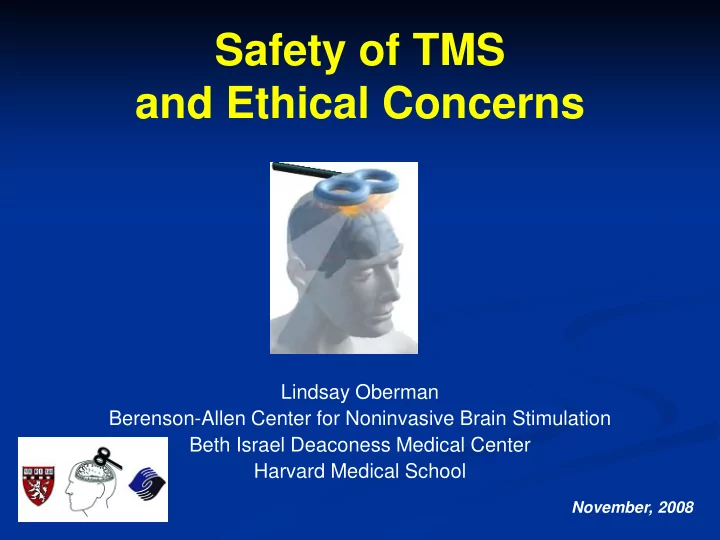
Safety of TMS and Ethical Concerns

Lindsay Oberman Berenson-Allen Center for Noninvasive Brain Stimulation Beth Israel Deaconess Medical Center Harvard Medical School

November, 2008

slide-2
SLIDE 2

Plan

1.

What are potential concerns?

2.

Ethics.

3.

Overview of adverse TMS effects.

4.

Risk of seizure.

5.

Safety parameters and guidelines

6.

Other adverse effects (known & theoretical)

7.

Contraindications

8.

Management of the risks

slide-3
SLIDE 3

Ethical considerations

  • Beneficence: the investigator should act in the best

interest of the patient

  • Non-maleficence: “first, do not harm”
  • Autonomy: the subject has the right to refuse or choose

the intervention

  • Justice: concerns the distribution of resources and equality

in deciding who participates

  • Dignity: the subject has the right to dignity
  • Truthfulness and honesty: the subject should not be lied

to, and deserves to know the truth about his/her treatment 6 principles of medical (research) ethics

slide-4
SLIDE 4

Ethical considerations

  • Potential benefit > risk of the intervention
  • Informed consent:
  • who will participate in the study
  • what will happen during the study
  • why this study is being done
  • possible risks, side effects and discomforts
  • benefits / alternatives
  • confidentiality / personal and health information
  • disclosure of special interest of the hospital or the

investigator

  • Informed consent does not substitute an ethical practice
slide-5
SLIDE 5

Known risks

 seizure  pseudoseizure and syncope  headache and neck pain  effects on cognition  effects on mood  endocrine effects  auditory effects  burns from scalp electrodes  psychiatric symptoms  nausea

Theoretical risks

 histotoxicity  kindling  long-term potentiation  long-term depression  unknown

Potential adverse effects of rTMS

Wassermann 1998; Machii et al. 2005

slide-6
SLIDE 6
  • Frequency of stimulation (Hz)
  • Intensity (% threshold/output)
  • Duration: train/total (seconds)
  • Intertrain interval (seconds)
  • Number of pulses: train/total

Important parameters for safety

E.g. depression protocol (20Hz)

train 1 2 sec 28 sec intertrain interval 2 sec 40 pulses 40 pulses train 2

0.1 ms

slide-7
SLIDE 7

Known risks

 seizure  pseudoseizure and syncope  headache and neck pain  effects on cognition  effects on mood  transient effects on hormones  transient auditory effects  burns from scalp electrodes  psychiatric symptoms  nausea

Theoretical risks

 histotoxicity  kindling  long-term potentiation  long-term depression  unknown

Potential adverse effects of rTMS

Wassermann 1998; Machii et al. 2005

slide-8
SLIDE 8

TMS-induced seizures

When applied in sufficiently high doses, high-frequency rTMS has proconvulsive potential in animals and humans.

(Wassermann and Lisanby 2001, Jennum and Klitgaard 1996 Pascual-Leone et al., 1993; Wassermann et al., 1996; Lisanby et al., 2001).

slide-9
SLIDE 9

TMS-induced seizures: mechanisms

+ + + + +

  • EXCESSIVE ACTIVATION OF PYRAMIDAL CELLS

Daskalakis and Chen 2005

SPREAD OF EXCITATION TO NEIGHBORING NEURONS OVERWHELMING OF INHIBITORY MECHANISMS

  • +

+

slide-10
SLIDE 10

TMS-induced seizures in animals

Primates: 40Hz 400% MT 4-5s; local anesthesia; only with custom device (induced voltage equal to that of electroconvulsive shock). (Lisanby et al 2001) In general, it is extremely difficult to induce seizures with TMS in animals Examples of proconvulsive effects: Rodents Chronic stimulation: 1 and 5 sec trains, stimulus intensity of 1.8 x Tm, every day for 30 days reduces latency of onset of PTZ-induced seizure (Jennum and Klitgaard 1996)

slide-11
SLIDE 11

TMS-induced seizures in humans

  • Seizure induction w/ single pulse TMS

Healthy subjects: No cases reported to date.

  • Seizure induction w/ single pulse TMS

Patients: Approximately 20 cases reported.

  • Seizure induction w/ repetitive TMS

Healthy subjects: Approximately 6 cases when parameters are outside of safety guidelines. 1 case when parameters are within safety guidelines.

  • Seizure induction w/ repetitive TMS

Patients: At least 3 cases.

slide-12
SLIDE 12

Safety guidelines

Pascual-Leone et al. (1993), Safety of transcranial magnetic stimulation in normal volunteers. Electroencephalogr Clin Neurophysiol, 89(2):120- 130 Chen et al. (1997), Safety of different inter-train intervals for repetitive transcranial magnetic stimulation and recommendations for safe rages

  • f stimulation parameters. Electroencephalogr Clin Neurophysiol

105(6):415-421

  • Wassermann. (1998), Risk and safety of repetitive transcranial

magnetic stimulation: report and suggested guidelines from the International Workshop on the Safety of Repetitive Transcranial Magnetic Stimulation. June-5-7, 1996. Electroencephalogr Clin Neurophysiol 108(1):1-16 Machii, et al. (2006). Safety of rTMS to non-motor cortical areas in healthy participants and patients. Clinical Neurophysiology. 117, 455- 471.

slide-13
SLIDE 13

Safety guidelines: Tables

Safe train durations / number of pulses for single trains of rTMS in healthy subjects

slide-14
SLIDE 14

Safety guidelines: Tables

Safety recommendation for inter-train intervals for 10 trains of rTMS at less than 20Hz

slide-15
SLIDE 15

TMS-induced seizures : Summary

  • Within safety guidelines, in healthy subjects, risk of

seizure is very low but still present. (<1 / 1,000 overall estimate; Machii et al 2006)

  • Risk of seizure increases when rTMS is outside of

safety parameters.

  • Risk of seizure may be higher for patients, due to

interaction of disease (e.g. stroke, Epilepsy) and TMS.

  • TMS-induced seizure ≠ Epilepsy
  • Balance of risk/benefit
slide-16
SLIDE 16

Other adverse effects

slide-17
SLIDE 17

Headache & Neck Pain

  • most common adverse effects reported
  • headache ≈ 23%
  • neck pain ≈ 12%
  • responds well to analgesics
  • contraindication for subjects susceptible to headaches
  • shorter blocks; breaks ~ every 5 min

Machii et al., 2006

slide-18
SLIDE 18

Neuropsychological & motor effects

  • overall no evidence of long term adverse effect on

cognitive, perceptual or motor functions (but not sufficiently studied)

  • some studies observed a trend towards improved working

memory and motor reaction time

Pascual-Leone et al. 1993; Wassermann et al. 1996; Jahanshahi et al. 1997; Loo et al.1999, 2001; Speer et al. 2001; Jenkins et al. 2002; Micheal et al. 2003; Wagner et al. 2005; Anderson et al. 2006, Martis, eta al, 2003

slide-19
SLIDE 19

Effects on mood in healthy subjects

 not common in healthy participants - but observed for

RPFC & LPFC

 healthy participants (10Hz, 110% MT, 25 - 5sec trains)

changes in self-rating

 L PFC: ↓ happiness, ↑ sadness  depressed patients: high frequency rTMS to LPFC

might improve mood

Pascual-Leone et al. 1996; George et al. 1996

slide-20
SLIDE 20

Effects on hearing

 no permanent hearing loss reported in humans  rare, but reported:  transient rise in auditory threshold  tinnitus  mild high-frequency hearing loss after several

weeks of rTMS

 ear plugs recommended Pascual-Leone et al. 1992; 1993; Loo et al. 2001; Boutros et al. 2002; Anderson et al. 2006

slide-21
SLIDE 21

Endocrine effects

 no changes in:  prolactin  adrenocorticotropic (ACTH)  lutenizing- (LH)  follicle-stimulating hormones (FSH) change reported in:  increase in thyroid-stimulating hormone (TSH)  acute increase in cortisol (stress?)  reported effects on neurotransmitters:  release of dopamine (caudate nucleus)  increase in glutamate/glutamine

Pascual-Leone et al. 1993; George et al. 1996; Wassermann et al. 1996; Cohrs et al. 2001; Evers et al. 2001; Strafella et al. 2001; Padberg et al. 2002; Micheal et al. 2003, Szuba, et al., 1999

slide-22
SLIDE 22

Burns from scalp electrodes

Roth et al. 1992

risk of heating and skin burns with the use of rTMS near metal surface EEG electrodes

 the use of MRI compatible electrodes is

recommended

slide-23
SLIDE 23

Psychotic symptoms

Garcia-Toro 1999; Dolberg et al. 2001; Zwanzger et al. 2002

  • psychotic symptoms induced by rTMS to the

dorsolateral prefrontal cortex in patients with depression (4 cases)

slide-24
SLIDE 24

Theoretical risks

Effects that have never been reported in humans with TMS, but remain safety considerations.

 histotoxicity: tissue damage  kindling  long-term potentiation  long-term depression  effects of magnetic field

slide-25
SLIDE 25

Theoretical risks: Histotoxcity

  • Evidence from animals: surface electrode

stimulation & TMS

  • Evidence from TMS in humans

“The chance of excitotoxicity with rTMS in humans seems to be remote.” (Wassermann, 1998)

slide-26
SLIDE 26

Iriki et al. 1991; Artola et al. 1991, Ziemann (2004)

Theoretical risks: LTP or LTD

electrical stimulation can induce LTP or LTD of synaptic transmission in animals

Devinky and Duchowny, 1983; Goldensohn, 1984

Theoretical risks: kindling & epileptogenisis

  • electrical stimulation can induce kindling in animals
  • conditions necessary for kindling are not met by current

TMS protocols

  • no kindling in humans receiving DCS or ECT
slide-27
SLIDE 27

Properties of magnetic field produced by TMS:

  • strength in 1.5T to 2T range
  • falls of rapidly with distance from the coil
  • rapidly changing

No proven health risks of electromagnetic fields

Theoretical risk: magnetic fields

slide-28
SLIDE 28

Contraindications (1)

 intracranial metallic or magnetic pieces

transient magnetic field can displace or heat objects

 pacemakers and other implantible medical devices

induced pulse may disturb electronic circuitry

 history of seizures or epilepsy

including history in a first degree relative

 medications (e.g. TCAs, neuroleptic agents)

reduction in seizure threshold

 subjects who are pregnant

test those of childbearing potential

slide-29
SLIDE 29

 history of serious head trauma  history of substance abuse  stroke  brain surgery  other medical/neurologic conditions either

associated with epilepsy or in whom a seizure would be particularly hazardous

Contraindications (2)

slide-30
SLIDE 30

TMS Adult Safety Screen

Adapted from Keel et al. 2001

Have you ever:

  • Had an adverse reaction to TMS?
  • Had a seizure?
  • Had an electroencephalogram ?
  • Had a stroke?
  • Had a serious head injury (include neurosurgery)?
  • Do you have any metal in your head (outside the mouth) such as

shrapnel, surgical clips, or fragments from welding or metalwork?

  • Do you have any implanted devices such as cardiac pacemakers,

medical pumps, or intracardiac lines?

  • Do you suffer from frequent or severe headaches?
  • Have you ever had any other brain-related condition?
  • Have you ever had any illness that caused brain injury?
  • Are you taking any medications?
  • If you are a woman of childbearing age, are you sexually active,

and if so, are you not using a reliable method of birth control?

  • Does anyone in your family have epilepsy?
  • Do you need further explanation of TMS and its associated risks?

If you answered yes to any of the above, please provide details: Yes No                            

slide-31
SLIDE 31

Managing the risks

TMS should be administered:

  • under the supervision of an appropriate trained

and licensed physician

  • by a trained first responder to render appropriate

care in the event of seizure

  • in a medical setting with appropriate emergency

facilities

Belmaker et al. 2003

slide-32
SLIDE 32

Monitoring: during TMS

Subjects should be monitored to:

 detect potential epileptogenic markers (after-

discharges and spread of excitation)

 reconstruct the events preceding the seizure

 EEG  EMG  visual monitoring

slide-33
SLIDE 33

Monitoring: after TMS

Neuropsychological monitoring to assess short and long-term effects on cognitive function

 Beck scores for patients with depression

at different time period

 Cognitive Assessment

slide-34
SLIDE 34

TMS acute side effects questionnaire

Severity ratings: 1- absent, 2- mild, 3- moderate, 4- severe Relationship ratings: 1- none, 2- remote, 3- possible, 4- probable, 5- definite

symptoms severity relationship notes

headache neack pain seizure scalp burns hearing impairment impaired cognition trouble concentrating acute mood change

  • ther (specify)
slide-35
SLIDE 35

Our lab policies

Staff

 specially trained in recognition and treatment of

seizures

 a neurologist is on location during all TMS sessions

Equipment

 the TMS equipment is regularly checked  a fully equipped “crash cart” with emergency

medical equipment is in lab and regularly checked

Supplies

 include IV access equipment, oxygen, and

emergency medications for treatment of a seizure

 ear plugs, acetaminophen