Santa Margarita River WQIP Consultation Committee Meeting 1 - - PowerPoint PPT Presentation

santa margarita river wqip
SMART_READER_LITE
LIVE PREVIEW

Santa Margarita River WQIP Consultation Committee Meeting 1 - - PowerPoint PPT Presentation

Santa Margarita River WQIP Consultation Committee Meeting 1 October 17, 2017 Welcome and Introductions Responsible Agencies City of City of City of Menifee Murrieta Temecula City of County of County of San Wildomar Riverside Diego


slide-1
SLIDE 1

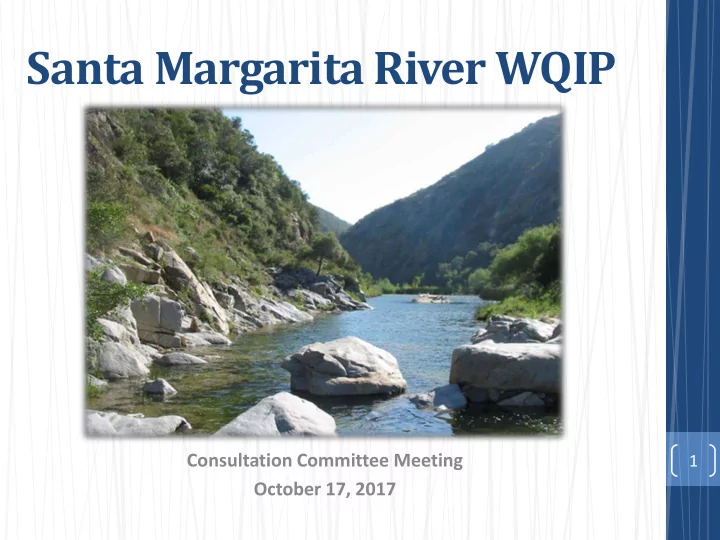
Santa Margarita River WQIP

Consultation Committee Meeting October 17, 2017

1
slide-2
SLIDE 2

Welcome and Introductions

2

City of Menifee City of Murrieta City of Temecula City of Wildomar County of Riverside County of San Diego Riverside County Flood Control

Responsible Agencies

slide-3
SLIDE 3

Welcome and Introductions

Consultation Committee Members

Required Members

  • Erica Ryan, San Diego RWQCB
  • Terri Biancardi, Environmental Community
  • Clint Lorimore/Mark Grey, Development Community

At Large Members

  • Ben Drake/Robert Renzoni, Temecula Winegrowers Association
  • Andy Domenigoni, Riverside County Farm Bureau
  • Kyle Cook, Camp Pendleton Marine Base
  • Pablo Bryant, Santa Margarita Ecological Reserve
  • Laurie Correa, Regional Conservation Authority
  • Rick Neugebauer, Temecula, Elsinore, Anza, Murrieta (TEAM-RCD)

3

slide-4
SLIDE 4

Purpose & Structure

Dave Ceppos, Associate Director Center for Collaborative Policy

4

slide-5
SLIDE 5

Process and Purpose

  • Provide transparency
  • Receive recommendations
  • Answer questions
  • Build working relationships

5

slide-6
SLIDE 6

Consultation Committee

  • Review draft submittals of WQIP
  • Provide written recommendations and comments
  • Represent service area category & expertise
  • All recommendations will be considered

6

slide-7
SLIDE 7

Meeting Guidelines

  • Listen to understand
  • Everyone’s perspective is valued
  • Everyone has an equal opportunity to participate
  • Keep the conversation focused

7

slide-8
SLIDE 8

Meeting Objectives

  • WQIP Process Overview and Update
  • B2/B3 Comments
  • Watershed Management Area Analysis (WMAA) Updates
  • Monitoring and Assessment Program
  • Questions/Discussion

8

slide-9
SLIDE 9

Water Quality Improvement Plan Overview

Stuart McKibbin Riverside County Flood Control and Water Conservation District

9

slide-10
SLIDE 10

Santa Margarita River Watershed Management Area

10

slide-11
SLIDE 11

Water Quality Improvement Plans

  • Focus planning & future implementation
  • n watershed priority conditions
  • Establish numeric goals, strategies &

schedules

  • Incorporate monitoring, assessment &

adaptive management programs

11

slide-12
SLIDE 12

Watershed Planning - Overview

  • 2 year development process
  • Public participation requirement
  • Collaborative process
  • Consultation Committee
  • Mandated interim deliverables
  • Phased approach

12

slide-13
SLIDE 13

Watershed Planning

13

Phase I

  • Water

Quality Assessment

  • Prioritization
  • Sources
  • Potential

Strategies

Phase II

  • Goals
  • Strategies
  • Schedules
  • Sources
  • WMAA

Phase III

  • Monitoring
  • Assessment
  • Adaptive

Management

slide-14
SLIDE 14

Progress to Date

14

B2

  • Prioritization, Potential Strategies
  • Consultation Committee – September 2016
  • Revisions and Draft Submittal to Regional Board – Jan 2017
  • Regional Board Comments – March 30 and October 11, 2017

B3

  • Goals, Strategies, Schedules
  • Consultation Committee – May 2017
  • B2 Revisions and Draft B3 Submittal to Regional Board – July 7, 2017
  • Regional Board Comments – October 11, 2017

WQIP

  • Monitoring and Assessment
  • Adaptive Management
  • Consultation Committee – TODAY
slide-15
SLIDE 15

WQIP – Overview of Elements

Water Quality Improvement Plans include:

  • Priority Water Quality Conditions
  • Goals and Schedules
  • Strategies and Schedules
  • Monitoring
  • Assessment

15

Today’s Focus

slide-16
SLIDE 16

B2/B3 Comments from Regional Water Board

Received October 11, 2017

Richard Boon Riverside County Flood Control and Water Conservation District

16

slide-17
SLIDE 17

General Comments

  • Format and Terminology – improve

readability

  • Technical Studies – incorporate additional

studies

  • Agriculture Lands – include control

strategy

17

slide-18
SLIDE 18

B2 Comments Priority Water Quality Conditions

  • HPWQC – need better linkage to sources
  • Geographic Extent – consideration of

intermittent streams

  • RFCWCD Areas and Activities

18

slide-19
SLIDE 19

B3 Comments Goals, Strategies, Schedules

  • Goals – attaining numeric goals is

uncertain

  • Strategies – agricultural land
  • WMAA – need for further evaluation

19

slide-20
SLIDE 20

Questions?

20

slide-21
SLIDE 21

Watershed Management Area Analysis Update

Stuart McKibbin Riverside County Flood Control and Water Conservation District

21

slide-22
SLIDE 22

Background

  • New Development Projects
  • Stormwater quality retention requirements
  • Hydromodification requirements (Larger BMPs)

An Alternative Compliance Option is available 42

slide-23
SLIDE 23

Watershed Management Area Analysis

  • How data will be used
  • Land Use – Evaluate potential impacts resulting from land development
  • Hydrologic Processes – Identify opportunities for enhanced infiltration
  • Streams and Channels – Assess stream stability
  • Coarse sediment areas – Identify areas of sediment supply which

contributes to stream stability 23

slide-24
SLIDE 24

Watershed Management Area Analysis

48

slide-25
SLIDE 25

Hydromodification Management

  • Reaches selected for exemption analysis
  • Exempt in June 2013 Santa Margarita Region

Hydromodification Management Plan

River Downstream Limit Upstream Limit

Santa Margarita River Outfall to Pacific Ocean At Origin: Confluence with Temecula Creek and Murrieta Creek Temecula Creek Confluence with Santa Margarita River Outflow of Vail Lake Murrieta Creek Confluence with Santa Margarita River 850 feet upstream of Hawthorn Street

61

slide-26
SLIDE 26

Exemption Analysis: Results

River Ep Sp Recommendation

Santa Margarita River 1.03 0.83 Analysis supports Exemption Temecula Creek Analysis In Progress Murrieta Creek Analysis In Progress

64

slide-27
SLIDE 27

Questions?

27

slide-28
SLIDE 28

Introduction to Monitoring and Assessment

Paul Hartman Larry Walker Associates

28

slide-29
SLIDE 29

Monitoring and Assessment Program Purpose

29

  • Support assessment of:
  • Progress toward numeric goals and schedules
  • Progress addressing eutrophication and nutrient loading
  • Each Copermittee’s overall efforts to implement the WQIP
slide-30
SLIDE 30

Monitoring Overview Receiving Waters

30

slide-31
SLIDE 31

Monitoring Overview MS4 Outfalls

31

slide-32
SLIDE 32

MS4 Outfall Dry Weather Monitoring

32

Monitoring (5 sites)

Field Screening Target Areas

slide-33
SLIDE 33

Monitoring Overview Special Studies

33

slide-34
SLIDE 34

Assessment Overview

34

Receiving Waters

  • Condition Assessments
  • Status and Trends

Storm Drain Outfalls

  • Pollutant Reduction
  • Strategy Assessments

Special Studies

  • Receiving Waters
  • Sources/Strategies
slide-35
SLIDE 35

BREAK

35

slide-36
SLIDE 36

Provision B. 4 Monitoring and Assessment Program (MAP)

Paul Hartman Larry Walker Associates

36

slide-37
SLIDE 37

Receiving Water Monitoring

Provision D.1

37

Receiving Water Monitoring Long Term Monitoring Stations Regional Sediment Quality Objectives

slide-38
SLIDE 38

Long Term Monitoring Stations

What is necessary?

  • Minimum of one station
  • Representative of Receiving Water Conditions

What is the purpose?

  • Status and Trends – short/long term

improvements

  • Progress to Goals
  • Are strategies working?
  • Are Beneficial Uses Protected?

34

slide-39
SLIDE 39

39

slide-40
SLIDE 40

Long Term Monitoring Stations

Dry Weather

  • 3 Events
  • Chemistry, Toxicity

Wet Weather

  • 3 Events
  • Chemistry, Toxicity

Bioassessment

  • Benthic Macroinvertebrates
  • Benthic Algae

Hydromodification

  • Bed and Bank Condition

36

slide-41
SLIDE 41

Regional Receiving Water Monitoring

Stormwater Monitoring Coalition

  • Long Term, Well Established Program
  • Bioassessment Focused
  • Reference Conditions

Southern California Bight Program

  • Every 5 Years
  • Multiple Stakeholders and Interests
  • Marine, Estuarine, Watersheds

37

slide-42
SLIDE 42

Sediment Quality Monitoring

Sediment Quality in Estuaries

  • Condition Assessments

– multiple sites

  • Triad Approach

Chemistry Benthic Ecology Toxicity

Unimpacted Likely Unimpacted Possibly Impacted Likely Impacted Clearly Impacted Inconclusive 38

slide-43
SLIDE 43

Receiving Water Monitoring Question and Relationship to SMR Goals (example)

39

Monitoring Question: What are the Total Nitrogen and Total Phosphorus loadings in the SMR at the base of the Upper Watershed? How are they changing over time? Goal: Reduce dry weather loads in receiving waters by 10%.

slide-44
SLIDE 44

Questions?

44

slide-45
SLIDE 45

MS4 Outfall Monitoring

Provision D.2 MS4 Outfall Monitoring

Dry Weather Field Screening Non- Stormwater Persistent Flow Monitoring Wet Weather Monitoring

41

slide-46
SLIDE 46

Dry Weather Field Screening

What is necessary?

  • Inspect 80% of Major Outfalls
  • 2x/Year
  • Visual Observations focused on FLOW

What is the purpose?

  • Source identification and elimination
  • Prioritization of outfalls – persistent flow
  • Calculate/estimate non-storm water volumes and

pollutant loads

  • Identify reductions in non-storm water flows and illicit
  • Evaluate strategies

42

slide-47
SLIDE 47

Dry Weather Field Screening Monitoring Approach

47

Copermittee Major Outfalls (Total) 80% of Total Visual Inspections Per Year RCFCWCD 83 67 134 County of Riverside 6 5 10 Menifee Murrieta 39 32 64 Temecula 117 94 188 Wildomar 13 11 22 County of San Diego 13 10 20 Total 271 219 438

slide-48
SLIDE 48

Non-stormwater Persistent Flow Monitoring

What is necessary?

  • Monitor top 5 sites (per jurisdiction)
  • 2x/Year
  • Visual Observations + Chemistry

What is the purpose?

  • Source identification and elimination
  • Calculate/estimate non-storm water volumes and

pollutant loads

  • Identify reductions in non-storm water flows and

illicit

  • Evaluate strategies

44

slide-49
SLIDE 49

Non-stormwater Persistent Flow Monitoring Approach

49

  • Persistent Flow
  • Contribute to

HPWQC

  • Sources
  • Target Areas

Prioritize

  • Elimination
  • Not a source of

pollutants

  • Authorized

Monitor

  • Eliminate one
  • Select next

highest

Reprioritize

slide-50
SLIDE 50

Non-stormwater Persistent Flow Monitoring Example

46

slide-51
SLIDE 51

Wet Weather Outfall Monitoring

What is necessary?

  • 5 Sites per WMA
  • 1 Site per Permittee
  • 1 Storm Event per Year – HPWQC, Impairments

What is the purpose?

  • Calculate/estimate stormwater volumes and

pollutant loads and changes over time

  • Validate WQIP assumptions (e.g., land use

estimates)

  • Evaluate strategies

47

slide-52
SLIDE 52

52

slide-53
SLIDE 53

MS4 Outfall Monitoring Questions and Relationship to SMR Goals

29

Goal (examples) Monitoring Question

Dry Weather Field Screening Non-stormwater Persistent Flow Monitoring

10% Reduction in Non-stormwater Flow How much NSW flow is being discharged by each Copermittee (as compared to the baseline)? 10% Reduction in Dry Weather Loading How much has TN and TP loading been reduced at Copermittee

  • utfalls?

X X X

slide-54
SLIDE 54

Questions?

54

slide-55
SLIDE 55

Special Studies

Provision D.3

What is necessary?

  • 2 Studies per WMA
  • 1 Regional Study (can substitute for WMA study)

What is the purpose?

  • Relate to the HPWQC
  • Identify sources of pollutants and/or stressors

51

slide-56
SLIDE 56

Special Studies

56

Special Studies Nutrient Initiative Studies Regional Reference Streams

slide-57
SLIDE 57

Special Studies Monitoring Question and Relationship to SMR Goals (example)

53

Monitoring Question: Are there sources of pollutants causing exceedances

  • f targets that are outside of Copermittee control?

If an Estuary related Goal is not met (e.g., interim targets for eutrophic indicators):

slide-58
SLIDE 58

Rainbow Creek Total Maximum Daily Load for Total Nitrogen and Total Phosphorus

Attachment E

  • Incorporate the Sampling and Analysis

Plan for Rainbow Creek

  • Perform monitoring to demonstrate

progress towards TMDL compliance targets

58

slide-59
SLIDE 59

Questions?

59

slide-60
SLIDE 60

Adaptive Management Approach

60

slide-61
SLIDE 61

Questions?

61

slide-62
SLIDE 62

Closing Comments, Discussion, Next Steps

Dave Ceppos, Associate Director Center for Collaborative Policy

62

slide-63
SLIDE 63

Next Steps

  • Comments and Feedback on Today’s

Material

  • WMAA Updates
  • Monitoring and Assessment
  • Final Draft WQIP
  • Submittal to Regional Board January 5,

2018

63

slide-64
SLIDE 64

Questions?

64

slide-65
SLIDE 65

Comments/Feedback

To Darcy Kuenzi, Government Affairs Officer

Riverside County Flood Control and Water Conservation District 1995 Market Street Riverside, CA 92501 DarcyK@rcflood.org

65