
SLIDE 1
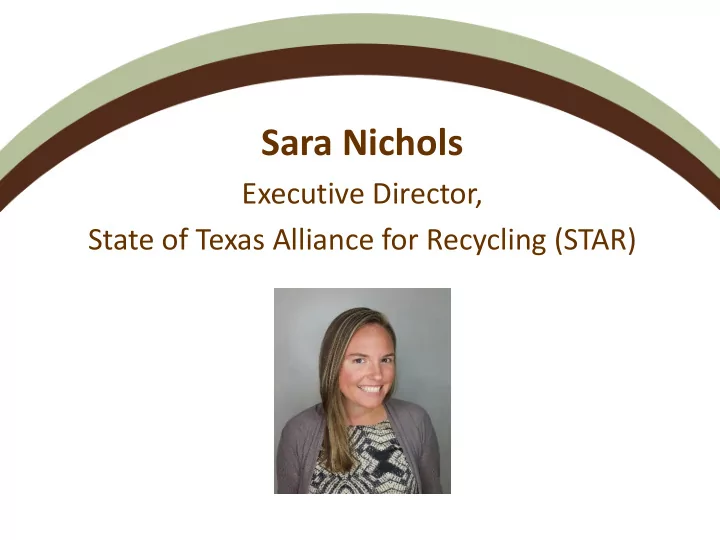
Sara Nichols Executive Director, State of Texas Alliance for - - PowerPoint PPT Presentation
Sara Nichols Executive Director, State of Texas Alliance for Recycling (STAR) 2 October 2017 CURC Workshop Recycling in Texas & its Economic Impacts Who is STAR? Our Mission: To increase recycling rates to the highest level afforded
2
October 2017
Our Mission: To increase recycling rates to the highest level afforded by balanced economic and environmental sustainability principles, for the benefit of the State and the people of Texas.
Regional/Topical Councils
Educate Texans – “from school children to senators” Released the Texas Recycling Data Initiative (TRDI) Provide industry professionals with information, updates &
training through webinars & workshops
Liaison with the public Networking Facilitate communication Policy initiatives & legislative work
Collection: What can the infrastructure
handle? What kind of volume? What materials? Innovations? Education?
Processing: Contamination/quality,
advanced sorting technology, this is where the cost is to sort and bale material
End markets: Materials aren’t actually
recycled until they make it to a market!
The times they are a changin’
Shift on the national level in past few years to
materials management: many states adopting
Sustainable materials management: a systemic
approach to using and reusing materials more productively over their entire lifecycle (EPA definition)
Life cycle assessment (LCA): technique to make
more informed decisions through a better understanding of human health and environmental impacts of products, processes and activities (EPA definition)
Factors leading to painful markets:
Oil prices Supply and demand China Sword! Increasing quality concerns
material
In 2014, Americans
generated about 258 million tons of trash
Of this, about 89 million
tons of this material were recycled or composted
Equates to 34.6 percent
national recycling rate (EPA)
In Texas for 2015, 22.7
percent recycling rate (SEIR)
9.2 million tons recycled in
2015 (SEIR)
Source: SEIR, 2017
Because Texas is a huge market.
Other key economic points:
9.2 million tons valued at $702
million (SEIR)
Overall impact of recycling MSW
$3.3 billion (SEIR)
Generated nearly $195 million of
revenue for state and local govts.
Equivalent industries in TX are
pipeline transportation, paper manufacturing, & broadcasting
Key attributes of Texas:
4 of the top 10 fastest growing
cities in the US
More people = more material Key corporations call Texas home Low recovery = more opportunity Low taxes & light regulation =
investment opportunities
Because recycling = jobs & economic development.
For every 10K tons going to landfills, 1 job is
created
For every 10K kept out of landfills, 10 recycling
jobs created (Institute for Local Self-Reliance)
In 2015, US scrap recycling industry powerful
enough to create almost 472,000 jobs (ISRI)
Industry generates nearly $105.81 billion
annually in economic benefits in the US (ISRI)
In Texas, more than 17,000 jobs (SEIR) In Texas: Lots of opportunity for industry and job
creation!
$62 million investment, 100m lbs PET $20-25 million investment
To save resources… water, energy, money, etc.
Source: STAR graph, data sources listed
We’re at a crossroads And recycling is just one piece of the puzzle – and aren’t anywhere close to having all the answers
The single-stream debacle
Increased recovery = more contamination Increased quality concerns with markets = lower value “Wishful recycling”
Educate, educate, educate!
Educating a community that’s constantly evolving is
very difficult
Understanding your audience Ad Council campaign examples
Source: icestoneusa.com Source: austinfootwear.com Source: rewallsolutions.com
Public/private partnerships &
The Recycling Partnership Closed Loop Fund Southeast Recycling Development Council (SERDC)
Trade association leadership & commodity
representation
Voice of manufacturers
State/Federal government leadership/policy Get involved with STAR! Professional development,
student memberships, networking…