Saudi Arabia Dr Yara Al Mosa Professor Sharyn Rundle-Thiele Dr Joy - - PowerPoint PPT Presentation

saudi arabia
SMART_READER_LITE
LIVE PREVIEW

Saudi Arabia Dr Yara Al Mosa Professor Sharyn Rundle-Thiele Dr Joy - - PowerPoint PPT Presentation

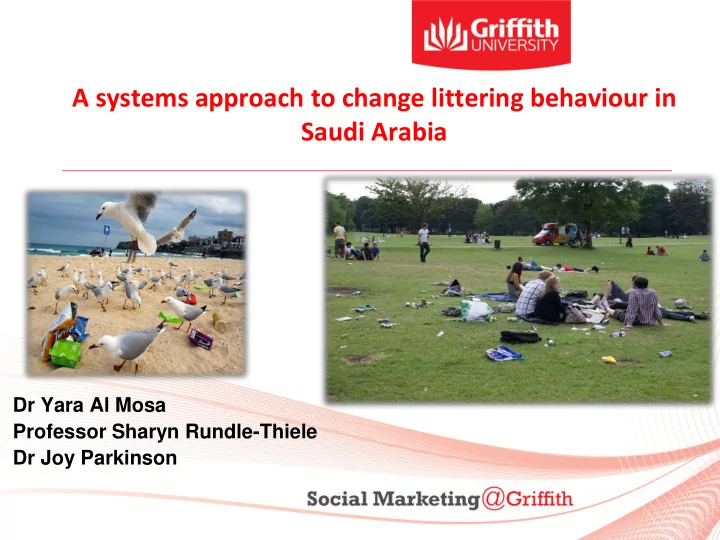
A systems approach to change littering behaviour in Saudi Arabia Dr Yara Al Mosa Professor Sharyn Rundle-Thiele Dr Joy Parkinson @SMGriffith1 | Follow us on Twitter Litter overview Definition: Any piece of misplaced solid waste


slide-1
SLIDE 1

A systems approach to change littering behaviour in Saudi Arabia

Dr Yara Al Mosa Professor Sharyn Rundle-Thiele Dr Joy Parkinson

slide-2
SLIDE 2

@SMGriffith1 | Follow us on Twitter

slide-3
SLIDE 3

@SMGriffith1 | Follow us on Twitter

Litter overview

Definition: “Any piece of misplaced solid waste” Environmental problem:

  • 1. Endangering and killing wildlife.
  • 2. Degrading water quality.
  • 3. Contributing to flooding.
slide-4
SLIDE 4

@SMGriffith1 | Follow us on Twitter

Financial and Social problem

  • 1. Uses a substantial part of

community funds for cleaningUS$11 billion annually in the United States.

  • 2. Presence of littering in a residential

community reduces property values.

  • 3. Create many hazards including

health, fire and safety.

slide-5
SLIDE 5

@SMGriffith1 | Follow us on Twitter

Approaches to solving littering

Identifiable, and accessible receptacles De Kort et al. (2008) The presence of anti-littering signs Wicherts & Bakker ( 2013) Persuasive messages Brown et al. (2010) Use the power of social norms Reich & Robertson (1979) personal and Community benefits Tudor et al. (2007) The use of fees Schneider et al. (2011) Media messages Schultz et al. (2011) Publicity, education and legislation Storrier & McGlashan (2006)

slide-6
SLIDE 6

@SMGriffith1 | Follow us on Twitter

Justification for Selecting the Middle East

 Golf countries rank in the top-ten worldwide in terms of per capita solid waste generation, mainly because of the high standard of living and lack of awareness about sustainable waste management practices.  Non-Western cultural context deserves attention

slide-7
SLIDE 7

@SMGriffith1 | Follow us on Twitter

Formative research

 Mixed methods approach.  Identify key barriers and motivators.  Identify the different approaches.  Gives a comprehensive insight.

slide-8
SLIDE 8

@SMGriffith1 | Follow us on Twitter

Structured observation (Quantitative approach)

 Strict protocol  Covert observations.  A convenience sample.  362 participants  Parks are a public place.

slide-9
SLIDE 9

@SMGriffith1 | Follow us on Twitter

Variables and Measurements

Contextual level:

  • Amount of litter exist
  • Distance to rubbish bins
  • Cleanness
  • Beautification
  • Crowdedness
  • Fence vs unfenced park

Individual level:

  • Age
  • Gender
  • Alone or in group

➢SPSS using frequencies, Generalized linear model data analysis techniques.

slide-10
SLIDE 10

@SMGriffith1 | Follow us on Twitter

Semi-structured interview (Qualitative approach)

 25 face to face interviews, ~ 1.5 hours  Guided by MOAB framework  Qualitative data analysis

▪ Translated and Transcribed ▪ NVivo 10, QSR International’s ▪ Code, index, nodes ▪ Category of codes ▪ Themes

slide-11
SLIDE 11

@SMGriffith1 | Follow us on Twitter

Contribution

 Addressed the call to apply theory in social marketing studies, empirically tested the MOAB framework which guided the in depth interview and observational enquiry.  Addressed the call to extend beyond self-report methods (Carins et al., 2016) by employing covert observations in addition to interviews in response to calls for use of multiple methods in formative research.  Offering a social marketing formative research study whose aim is to understand both the individual and environmental factors influencing littering in public spaces in Middle Eastern countries to gain actionable insights that can be used to develop an intervention to reduce littering in cultures outside of a western context.

slide-12
SLIDE 12

@SMGriffith1 | Follow us on Twitter

References

 Al-Khatib, I. A. (2009). Children’s perceptions and behavior with respect to glass littering in developing countries: A case study in Palestine’s Nablus district. Waste management, 29(4), 1434-1437.  Al-Khatib, I. A., Arafat, H. A., Daoud, R., & Shwahneh, H. (2009). Enhanced solid waste management by understanding the effects of gender, income, marital status, and religious convictions on attitudes and practices related to street littering in Nablus–Palestinian territory. Waste management, 29(1), 449-455.  Andreasen, A. R. (2002). Marketing social marketing in the social change marketplace. Journal of Public Policy & Marketing, 21(1), 3-13.  Arafat, H. A., Al-Khatib, I. A., Daoud, R., & Shwahneh, H. (2007). Influence of socio-economic factors on street litter generation in the Middle East: effects of education level, age, and type of residence. Waste management & research, 25(4), 363-370.  Campbell, M. L., Paterson de Heer, C., & Kinslow, A. (2014). Littering dynamics in a coastal industrial setting: The influence of non-resident populations. Marine Pollution Bulletin.  Cialdini, R. B. (2003). Crafting normative messages to protect the environment. Current directions in psychological science, 12(4), 105-109.  Cialdini, R. B., & Baumann, D. J. (1981). Littering: a new unobtrusive measure of attitude. Social Psychology Quarterly, 254-259.  Collins, K. (2014). Is there a role for marketing in community development? Community Development Journal, bsu028.  Ernest-Jones, M., Nettle, D., & Bateson, M. (2011). Effects of eye images on everyday cooperative behavior: a field

  • experiment. Evolution and Human Behavior, 32(3), 172-178.

 Evans, W., Pattanayak, S., Young, S., Buszin, J., Rai, S., & Bihm, J. W. (2014). Social marketing of water and sanitation products: A systematic review of peer-reviewed literature. Social Science & Medicine, 110, 18-25.  Finnie, W. C. (1973). Field experiments in litter control. Environment and Behavior.

slide-13
SLIDE 13

@SMGriffith1 | Follow us on Twitter

Thank you for your attention Any questions?