
SLIDE 1
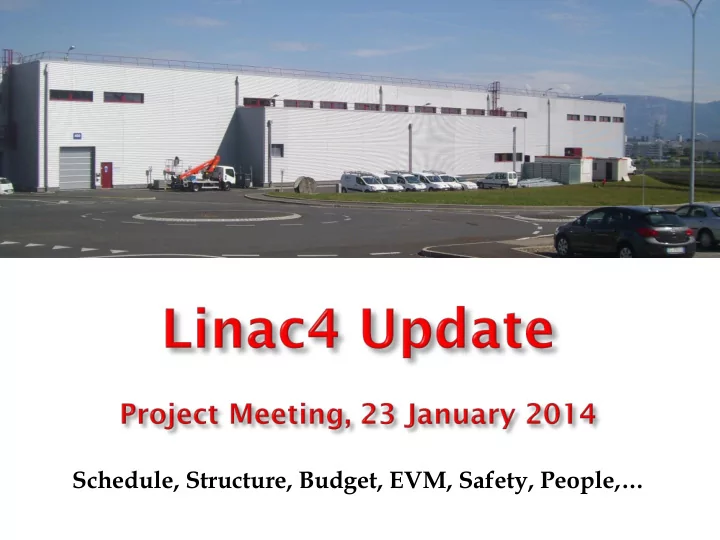
Schedule, Structure, Budget, EVM, Safety, People, 2013 : a memorable - - PowerPoint PPT Presentation
Schedule, Structure, Budget, EVM, Safety, People, 2013 : a memorable year ! First beam accelerated by the RFQ, 13.3.2013 Klystrons and modulators installed in the Linac4 Hall 22.11.2013: 3 MeV beam in the tunnel 12.12.2013: 52 mA from IS-02
First beam accelerated by the RFQ, 13.3.2013 28-30.9.2013, Open Days: 2’500 visitors!
Klystrons and modulators installed in the Linac4 Hall 22.11.2013: 3 MeV beam in the tunnel 12.12.2013: 52 mA from IS-02
to be compared to 9 months needed for PSB H- injection installation and commissioning July 2018, LS2: start Linac4 connection work Present Linac4 commissioning schedule ends December 2016. Restart after EYETS in April 2017: need a program for Linac4 from May 2017 to July 2018.
New: revised yesterday, integrating comments at the Installation meeting and latest DTL schedule Milestones:
2016 (or more?) for reliability run, partial transfer line commissioning, PSB half-sector test Red: tunnel closed Blue: free access
Schedule different from what discussed on Monday – to be now detailed by Julie Next step: Drift Tube Linac commissioning (see presentation by S. Ramberger) – DTL1, DTL2, DTL3
conditioning of DTL1 (tunnel closed, access possible during day) – May: Beam tests DTL1 (beam permit for May 1st!) – from June 15th: moving and rearranging diagnostics line, installation CCDTL and PIMS1, DTL3 installation at end July – August: 1st half RF conditioning DTL3 (tunnel closed, access possible during day), 2nd half installation DTL2 – September: conditioning DTL3 (2 weeks), beam measurements – October: beam measurements until 15.10 – From October 15th: installations (CCDTL last 2 modules, 100 MeV diagnostics line, transfer line) – December: Start HW tests 105 MeV. Windows for ion source (IS02 installation): 15.6 – 30.8 (2.5 months), 15.10 – 31.12 (2.5 months).
2016: reliability run, partial transfer line commissioning, PSB half-sector test 2017/18: three options 1. continue half-sector test and other beam measurements 2. leave Linac4 idle, run it from time to time 3. switch Linac4 to protons for injection tests at 50 MeV in the PSB, delivering 80 mA (maximum allowed by RFQ and RF – to be confirmed for the ion source) with 0.6 p mm mrad rms emittance = half the current and half the emittance than Linac2 – good for LHC, could lead to lower losses for ISOLDE and same intensity. Need switching magnet at BHZ20 position to allow injection from both linacs.
Welcome to Jeremie Bauche who replaces Thomas Zickler for the magnet WP
Note that from 1.7.2014 I will leave the BE Department to be attached to F. Bordry (as EuCARD2 and not as Linac4!) and I’ll move my office to B.30 sometimes in March.
Have been sent yesterday to Rpc the budget estimates (CET) for 2014, based on EVM and (in all critical cases) on your direct input. Foreseen expenditure in 2014 is 11 MCHF Good agreement in EVM between EV and AC
From January 1st, 2014:
B.400, but remain compulsory for: lifting interventions works where the VIC requires personal protections
surface hall underground areas