School of Civil Engineering (iPHEE) School of Civil Engineering - - PowerPoint PPT Presentation

school of civil engineering iphee school of civil
SMART_READER_LITE
LIVE PREVIEW

School of Civil Engineering (iPHEE) School of Civil Engineering - - PowerPoint PPT Presentation

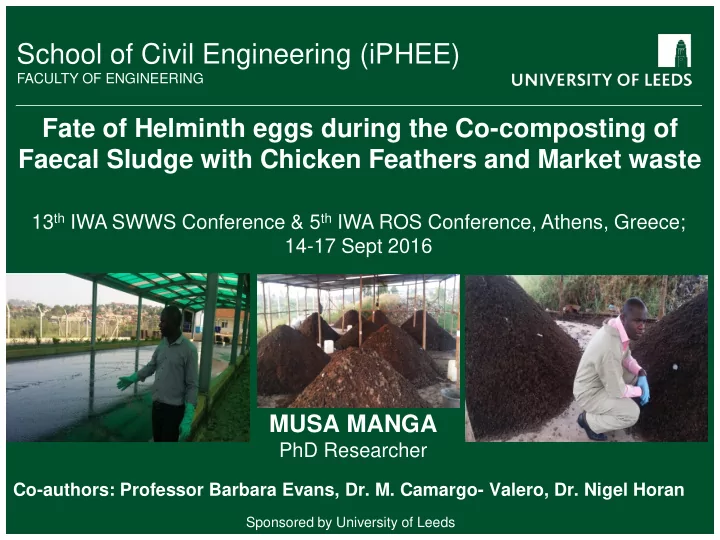
School of Civil Engineering (iPHEE) School of Civil Engineering (iPHEE) FACULTY OF ENGINEERING FACULTY OF ENGINEERING Fate of Helminth eggs during the Co-composting of Faecal Sludge with Chicken Feathers and Market waste 13 th IWA SWWS


slide-1
SLIDE 1

School of Civil Engineering (iPHEE)

FACULTY OF ENGINEERING

School of Civil Engineering (iPHEE)

FACULTY OF ENGINEERING

Fate of Helminth eggs during the Co-composting of Faecal Sludge with Chicken Feathers and Market waste

Sponsored by University of Leeds

Co-authors: Professor Barbara Evans, Dr. M. Camargo- Valero, Dr. Nigel Horan

MUSA MANGA

PhD Researcher 13th IWA SWWS Conference & 5th IWA ROS Conference, Athens, Greece; 14-17 Sept 2016

slide-2
SLIDE 2

School of Civil Engineering (iPHEE)

FACULTY OF ENGINEERING

Presentation Outline

  • 1. Introduction
  • 2. Methodology
  • 3. Results and Discussion
  • 4. Conclusions
  • 5. Acknowledgements
slide-3
SLIDE 3

School of Civil Engineering (iPHEE)

FACULTY OF ENGINEERING

Introduction

  • Sanitation service delivery has not been harmonised with

the needs of the increasing population.

  • Sustainable FS treatment technologies are largely still

lacking in urban Africa.

So where do the diverted FS trunks that don’t reach Bugolobi treatment plant dispose of ????

slide-4
SLIDE 4

School of Civil Engineering (iPHEE)

FACULTY OF ENGINEERING

Introduction Cont’d

  • Proper and sustainable treatment is required to inactivate pathogens if

FS is reused in agriculture

Source: SuSanAforum

slide-5
SLIDE 5

School of Civil Engineering (iPHEE)

FACULTY OF ENGINEERING

Introduction Cont’d

  • Composting has been proven to be a economically and technically

feasible FS treatment technology with recovery of nutrients as added value.

  • However, it is associated with both insufficient pathogen inactivation and

longer inactivation periods (especially helminth eggs)

  • Helminth eggs (esp. Ascaris eggs) are the best pathogenic indicators.
  • Moreover, little is known about the fate of viable helminth eggs during

composting of FS.

  • This study assessed the effect of locally available organic waste types

and their mixing ratios with FS on viable helminth eggs inactivation efficiency.

slide-6
SLIDE 6

School of Civil Engineering (iPHEE)

FACULTY OF ENGINEERING

Methodology: Field trials _Composting facility

Constructed Compost facility

slide-7
SLIDE 7

School of Civil Engineering (iPHEE)

FACULTY OF ENGINEERING

Methodology Cont’d: Collection of waste materials

slide-8
SLIDE 8

School of Civil Engineering (iPHEE)

FACULTY OF ENGINEERING

Methodology Cont’d: Collection of waste materials

slide-9
SLIDE 9

School of Civil Engineering (iPHEE)

FACULTY OF ENGINEERING

Methodology Cont’d: Collection of waste materials

slide-10
SLIDE 10

School of Civil Engineering (iPHEE)

FACULTY OF ENGINEERING

Methodology Cont’d: Setting-up of Composting piles

  • SOS1: Sludge: Organic market waste: Sawdust (1:2:1)
  • SOS2: Sludge: Organic market waste: Sawdust (1:3:1)
  • SCS1: Sludge: Chicken feather: Sawdust (1:2:1)
  • SCS2: Sludge: Chicken feather: Sawdust (1:3:1)
slide-11
SLIDE 11

School of Civil Engineering (iPHEE)

FACULTY OF ENGINEERING

Methodology Cont’d: Monitoring of composting piles

  • Pile temperature: Top, middle, bottom and outer layers
  • Pile aeration: -Manual Turning
  • Moisture Content: 50 - 60%
slide-12
SLIDE 12

School of Civil Engineering (iPHEE)

FACULTY OF ENGINEERING

Methodology Cont’d: Monitoring of composting piles

  • Analytical methods

 Total Solids- (USEPA 2003)  Helminth eggs- (USEPA 2003)

  • Statistical Analysis

 Friedman test, with 95% confidence level.  Spearman’s rho test

slide-13
SLIDE 13

School of Civil Engineering (iPHEE)

FACULTY OF ENGINEERING

14 28 42 56 70 84 20 30 40 50 60 70 14 28 42 56 70 84 20 30 40 50 60 70 14 28 42 56 70 84 20 30 40 50 60 70 14 28 42 56 70 84 20 30 40 50 60 70

Temperature (

0C)

Composting Period (Days)

Pile 1_SOS1 Pile 2_SOS1 Ambient

Temperature (

0C)

Composting Period (Days)

Pile1_SCS2 Pile 2_SCS2 Ambient

Temperature (

0C)

Composting Period (Days)

Pile 1_SCS1 Pile 2_SCS1 Ambient

Temperature (

0C)

Composting Period (Days)

Pile 1_SOS2 Pile 2_SOS2 Ambient

Results and Discussion: Composting Temperatures

32 days 39 days 39 days 46 days
slide-14
SLIDE 14

School of Civil Engineering (iPHEE)

FACULTY OF ENGINEERING

14 28 42 56 70 20 40 60 80 100

Viable Ascaris Eggs Die-off (% of Initial Viable Count) Composting Period (days) SOS1 SOS2 SCS1 SCS2

  • Chicken feathers piles exhibiting a higher inactivation efficiency and

shorter inactivation period than market waste piles.

  • Composting of FS with chicken feathers reduces the helminth eggs

inactivation period from 8 weeks to about 4-6 weeks, which represents approximately 42% reduction in the inactivation periods.

Results and Discussion: Pathogen Inactivation

SOS1 & SOS2 SCS1 & SCS2

  • Mixing ratios had little effect
  • f helminth eggs inactivation

periods

slide-15
SLIDE 15

School of Civil Engineering (iPHEE)

FACULTY OF ENGINEERING

14 28 42 56 70 84 20 30 40 50 60 70 20 40 60 80 100

Mean Temperature (

0C)

Composting Period (Days)

SOS1 SOS2 SCS1 SCS2 Ambient

Viable Ascaris Eggs Inactivated (%)

  • All the composting piles met the USEPA

(2003) criteria for pathogen inactivation.

  • Helminth eggs inactivation efficiency was

significantly different.

  • Other mechanisms could have been

responsible for pathogen inactivation during composting such as

 antibiotic action induced by indigenous microorganisms  antagonistic effect between organisms  Toxic by-products (such as NH3)

Results and Discussion: Temperature-Time Relationship Vs Helminth Inactivation

SCS1 & SCS2 SOS1 & SOS2

≥550C for ≥21 days

slide-16
SLIDE 16

School of Civil Engineering (iPHEE)

FACULTY OF ENGINEERING

  • The mixing ratios had little effect onto the pathogen inactivation efficiency,

but 1:2:1 preferred to 1:3:1.

  • Compost piles containing chicken feathers achieved the shortest pathogen

survival period of 4 weeks compared to 6-8 weeks for market waste piles.

  • Apart from the temperature-time relationship, other mechanisms were

responsible for enhancing pathogen inactivation efficiency within the chicken feathers composting piles.

  • All the composting piles attained 100% pathogen inactivation from faecal

sludge

  • Composting of faecal sludge with chicken feather can reduce pathogen

inactivation periods by 42%, which may thus reduce the operational costs of faecal sludge treatment facility.

Conclusions

slide-17
SLIDE 17

School of Civil Engineering (iPHEE)

FACULTY OF ENGINEERING

  • Funder: University of Leeds

through the Leeds International Research Scholarship.

  • Supervisors: Prof. Barbara

Evans, Dr. Miller & Dr. Horan.

  • National Water and Sewerage

Corporation staff at the Bugolobi and Lubigi FS treatment facility

Acknowledgements

slide-18
SLIDE 18

School of Civil Engineering (iPHEE)

FACULTY OF ENGINEERING

THANK YOU!!!