Science cooperation and the future of TFHTAP/GAPF 1. There are a - - PowerPoint PPT Presentation

science cooperation and the future of tfhtap gapf 1 there
SMART_READER_LITE
LIVE PREVIEW

Science cooperation and the future of TFHTAP/GAPF 1. There are a - - PowerPoint PPT Presentation

Science cooperation and the future of TFHTAP/GAPF 1. There are a number of organizations with scientific programmes of relevance (though approaches differ) how could these be engaged to develop policy relevant global science? 2. Air


slide-1
SLIDE 1

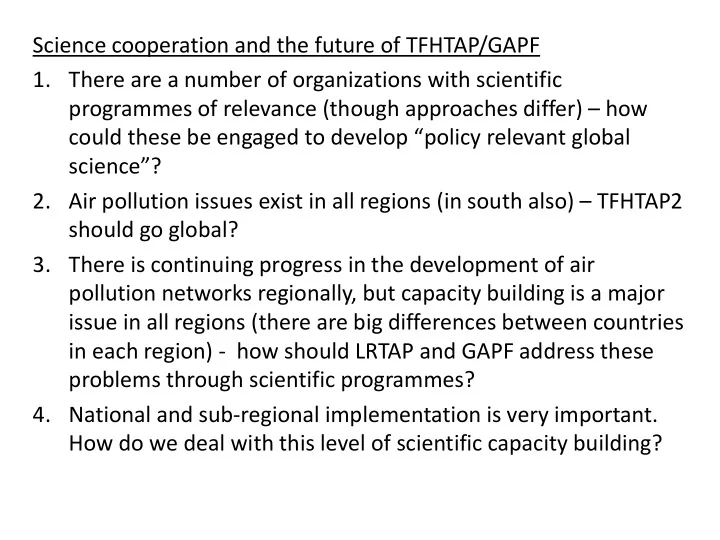
Science cooperation and the future of TFHTAP/GAPF

  • 1. There are a number of organizations with scientific

programmes of relevance (though approaches differ) – how could these be engaged to develop “policy relevant global science”?

  • 2. Air pollution issues exist in all regions (in south also) – TFHTAP2

should go global?

  • 3. There is continuing progress in the development of air

pollution networks regionally, but capacity building is a major issue in all regions (there are big differences between countries in each region) - how should LRTAP and GAPF address these problems through scientific programmes?

  • 4. National and sub-regional implementation is very important.

How do we deal with this level of scientific capacity building?

slide-2
SLIDE 2

OUTREACH IN CLRTAP/TFHTAP CLRTAP Executive Body decision, 1999

  • Outreach. “The Convention has an important role to play as

an example for similar action beyond the UN/ECE region. The secretariat, as guided by the Executive Body, will coordinate the dissemination of information and take an active part in raising awareness in other regions.” Mandate of TFHTAP, 2004 “The chair(s) are encouraged to invite individuals with expertise relevant to the work of the Task Force and experts from non-Convention countries in the northern hemisphere.” How should outreach be framed in the CLRTAP strategy?

slide-3
SLIDE 3

Science cooperation and the future of TFHTAP/GAPF

  • 5. Co-benefits with climate change provide possibilities for raising

the profile of air pollution issues. Should this be a continued (or increased) strategy focus for GAPF and LRTAP?

  • 6. A globally coordinated science programme could be a first step

to a global framework for air pollution. Are science programmes to address policy questions best developed within a policy framework? Is there a suitable global policy framework?

  • 7. Closer links between the UNECE secretariat, UNEP and perhaps

WMO and others could help promote a global policy framework for global science. Is there a case for a “UN Atmosphere”? Could something be developed through the “UN Environmental Management Group”.

slide-4
SLIDE 4

The Environment Management Group (EMG) is a United Nations (UN) System-wide coordination body. Its Membership consists of the specialized agencies, programmes and organs of the United Nations including the secretariats of the Multilateral Environmental Agreements. It is chaired by the Executive Director of United Nations Environment Programme (UNEP) and supported by a secretariat provided by UNEP.

slide-5
SLIDE 5

Commission on Sustainable Development Fourteenth Session (Atmosphere, Air Pollution and Industrial Development), 1-12 May 2006, New York

Atmosphere/Air Pollution: Best Practices, Lessons Learnt and Case Studies By UN Cooperative Programmes and Activities

Report of the UN Issues Management Group (IMG) of EMG Conclusion “There is a lack of awareness at the technical level in organizations of each

  • ther’s activities and programmes related to air pollution. An internal “UN

Technical Forum on UN Air Pollution Activities From Urban to Global Scales” every four years would promote information exchange and integration. Co- sponsored and organized by the specialized agencies involved (e.g UNEP, WMO, UNECE, IAEA, WHO), it would bring together leaders of the technical programmes to document activities and to identify potential areas of cooperation.”

slide-6
SLIDE 6

Strengths of Different Approaches

A Continuum of Formality, Sustainability

  • WMO/GAW = A framework to build upon for

monitoring programs

  • LRTAP TF’s/Centers = Lots of expertise, Limited

reach

  • UN Atmosphere = Important Players, Limited
  • IGBP = A forum for mobilizing scientific

cooperation

  • GEO Communities of Practice = Flexible, but

Ephemeral

  • GEOSS = An information system for facilitating

information exchange across all levels

slide-7
SLIDE 7

Would TF HTAP be more effective under a more global flag?

  • Existing Institutions: WMO, IGBP
  • New: IPAQ, A Joint WMO/UNEP

Institution

  • Combine: Joint Task Forces/Forums

– Build on LRTAP Task Forces – Add Sponsorship of WMO/UNEP/Other Regional Networks

  • Develop Communities of Practice
slide-8
SLIDE 8

How to Support Global Cooperation?

  • Monitoring:
  • Emissions Inventory:
  • Modeling and Analysis:
  • Impact Assessment:
  • Control Strategy Evaluation:
slide-9
SLIDE 9

Science Cooperation

  • What functions are necessary at the global level vs. the

regional level?

  • How far do tasks such as monitoring, modeling, emissions

inventory development, impact assessment, and control strategy evaluation need to be harmonized at different scales (e.g. hemispherically/globally)?

  • What would a global alliance of regional networks look like?
  • What contributions could be made by WMO, UNEP, IGBP,

GEO, ...?

  • Is there a need for an ongoing assessment activity (i.e., an

IPCC for Air Quality)?