Scientific Computing I Part I Module 5: Heat Transfer Discrete and - - PDF document

scientific computing i part i
SMART_READER_LITE
LIVE PREVIEW

Scientific Computing I Part I Module 5: Heat Transfer Discrete and - - PDF document

Scientific Computing I Part I Module 5: Heat Transfer Discrete and Contiuous Models Discrete Models Michael Bader Lehrstuhl Informatik V Winter 2006/2007 Motivation: Heat Transfer A Wiremesh Model consider rectangular plate as fine


slide-1
SLIDE 1

Scientific Computing I

Module 5: Heat Transfer – Discrete and Contiuous Models Michael Bader

Lehrstuhl Informatik V

Winter 2006/2007

Part I Discrete Models Motivation: Heat Transfer

  • bjective: compute the temperature distribution of

some object under certain prerequisites:

temperature at object boundaries given heat sources material parameters

  • bservation from physical experiments:

q ≈ k·δT heat flow proportional to temperature differences

A Wiremesh Model

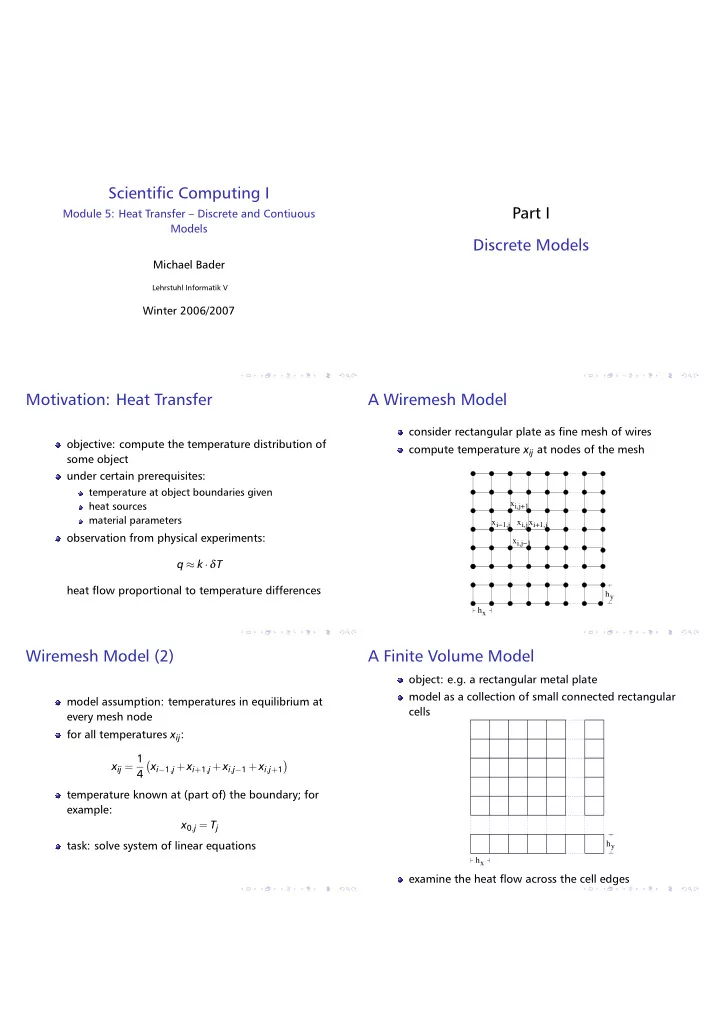
consider rectangular plate as fine mesh of wires compute temperature xij at nodes of the mesh

xi,j xi−1,j xi+1,j xi,j+1 xi,j−1 hx hy

Wiremesh Model (2)

model assumption: temperatures in equilibrium at every mesh node for all temperatures xij: xij = 1 4

  • xi−1,j +xi+1,j +xi,j−1 +xi,j+1
  • temperature known at (part of) the boundary; for

example: x0,j = Tj task: solve system of linear equations

A Finite Volume Model

  • bject: e.g. a rectangular metal plate

model as a collection of small connected rectangular cells

hx hy

examine the heat flow across the cell edges

slide-2
SLIDE 2

Heat Flow Across the Cell Boundaries

Heat flow across a given edge is proportional to

temperature difference (T1 −T0) between the adjacent cells length h of the edge

e.g.: heat flow across the left edge: q(left)

ij

= kx

  • Tij −Ti−1,j
  • hy

heat flow across all edges determines change of heat energy: qij = kx

  • Tij −Ti−1,j
  • hy +kx
  • Tij −Ti+1,j
  • hy

+ ky

  • Tij −Ti,j−1
  • hx +ky
  • Tij −Ti,j+1
  • hx

Temperature change due to heat flow

in equilibrium: total heat flow equal to 0 but: consider additional source term Fij due to

external heating radiation

Fij = fijhxhy (fij heat flow per area) equilibrium with source term requires qij +Fij = 0: fijhxhy = −kxhy

  • 2Tij −Ti−1,j −Ti+1,j
  • −kyhx
  • 2Tij −Ti,j−1 −Ti,j+1
  • Finite Volume Model

divide by hxhy: fij = −kx hx

  • 2Tij −Ti−1,j −Ti+1,j
  • −ky

hy

  • 2Tij −Ti,j−1 −Ti,j+1
  • again, system of linear equations

how to treat boundaries?

prescribe temperature in a cell (e.g. boundary layer of cells) prescribe heat flow across an edge; for example insulation at left edge: q(left)

ij

= 0

A Time Dependent Model

idea: set up ODE for each cell no external heat sources or drains: fij = 0 change of temperature per time is proportional to heat flow into the cell (no longer 0): ˙ Tij(t) = κx hx

  • 2Tij(t)−Ti−1,j(t)−Ti+1,j(t)
  • +

κy hy

  • 2Tij(t)−Ti,j−1(t)−Ti,j+1(t)
  • solve system of ODE

Part II A Continuous Model – The Heat Equation From Discrete to Contiuous

remember the discrete model: fij = −kx hx

  • 2Tij −Ti−1,j −Ti+1,j
  • −ky

hy

  • 2Tij −Ti,j−1 −Ti,j+1
  • assumption:heat flow accross edges is proportional

to temperature difference q(left)

ij

= kx

  • Tij −Ti−1,j
  • hy

in reality: heat flow proportional to temperature gradient q(left)

ij

≈ khy Tij −Ti−1,j hx

slide-3
SLIDE 3

From Discrete to Contiuous (2)

replace kx by k/hx, ky by k/hy, and get: fij = − k h2

x

  • 2Tij −Ti−1,j −Ti+1,j
  • − k

h2

y

  • 2Tij −Ti,j−1 −Ti,j+1
  • consider arbitrary small cells: hx,hy → 0:

fij = −k ∂ 2T ∂x2

  • ij

−k ∂ 2T ∂y2

  • ij

leads to partial differential equation (PDE): −k ∂ 2T(x,y) ∂x2 + ∂ 2T(x,y) ∂y2

  • = f(x,y)

Derivation of the Heat Equation

finite volume model, but with arbitrary control volume D change of heat energy (per time) is a result of

transfer of heat energy across D’s surface, heat sources and drains in D (external influences)

resulting integral equation: ∂ ∂t

  • D

ρcT dV =

  • D

qdV +

  • ∂D

k∇T · ndS density ρ, specific heat c, and heat conductivity k are material parameters heat sources and drains are modelled in term q

Derivation of the Heat Equation (2)

according to theorem of Gauß:

  • ∂D

k∇T · ndS =

  • D

k∆T dV leads to integral equation for any domain D:

  • D

ρcTt −q−k∆T dV = 0 hence, the integrand has to be identically 0: Tt = κ∆T + q ρc, κ := k ρc κ > 0 is called the thermal diffusion coefficient (since the Laplace operator models a (heat) diffusion process)

Heat Equations

Different scenarios: vanishing external influence, q = 0: Tt = κ∆T alternate notation ∂T ∂t = κ · ∂ 2T ∂x2 + ∂ 2T ∂y2 + ∂ 2T ∂z2

  • equilibrium solution, Tt = 0:

0 = κ∆T + q ρc − → −∆T = f “Poisson’s Equation”

Boundary Conditions

Dirichlet boundary conditions: fix T on (part of) the boundary T(x,y,z) = ϕ(x,y,z) Neumann boundary conditions: fix T’s normal derivative on (part of) the boundary: ∂T ∂n(x,y,z) = ϕ(x,y,z) special case: insulation ∂T ∂n(x,y,z) = 0