
SLIDE 1
Sconset Geotextile Tube Update ‘Sconset Bluff, Nantucket
Maria Hartnett, Associate
www.epsilonassociates.com
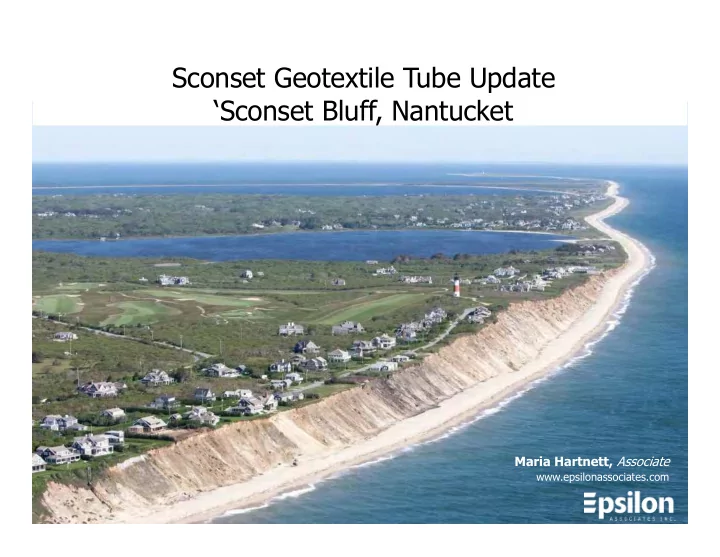
Sconset Geotextile Tube Update Sconset Bluff, Nantucket Maria - - PowerPoint PPT Presentation
Sconset Geotextile Tube Update Sconset Bluff, Nantucket Maria Hartnett, Associate www.epsilonassociates.com Presentation Outline Project Setting & Need for Erosion Control Project Components Geotubes Sand Mitigation
Maria Hartnett, Associate
www.epsilonassociates.com
Project Location
fetch of the Atlantic Ocean
vulnerable to nor’easters
Sconset Bluff
Community Setting
(Sconset)
late 1800’s and early 1900’s
accessway known as Baxter Road
Erosion History
in the 1970’s
north to south
Sconset Beach Preservation Fund (SBPF)
8
Baxter Road
10
moves)
2000 – inconsistent results)
2006-2007 – not approved)
gabions (applied 2010 – not approved)
envelopes (utilized since mid- 2000’s – useful in smaller storms but not effective in major or successive storms)
ease of installation and, if necessary, removal.
long.
returns installed October through December 2015. Total length 947 feet.
May 2015 August 2015
June 2016
mitigation
contribution
contribution
the geotubes instead of the base of the bluff.
away, contributing sand like the natural bluff would.
is regraded so the tubes are covered.
the geotextile tubes, the face of the bluff could also be stabilized by adding vegetation.
wind, rain, and stormwater runoff.
additional planting occurred in spring 2016 above the new returns.
June 2016
Baxter Road. This drainage system serves to capture stormwater runoff and redirect it, so that it no longer causes erosion from the top
runoff away from the face of the bluff.
Delivery Report
Invertebrate Monitoring
Video Monitoring
System Report
based on historic data, with no indication of accelerated erosion in front of or adjacent to the geotubes.
the historic contribution rate and the unprotected bluff.
well monitoring, or underwater video monitoring.
June 2016
May 2017
performed of the Project area on April 2,
completed late May 2017.
were compared to the 2013 aerial survey for those unprotected areas immediately adjacent to the geotextile tube project.
was 12.9 cy/lf/yr, which is 59% of mitigation volume.
Bluff Volume Loss in Unprotected Areas Adjacent to Geotextile Tubes Line Area Volume Lost (CY) Length (Feet) Duration (Years) Erosion Rate (CY/LF/YR) 1 North Unprotected Area 31,329 800 2.75 14.2 2 South Unprotected Area 4,370 210 2.75 7.6 3 Total Bluff Erosion for Adjacent Unprotected Areas 35,699 1,010 2.75 12.9
To the North: 800 ft unprotected bluff
Geotube Area (2013-2016):
Unprotected Bluff Areas (2013-2016):
along 6 miles of shoreline conducted quarterly
(MLW line) and
in the spring and fall
the geotextile tubes.
geotextile tubes and adjacent areas
Biota: June and October identified invertebrate species, fish species, and marine plant and algal species, with some seasonal variability (spider crabs bury into sediments; black sea bass, scup, and skates move offshore). Branching brown and red algae, bread crumb sponge, and rock crab were dominant biota. No indication of adverse effect on marine biota.
Pebbles 5%). TR-400
30%, Boulder 35%). TR-710.
Cobble 35%). TR-1265.
50%, Cobble 20%). TR-1925.
Cobble 10%, Boulder 30%). TR-1500.
Monitoring shows continued prevalence of cobble/bottom habitat located directly
being covered by the mitigation sand.
May 2017
Photo credits: George Riethof and the Sconset Trust, Rick Blair, Rob Benchley
Maria Hartnett, Associate
www.epsilonassociates.com
2014